







Question: School D X Grades ( X M Inbox - s X M Whiters X 2 5.2 Prob X 4 5.2 Probl X 4 5.1 Prob
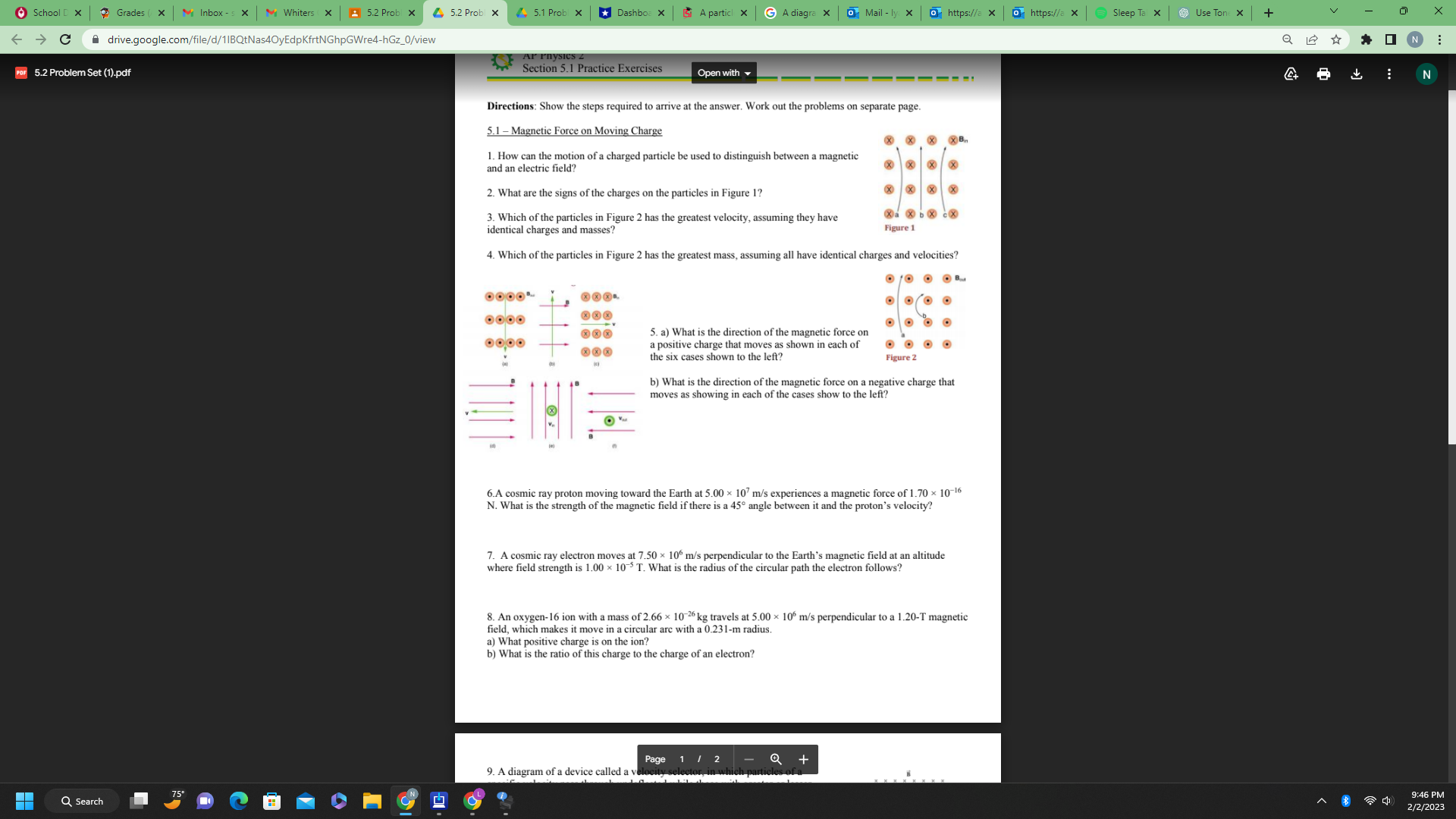
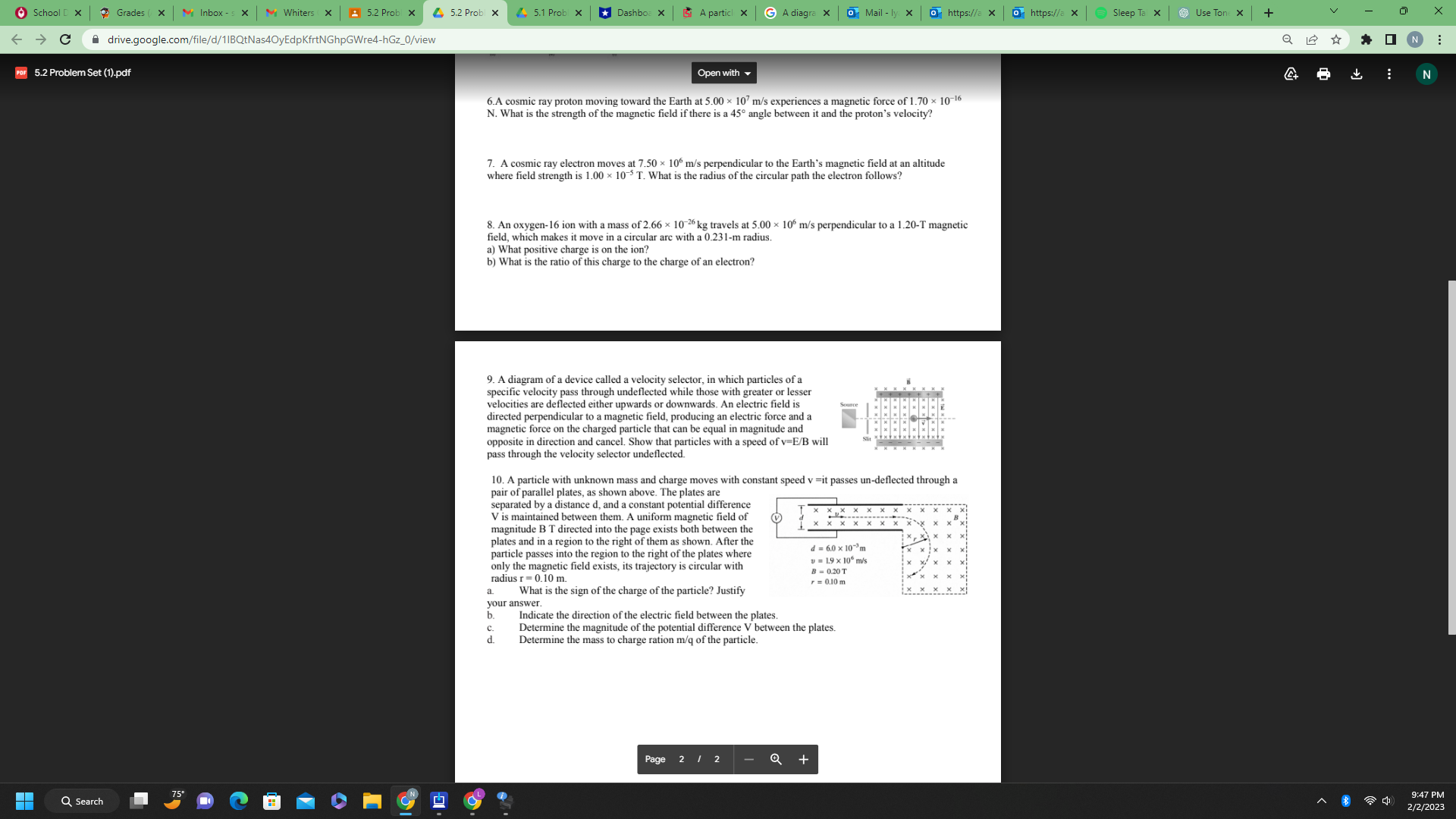
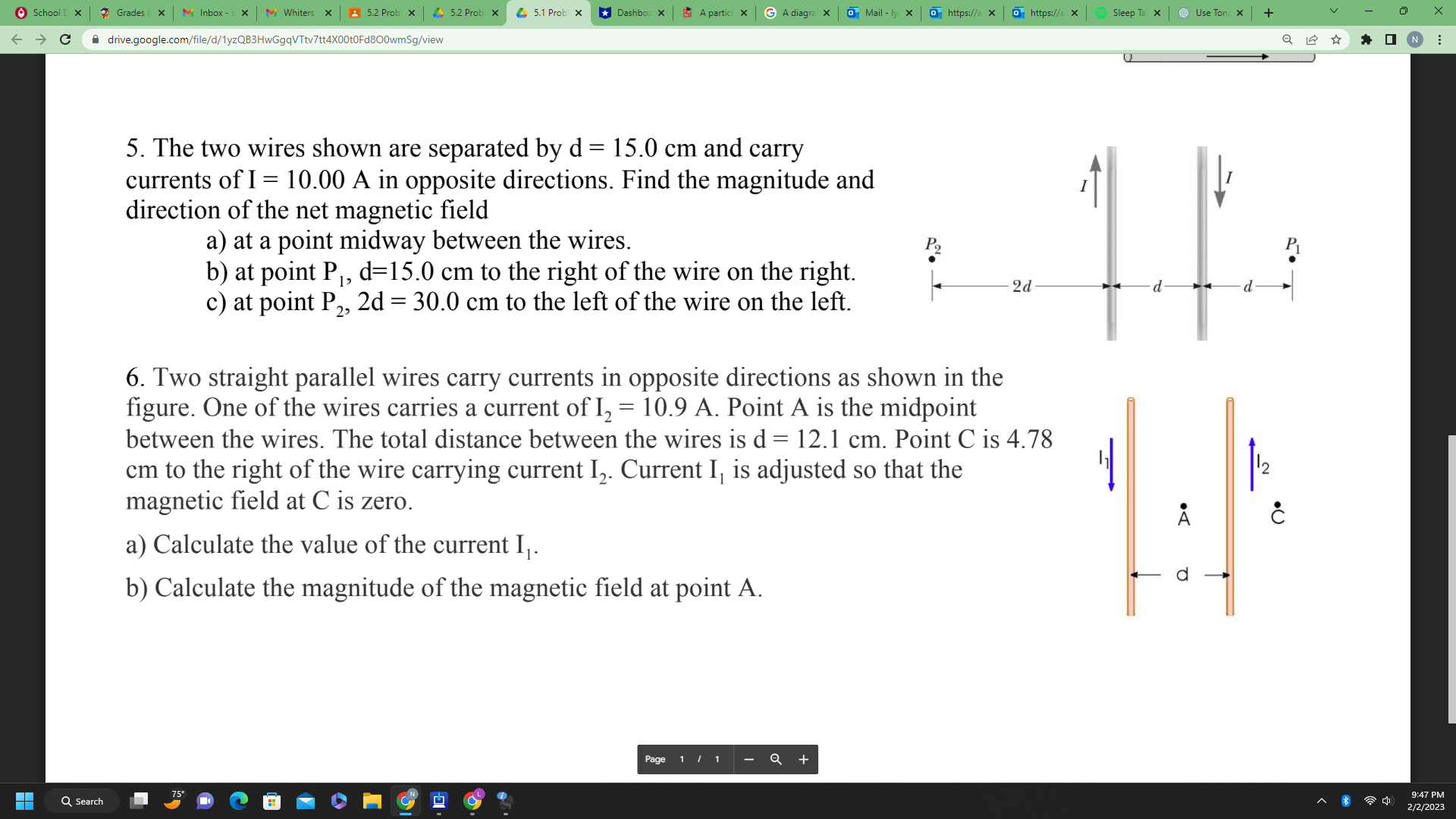
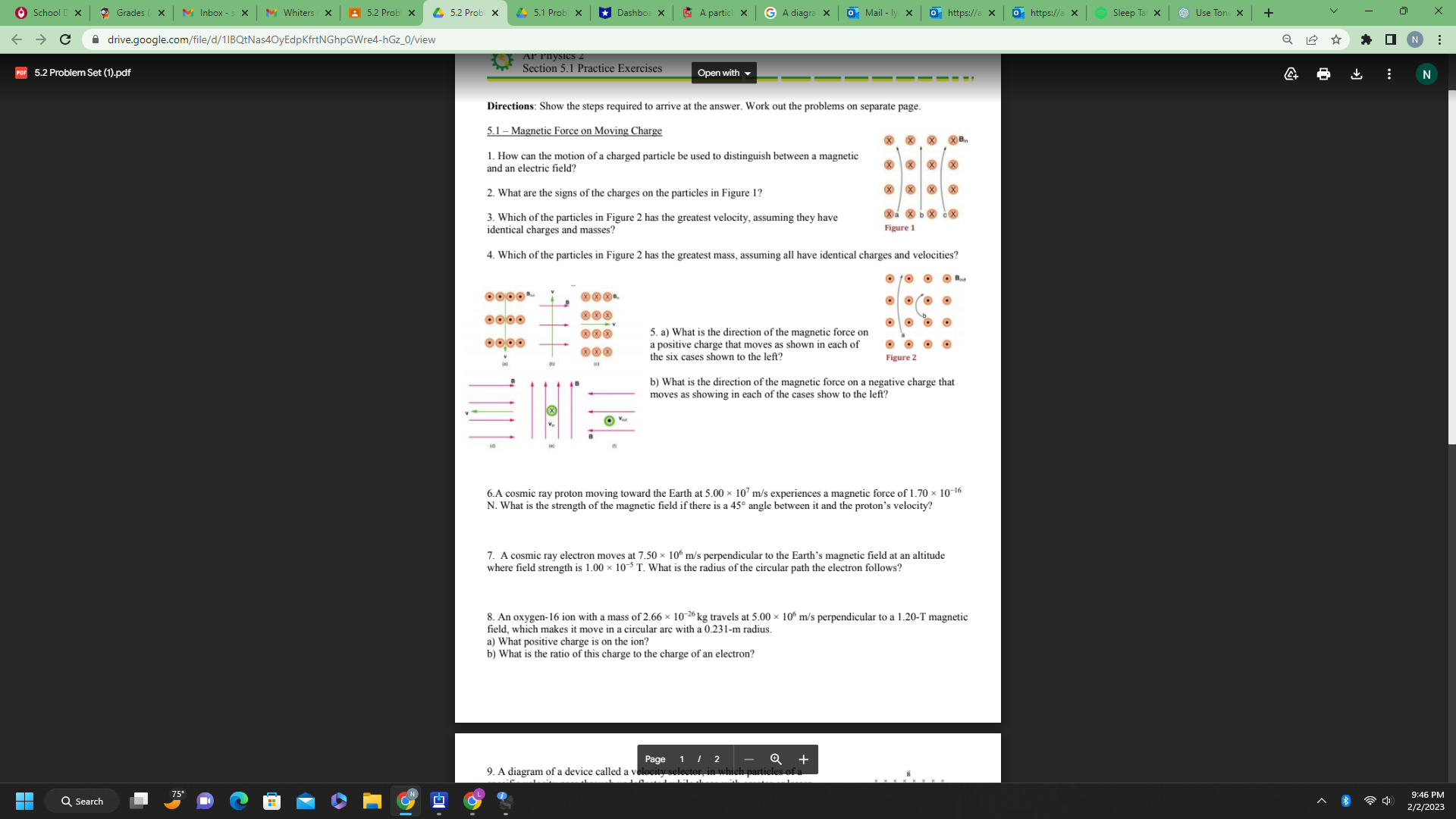
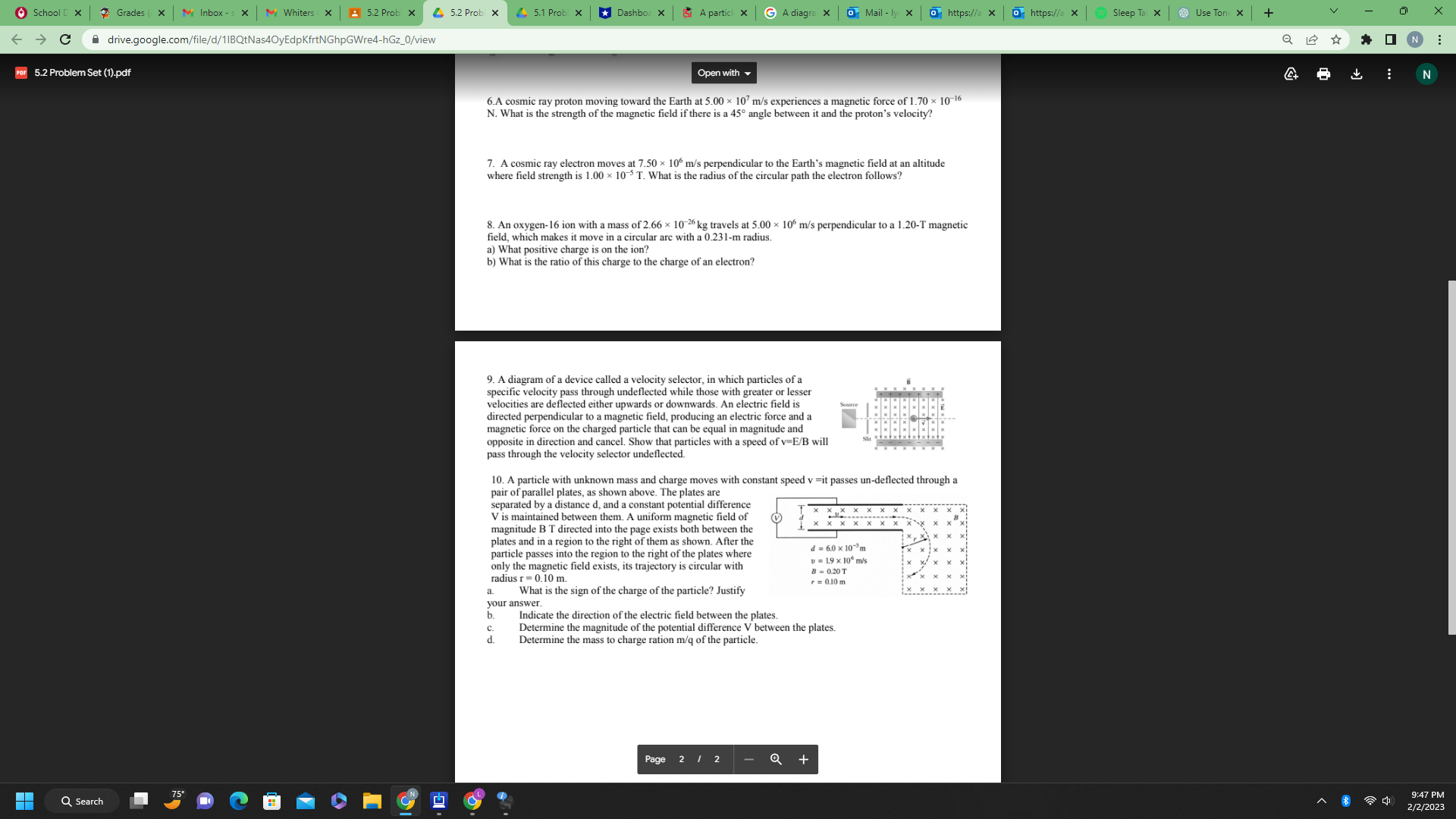
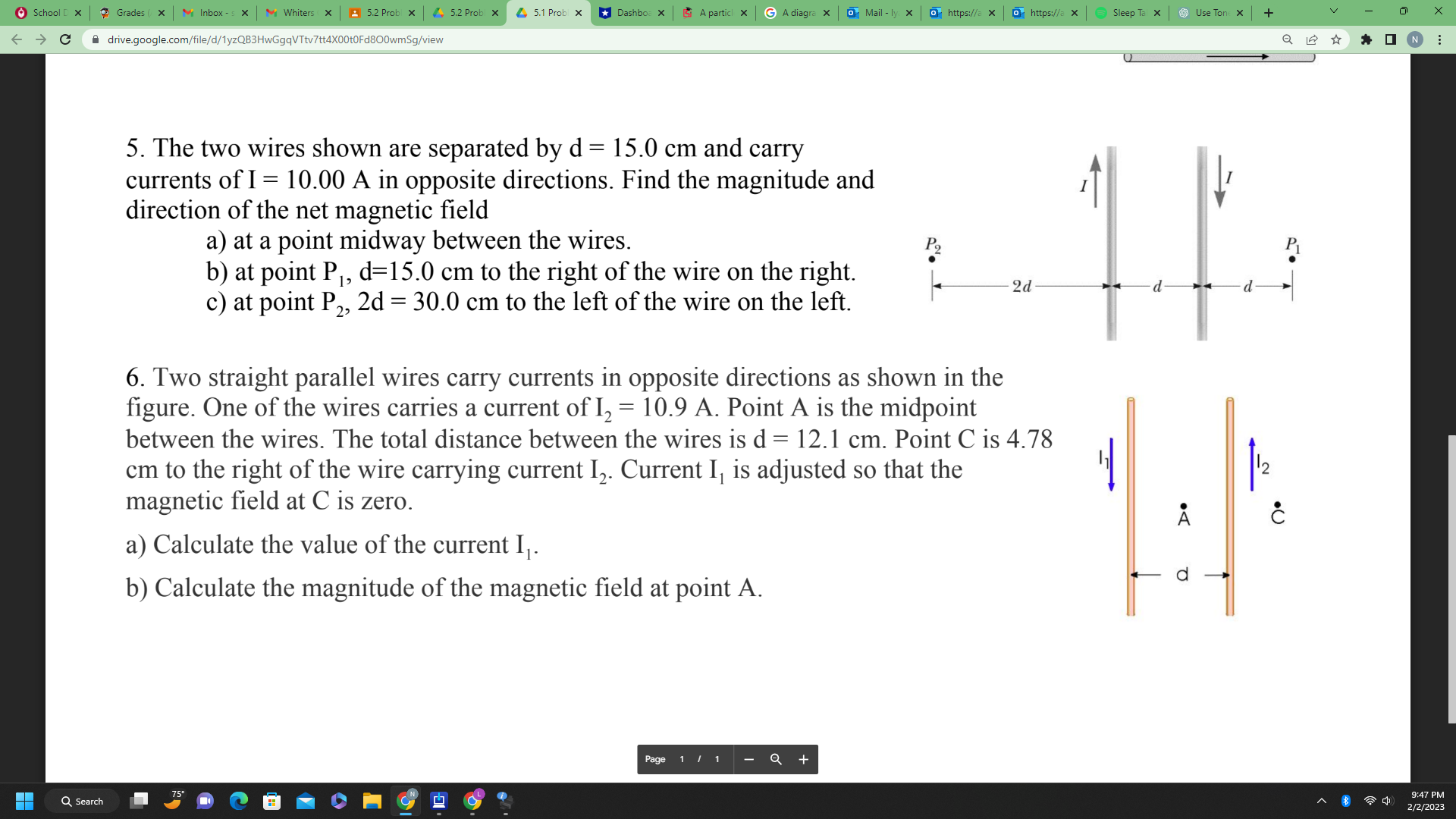
School D X Grades ( X M Inbox - s X M Whiters X 2 5.2 Prob X 4 5.2 Probl X 4 5.1 Prob X * Dashbor X | i A particl X | G A diagra x | 0 Mail - ly x | @ https://2 x | @ https://2 x | @ Sleep Ta x | @ Use Ton x| + V X C A drive.google.com/file/d/1/BQtNas4OyEdpKirtNGhpGWre4-hGz_0/view Q E X * IN Ar Physics 2 PDF 5.2 Problem Set (1).pdf Section 5.1 Practice Exercises Open with 4 N Directions: Show the steps required to arrive at the answer. Work out the problems on separate page. 5.1 - Magnetic Force on Moving Charge X X X XB 1. How can the motion of a charged particle be used to distinguish between a magnetic and an electric field? X X X X 2. What are the signs of the charges on the particles in Figure 1? X X X 3. Which of the particles in Figure 2 has the greatest velocity, assuming they have Xa X b X cX identical charges and masses? Figure 1 4. Which of the particles in Figure 2 has the greatest mass, assuming all have identical charges and velocities? OOOO OOoo 5. a) What is the direction of the magnetic force on OOOo a positive charge that moves as shown in each of the six cases shown to the left? Figure 2 b) What is the direction of the magnetic force on a negative charge that moves as showing in each of the cases show to the left? 6.A cosmic ray proton moving toward the Earth at 5.00 x 10' m/s experiences a magnetic force of 1.70 x 10⁻¹⁶ N. What is the strength of the magnetic field if there is a 45 angle between it and the proton's velocity? 7. A cosmic ray electron moves at 7.50 x 10 m/s perpendicular to the Earth's magnetic field at an altitude where field strength is 1.00 x 10" T. What is the radius of the circular path the electron follows? 8. An oxygen-16 ion with a mass of 2.66 x 10"2 kg travels at 5.00 x 10 m/s perpendicular to a 1.20-T magnetic field, which makes it move in a circular arc with a 0.231-m radius. a) What positive charge is on the ion? b) What is the ratio of this charge to the charge of an electron? Page 1 2 + 9. A diagram of a device called a v Q Search 9:46 PM 2/2/2023School D X Grades ( X M Inbox - s X M Whiters X 2 5.2 Prob X 4 5.2 Probl X 5.1 Prob X | Dashbor X | i A particl x | @ A diagra x | 0 Mail - ly x | @ https://z x | @ https://a x | Sleep Tax |@ Use Ton x| + V X C A drive.google.com/file/d/11BQtNas4OyEdpKfrtNGhpGWre4-hGz_0/view Q E X *IN PDF 5.2 Problem Set (1).pdf Open with 4 N 6.A cosmic ray proton moving toward the Earth at 5.00 x 10' m/s experiences a magnetic force of 1.70 x 10⁻¹⁶ N. What is the strength of the magnetic field if there is a 45 angle between it and the proton's velocity? 7. A cosmic ray electron moves at 7.50 x 10 m/s perpendicular to the Earth's magnetic field at an altitude where field strength is 1.00 x 10"ST. What is the radius of the circular path the electron follows? 8. An oxygen-16 ion with a mass of 2.66 x 10"2kg travels at 5.00 x 10 m/s perpendicular to a 1.20-T magnetic field, which makes it move in a circular are with a 0.231-m radius. a) What positive charge is on the ion? b) What is the ratio of this charge to the charge of an electron? 9. A diagram of a device called a velocity selector, in which particles of a specific velocity pass through undeflected while those with greater or lesser X X X X Z velocities are deflected either upwards or downwards. An electric field is directed perpendicular to a magnetic field, producing an electric force and a magnetic force on the charged particle that can be equal in magnitude and opposite in direction and cancel. Show that particles with a speed of v-E/B will pass through the velocity selector undeflected. 10. A particle with unknown mass and charge moves with constant speed v =it passes un-deflected through a pair of parallel plates, as shown above. The plates are separated by a distance d, and a constant potential difference V is maintained between them. A uniform magnetic field of magnitude B T directed into the page exists both between the plates and in a region to the right of them as shown. After the particle passes into the region to the right of the plates where d = 6.0 x 10 3m only the magnetic field exists, its trajectory is circular with U = 1.9 x 10* m/s B - 0.20 T radius r = 0.10 m. = 0.10 m a. What is the sign of the charge of the particle? Justify your answer . b. Indicate the direction of the electric field between the plates. C. d Determine the magnitude of the potential difference V between the plates. Determine the mass to charge ration m/q of the particle Page 2 / 2 - + Q Search 9:47 PM 2/2/2023School D X Grades ( X M Inbox - s X M Whiters X 2 5.2 Prob X 5.2 Prob X 4 5.1 Prob X Dashbo: X | Bi A particl x | G A diagra x | @ Mail - ly x | https:/2 x | |https:/2 x | @ Sleep Tax | @ Use Ton x| + V X C A drive.google.com/file/d/1yzQB3HwGgqVTtv7tt4X00tOFd800wmSg/view Q E 5. The two wires shown are separated by d = 15.0 cm and carry currents of I = 10.00 A in opposite directions. Find the magnitude and direction of the net magnetic field a) at a point midway between the wires. b) at point P , d=15.0 cm to the right of the wire on the right. 2d c) at point P2, 2d = 30.0 cm to the left of the wire on the left. 6. Two straight parallel wires carry currents in opposite directions as shown in the figure. One of the wires carries a current of I2 = 10.9 A. Point A is the midpoint between the wires. The total distance between the wires is d = 12.1 cm. Point C is 4.78 cm to the right of the wire carrying current 12. Current I, is adjusted so that the magnetic field at C is zero. A a) Calculate the value of the current I,- b) Calculate the magnitude of the magnetic field at point A. d Page 1 / 1 - + Q Search 9:47 PM 2/2/2023
Step by Step Solution
There are 3 Steps involved in it

Get step-by-step solutions from verified subject matter experts
 Study Help