Question: Science is based on observations and this is especially so in field studies. In today's world, a wealth of web-based videos along with online data
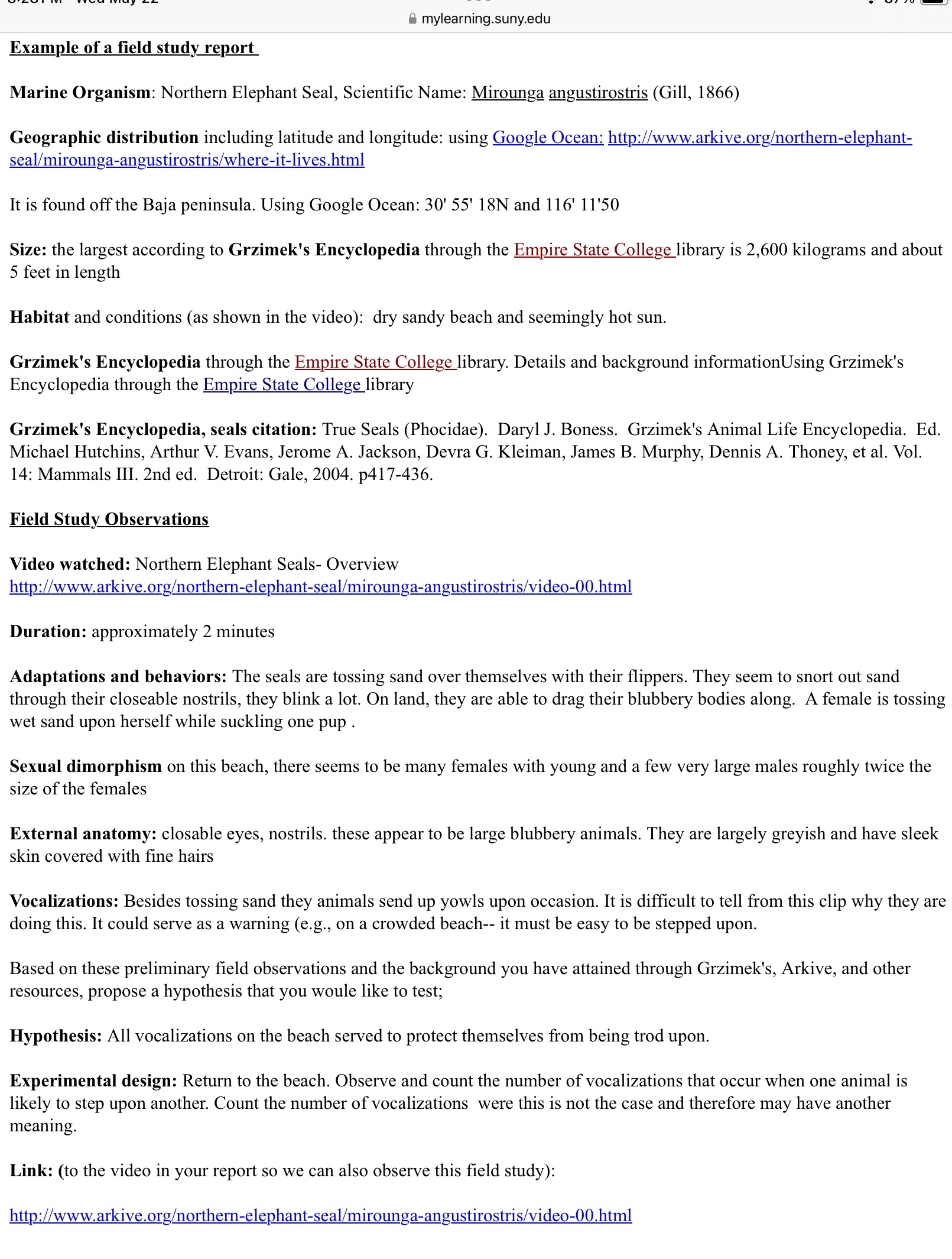
Science is based on observations and this is especially so in field studies. In today's world, a wealth of web-based videos along with online data from research groups offer virtual but truly authentic scientific experimental opportunities. For this activity, you will choose a marine organism and, using NOAA Fisheries video gallery, make report on your observations. Check out some of these other sites for great footage and online data:National GeographicWoods Hole Oceanographic InstituteMonterey Bay AquariumThe image shows how the answer should look like
mylearning.suny.edu Example of a field study report Marine Organism: Northern Elephant Seal, Scientific Name: Mirounga angustirostris (Gill, 1866) Geographic distribution including latitude and longitude: using Google Ocean: http://www.arkive.orgorthern-elephant- seal/mirounga-angustirostris/where-it-lives.html It is found off the Baja peninsula. Using Google Ocean: 30' 55' 18N and 116' 11'50 Size: the largest according to Grzimek's Encyclopedia through the Empire State College library is 2,600 kilograms and about 5 feet in length Habitat and conditions (as shown in the video): dry sandy beach and seemingly hot sun. Grzimek's Encyclopedia through the Empire State College library. Details and background information Using Grzimek's Encyclopedia through the Empire State College library Grzimek's Encyclopedia, seals citation: True Seals (Phocidae). Daryl J. Boness. Grzimek's Animal Life Encyclopedia. Ed. Michael Hutchins, Arthur V. Evans, Jerome A. Jackson, Devra G. Kleiman, James B. Murphy, Dennis A. Thoney, et al. Vol. 14: Mammals III. 2nd ed. Detroit: Gale, 2004. p417-436. Field Study Observations Video watched: Northern Elephant Seals- Overview http:/www.arkive.orgorthern-elephant-seal/mirounga-angustirostris/video-00.html Duration: approximately 2 minutes Adaptations and behaviors: The seals are tossing sand over themselves with their flippers. They seem to snort out sand through their closeable nostrils, they blink a lot. On land, they are able to drag their blubbery bodies along. A female is tossing wet sand upon herself while suckling one pup . Sexual dimorphism on this beach, there seems to be many females with young and a few very large males roughly twice the size of the females External anatomy: closable eyes, nostrils. these appear to be large blubbery animals. They are largely greyish and have sleek skin covered with fine hairs Vocalizations: Besides tossing sand they animals send up yowls upon occasion. It is difficult to tell from this clip why they are doing this. It could serve as a warning (e.g., on a crowded beach-- it must be easy to be stepped upon. Based on these preliminary field observations and the background you have attained through Grzimek's, Arkive, and other resources, propose a hypothesis that you woule like to test; Hypothesis: All vocalizations on the beach served to protect themselves from being trod upon. Experimental design: Return to the beach. Observe and count the number of vocalizations that occur when one animal is likely to step upon another. Count the number of vocalizations were this is not the case and therefore may have another meaning. Link: (to the video in your report so we can also observe this field study): http:/www.arkive.orgorthern-elephant-seal/mirounga-angustirostris/video-00.html









 Study Help