







Question: Scientists explored how hoverflies detect motion by testing their response to a free-fall condition. Hoverflies were dropped from rest in a 40-cm-tall enclosure. Air
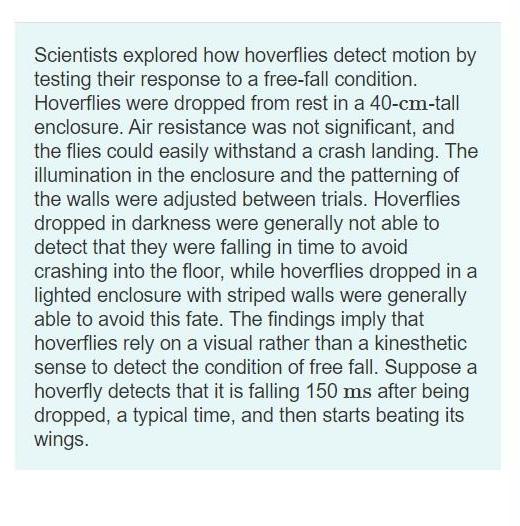

Scientists explored how hoverflies detect motion by testing their response to a free-fall condition. Hoverflies were dropped from rest in a 40-cm-tall enclosure. Air resistance was not significant, and the flies could easily withstand a crash landing. The illumination in the enclosure and the patterning of the walls were adjusted between trials. Hoverflies dropped in darkness were generally not able to detect that they were falling in time to avoid crashing into the floor, while hoverflies dropped in a lighted enclosure with striped walls were generally able to avoid this fate. The findings imply that hoverflies rely on a visual rather than a kinesthetic sense to detect the condition of free fall. Suppose a hoverfly detects that it is falling 150 ms after being dropped, a typical time, and then starts beating its wings. What subsequent vertical acceleration is needed to avoid a crash landing? Express your answer with the appropriate units. ay || xa Xb Value b X.10n m 2 s Xx ?
Step by Step Solution
3.31 Rating (154 Votes )
There are 3 Steps involved in it
It falls freely for Isoms in acceleration g V ... View full answer

Get step-by-step solutions from verified subject matter experts
 Study Help