







Question: Search for tools, help,'and more ( Option Comments Catch up Normal system ) . Inis hot water is created through heat exchange from low pressure
Search for tools, help,'and more Option
Comments
Catch up
Normal
system Inis hot water is created through heat exchange from low pressure steam from the campus plant. This hot water supply pumped upwards to floor where it is circulated through fan coil units.
Sources of Steam and Water
Water enters the building through the mechanical joint ductile iron pipe connected to the building's exterior water supply From there, it branches into different systems. Steam enters through a the and Low Pressure Steam lines to create hot water.
Conversion Stages & Units
Steam from the external campus energy plant is used to heat water in HX condensate generated by the steam is then collected in the condensate receiver and returned via the pumped condensate return line PCR to be recycled.
How Heated Air is Transported
Exhaust air is drawn from the building's return air system and passes through a filter and exhaust fan. Before being released outdoors, the air passes through the energy recovery wheel where energy is transferred to or from the incoming outside air, depending on the season. For heating, the wheel recovers heat from warm exhaust air for transfer to new incoming fresh air. If the preconditioned air is still too cold, it passes through a heating coil, where it is heated using hot water. The energy recovery process can be bypassed.
Air within spaces is also recirculated through various fan coil units where air is heated by the coils supplied by the pipe hydronic loop.
Where and how is air distributed vertically and horizontally
Heated fresh air is routed downwards vertically from the roof to all floor below where it is circulated into main spaces areas through ductwork consisting of various sizes. Fresh air is then recirculated through return grilles feeding fan coil units that reheat and redistribute hot air. Air is recirculated until eventually being pulled up through ductwork to MAU to be exhausted outside.
& Fit
MacBook Pro
Problem points
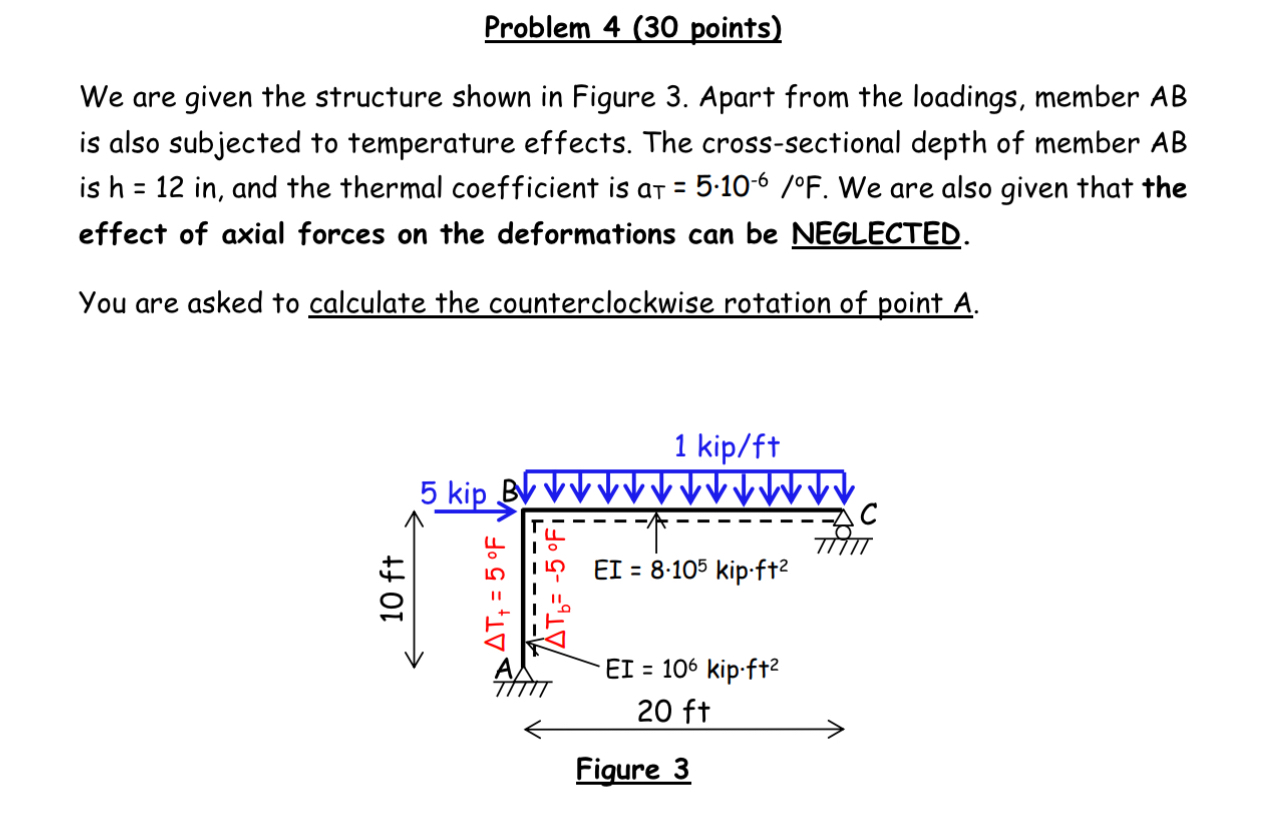
We are given the structure shown in Figure Apart from the loadings, member is also subjected to temperature effects. The crosssectional depth of member is and the thermal coefficient is We are also given that the effect of axial forces on the deformations can be NEGLECTED.
You are asked to calculate the counterclockwise rotation of point
Step by Step Solution
There are 3 Steps involved in it
1 Expert Approved Answer
Step: 1 Unlock

Question Has Been Solved by an Expert!
Get step-by-step solutions from verified subject matter experts
Step: 2 Unlock
Step: 3 Unlock
 Study Help