







Question: Second section: From Chapter 8 of the book 1. Consider a 74595 shift register (datasheet is on Sakai). Note that the part uses MOSI to
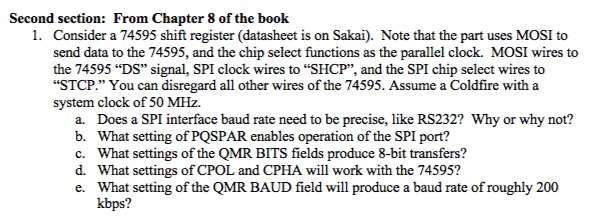
Second section: From Chapter 8 of the book 1. Consider a 74595 shift register (datasheet is on Sakai). Note that the part uses MOSI to send data to the 74595, and the chip select functions as the parallel clock. MOSI wires to the 74595 DS" signal, SPI clock wires to "SHCP", and the SPI chip select wires to "STCP." You can disregard all other wires of the 74595. Assume a Coldfire with a system clock of 50 MHz. a. b. c. d. e. Does a SPI interface baud rate need to be precise, like RS232? Why or why not? What setting of PQSPAR enables operation of the SPI port? What settings of the QMR BITS fields produce 8-bit transfers? What settings of CPOL and CPHA will work with the 74595? What setting of the QMR BAUD field will produce a baud rate of roughly 200 kbps? Second section: From Chapter 8 of the book 1. Consider a 74595 shift register (datasheet is on Sakai). Note that the part uses MOSI to send data to the 74595, and the chip select functions as the parallel clock. MOSI wires to the 74595 DS" signal, SPI clock wires to "SHCP", and the SPI chip select wires to "STCP." You can disregard all other wires of the 74595. Assume a Coldfire with a system clock of 50 MHz. a. b. c. d. e. Does a SPI interface baud rate need to be precise, like RS232? Why or why not? What setting of PQSPAR enables operation of the SPI port? What settings of the QMR BITS fields produce 8-bit transfers? What settings of CPOL and CPHA will work with the 74595? What setting of the QMR BAUD field will produce a baud rate of roughly 200 kbps
Step by Step Solution
There are 3 Steps involved in it

Get step-by-step solutions from verified subject matter experts
 Study Help