Question: Second Short Case Study: Annualized hours help Lowaters to retain its core team. Read the following case carefully and answer the questions Lowaters Nursery is
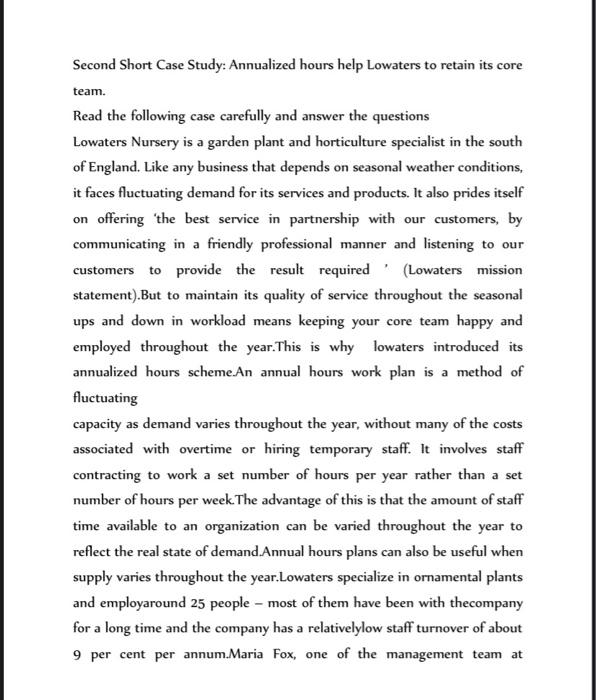
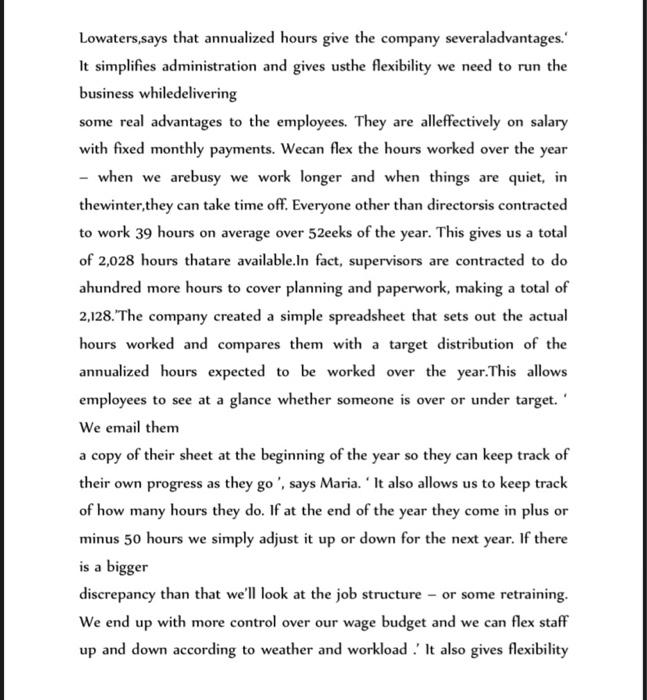
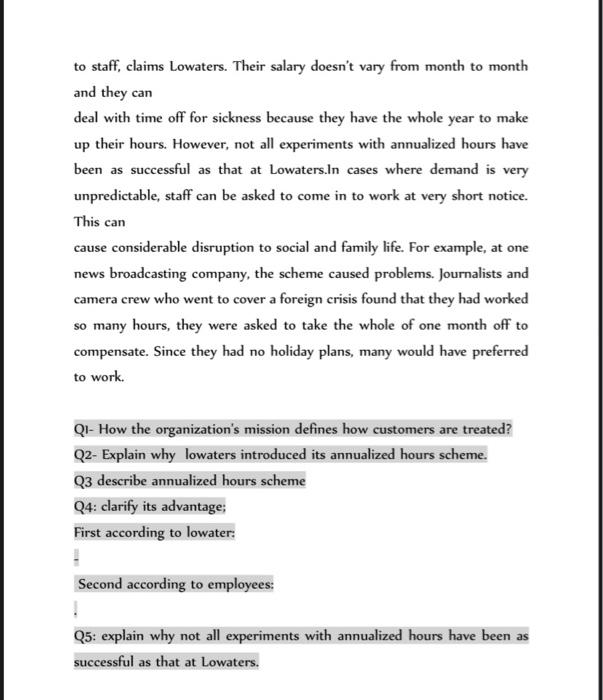
Second Short Case Study: Annualized hours help Lowaters to retain its core team. Read the following case carefully and answer the questions Lowaters Nursery is a garden plant and horticulture specialist in the south of England. Like any business that depends on seasonal weather conditions, it faces fluctuating demand for its services and products. It also prides itself on offering the best service in partnership with our customers, by communicating in a friendly professional manner and listening to our customers to provide the result required (Lowaters mission statement). But to maintain its quality of service throughout the seasonal ups and down in workload means keeping your core team happy and employed throughout the year. This is whylowaters introduced its annualized hours scheme.An annual hours work plan is a method of fluctuating capacity as demand varies throughout the year, without many of the costs associated with overtime or hiring temporary staff. It involves staff contracting to work a set number of hours per year rather than a set number of hours per week. The advantage of this is that the amount of staff time available to an organization can be varied throughout the year to reflect the real state of demand. Annual hours plans can also be useful when supply varies throughout the year.Lowaters specialize in ornamental plants and employaround 25 people - most of them have been with thecompany for a long time and the company has a relativelylow staff turnover of about 9 per cent per annum.Maria Fox, one of the management team at a Lowaters,says that annualized hours give the company severaladvantages. It simplifies administration and gives usthe flexibility we need to run the business whiledelivering some real advantages to the employees. They are alleffectively on salary with fixed monthly payments. Wecan flex the hours worked over the year - when we arebusy we work longer and when things are quiet, in thewinter, they can take time off. Everyone other than directorsis contracted to work 39 hours on average over 52eeks of the year. This gives us a total of 2,028 hours thatare available.In fact, supervisors are contracted to do ahundred more hours to cover planning and paperwork, making a total of 2,128. The company created a simple spreadsheet that sets out the actual hours worked and compares them with a target distribution of the annualized hours expected to be worked over the year. This allows employees to see at a glance whether someone is over or under target.' We email them a copy of their sheet at the beginning of the year so they can keep track of their own progress as they go', says Maria." It also allows us to keep track of how many hours they do. If at the end of the year they come in plus or minus 50 hours we simply adjust it up or down for the next year. If there is a bigger discrepancy than that we'll look at the job structure - or some retraining. We end up with more control over our wage budget and we can flex staff up and down according to weather and workload.' It also gives flexibility to staff, claims Lowaters. Their salary doesn't vary from month to month and they can deal with time off for sickness because they have the whole year to make up their hours. However, not all experiments with annualized hours have been as successful as that at Lowaters.In cases where demand is very unpredictable, staff can be asked to come in to work at very short notice. This can cause considerable disruption to social and family life. For example, at one news broadcasting company, the scheme caused problems. Journalists and camera crew who went to cover a foreign crisis found that they had worked so many hours, they were asked to take the whole of one month off to compensate. Since they had no holiday plans, many would have preferred to work. QI- How the organization's mission defines how customers are treated? Q2- Explain why lowaters introduced its annualized hours scheme. Q3 describe annualized hours scheme Q4: clarify its advantage First according to lowater: Second according to employees: . Q5: explain why not all experiments with annualized hours have been as successful as that at Lowaters









 Study Help