







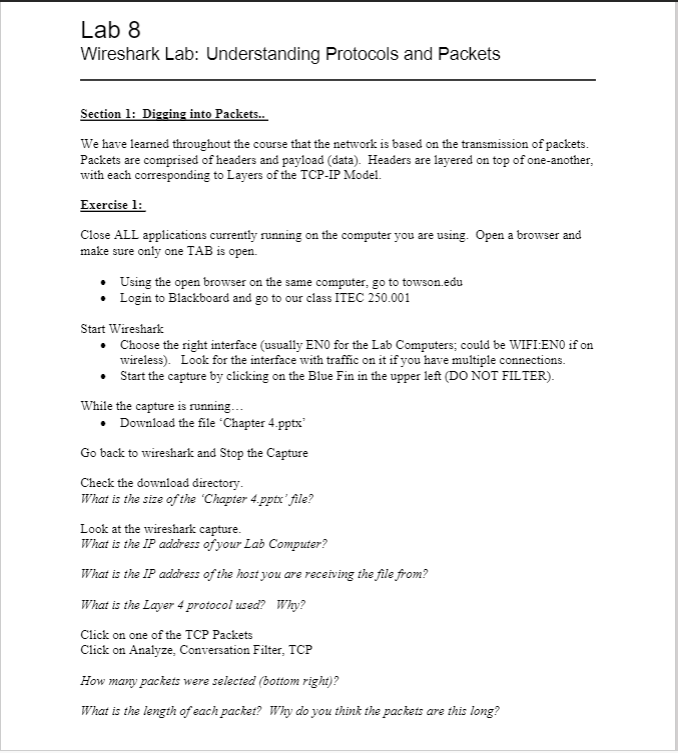
Question: Section 1 : Digging into Packets.. We have learned throughout the course that the network is based on the transmission of packets. Packets are comprised
Section : Digging into Packets..
We have learned throughout the course that the network is based on the transmission of packets.
Packets are comprised of headers and payload data Headers are layered on top of oneanother,
with each corresponding to Layers of the TCPIP Model.
Exercise :
Close ALL applications currently running on the computer you are using. Open a browser and
make sure only one TAB is open.
Using the open browser on the same computer, go to towsonedu
Login to Blackboard and go to our class ITEC
Start Wireshark
Choose the right interface usually ENO for the Lab Computers; could be WIFI:ENO if on
wireless Look for the interface with traffic on it if you have multiple connections.
Start the capture by clicking on the Blue Fin in the upper left DO NOT FILTER
While the capture is running...
Download the file "Chapter pptx
Go back to wireshark and Stop the Capture
Check the download directory.
What is the size of the 'Chapter pptx file?
Look at the wireshark capture.
What is the IP address of your Lab Computer?
What is the IP address of the host you are receiving the file from?
What is the Layer protocol used? Why?
Click on one of the TCP Packets
Click on Analyze, Conversation Filter, TCP
How many packets were selected bottom right
What is the length of each packet? Why do you think the packets are this long?
Step by Step Solution
There are 3 Steps involved in it
1 Expert Approved Answer
Step: 1 Unlock

Question Has Been Solved by an Expert!
Get step-by-step solutions from verified subject matter experts
Step: 2 Unlock
Step: 3 Unlock
 Study Help