





Question: Section 1: FR&B Chapters 2-3 (Calculations and Variables) [ left(kappa_{2}=310.0, C_{N_{2}}=205.00 ight) ] - Derive an expression for ( C_{mathrm{A}}(kappa) ). (See Eqs. 2.7-2, 2.7-3,
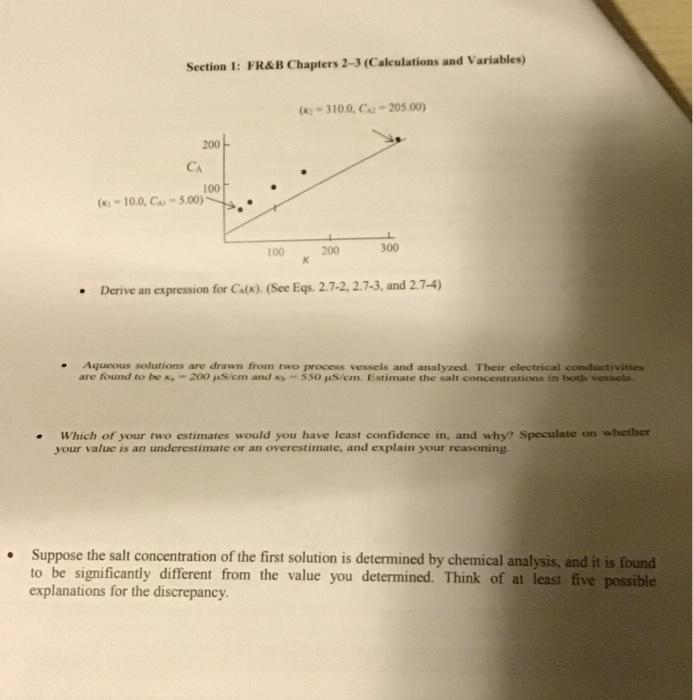
Section 1: FR&B Chapters 2-3 (Calculations and Variables) [ left(kappa_{2}=310.0, C_{N_{2}}=205.00 ight) ] - Derive an expression for ( C_{mathrm{A}}(kappa) ). (See Eqs. 2.7-2, 2.7-3, and 2.7-4) - Aqueous solutions are drawn from two process vessels and analyzed. Their electrical conductivities are found to be ( kappa_{a}=200 mu mathrm{S} / mathrm{cm} ) and ( kappa_{3}=550 mu mathrm{S} / mathrm{cm} ). Estimate the salt concentrations in both vessels. - Which of your two estimates would you have least confidence in, and why? Speculate on whether your value is an underestimate or an overestimate, and explain your reasoning. Suppose the salt concentration of the first solution is determined by chemical analysis, and it is found to be significantly different from the value you determined. Think of at least five possible explanations for the discrepancy.
 Section 1: FR&B Chapters 2-3 (Calculations and Variables) [ left(kappa_{2}=310.0, C_{N_{2}}=205.00

Section 1: FRAB Chapters 2-3 (Calculations and Variables) (x1=310.0,CN2=205.00) - Derive an expression for CA(x). (See Eqs. 2.7-2, 2.7-3, and 2.7-4) - Aqueous solutions are drawn from two process vessels and analyzed. Their electrical condectrinies - Which of your rwo estimates would you have least confidence in, and why? Speculate on whether your value is an underestimate or an overestimate, and explain your reasoning Suppose the salt concentration of the first solution is determined by chemical analysis, and it is found to be significantly different from the value you determined. Think of at least five possible explanations for the discrepancy

Step by Step Solution

There are 3 Steps involved in it

1 Expert Approved Answer
Step: 1 Unlock blur-text-image
Question Has Been Solved by an Expert!

Get step-by-step solutions from verified subject matter experts

Step: 2 Unlock
Step: 3 Unlock

Students Have Also Explored These Related Chemical Engineering Questions!