







Question: Section 1 Problem Areas As the controller of Tritec, Inc. (TI), several financial reporting issues need attention due to the circumstances outlined: Issue: Before year
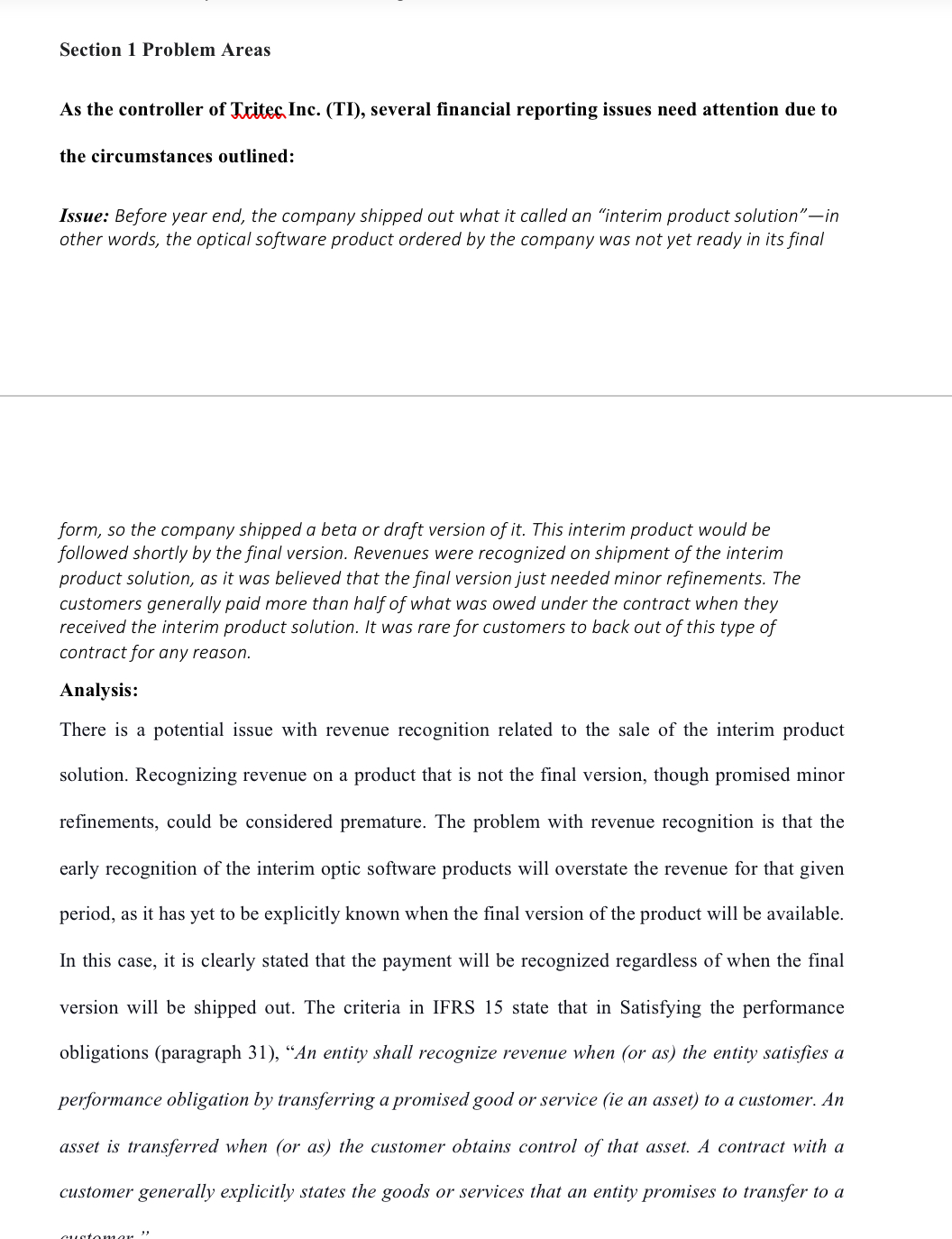
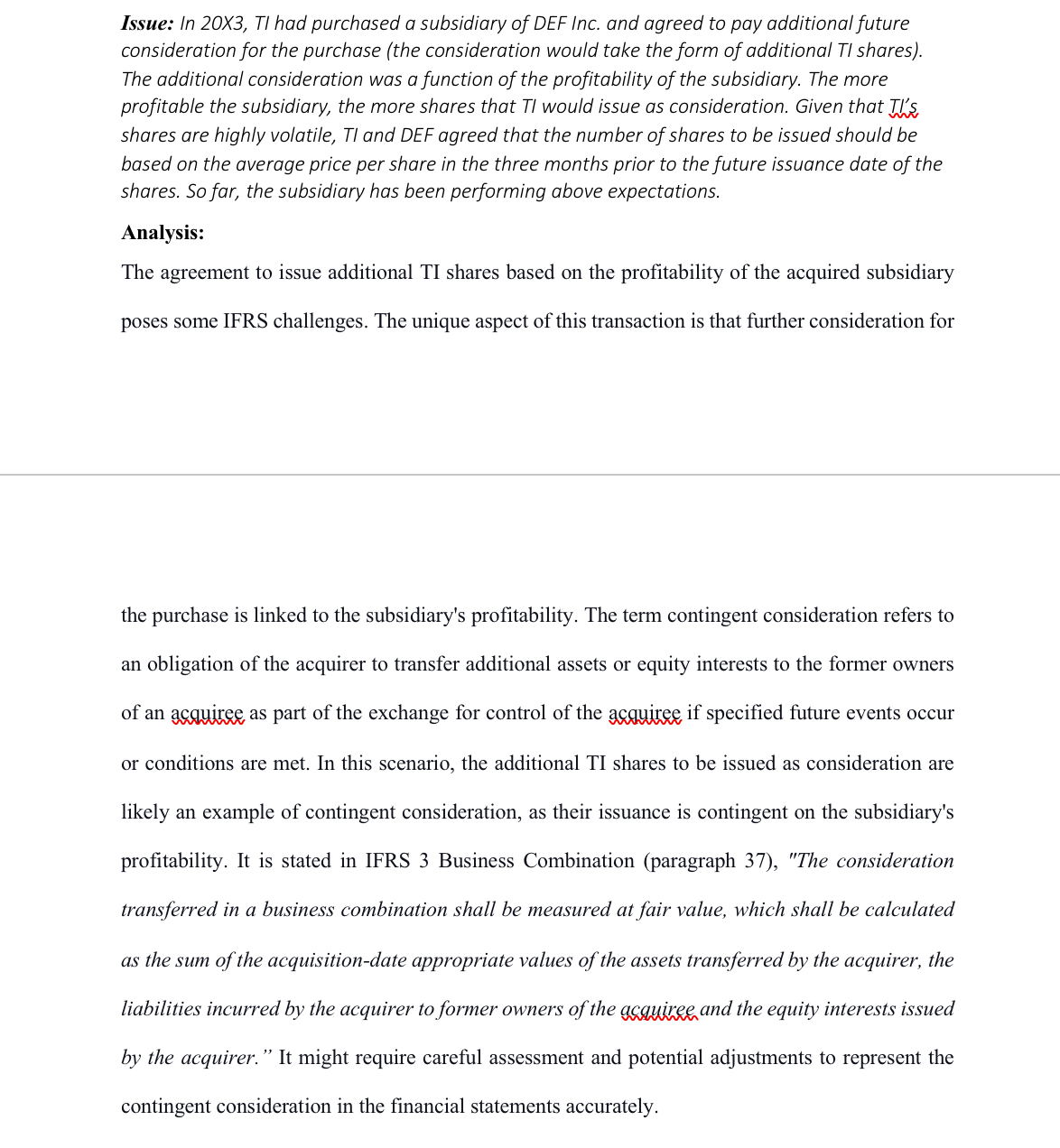
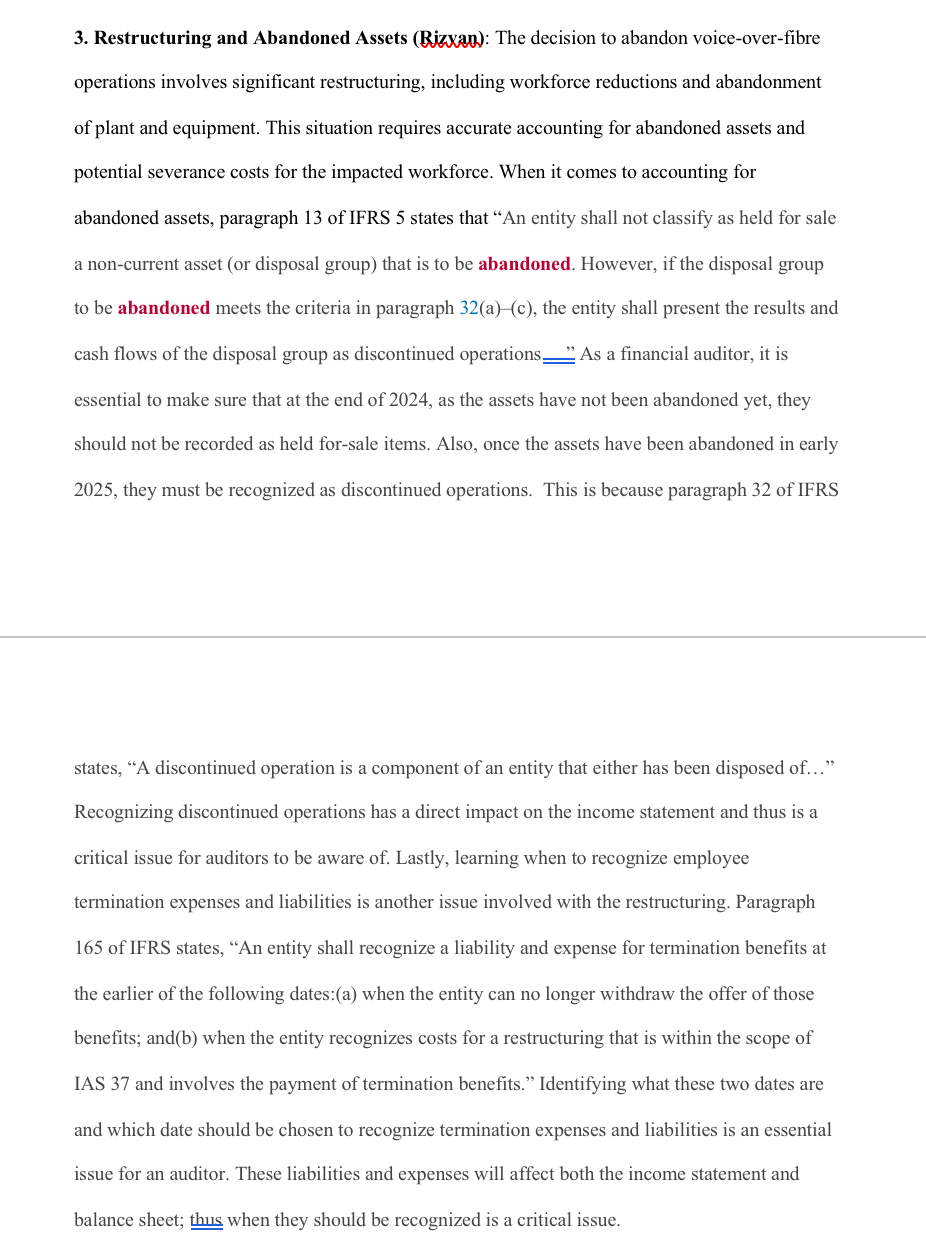
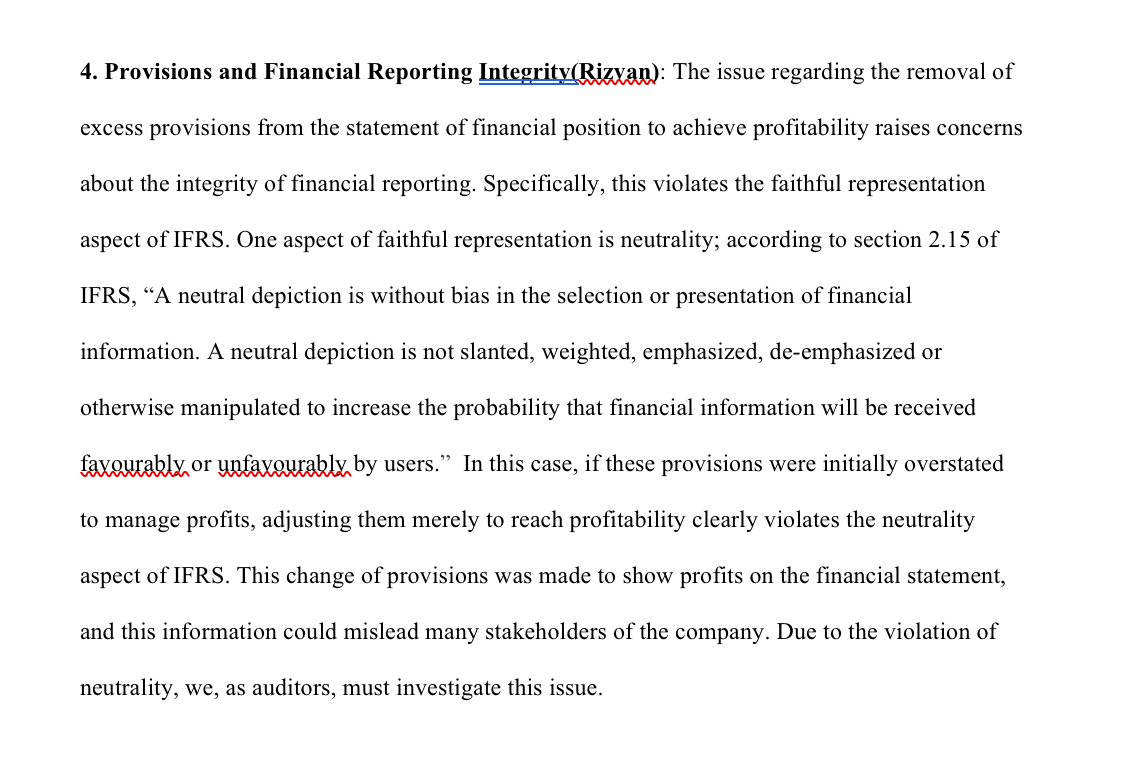
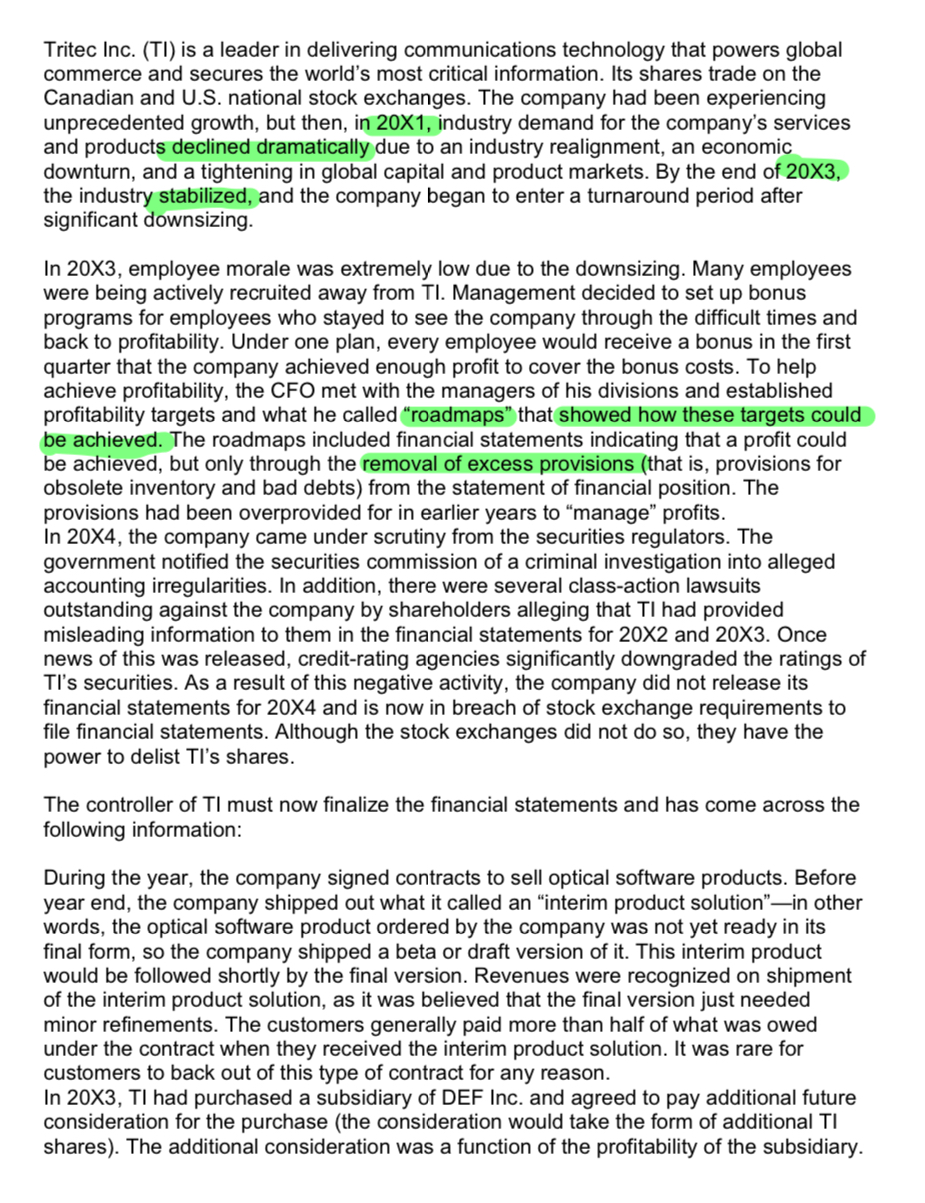
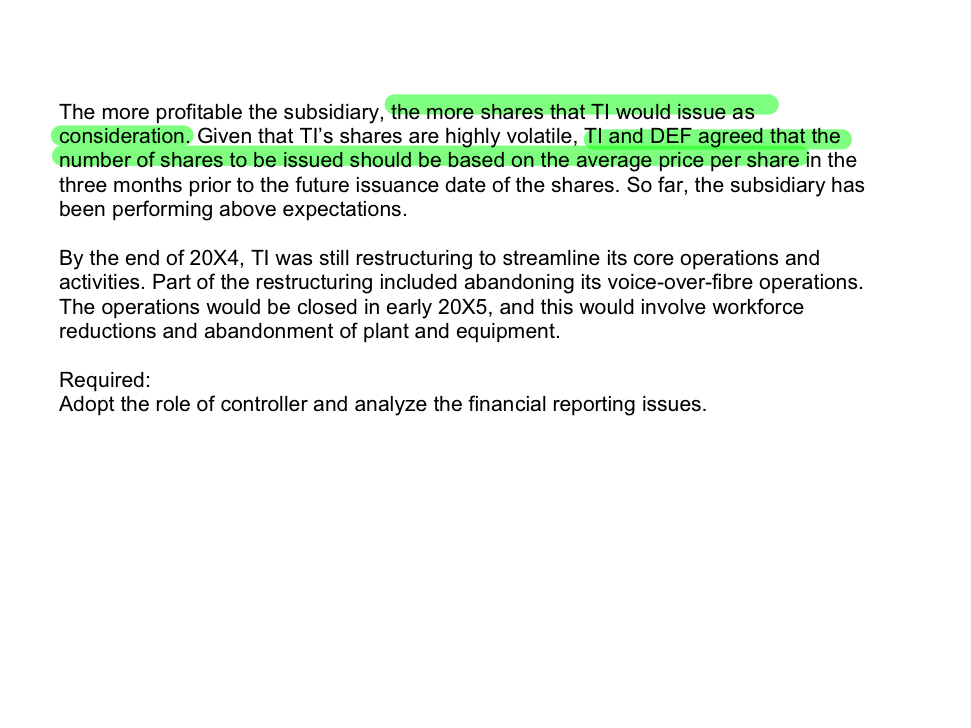
Section 1 Problem Areas As the controller of Tritec, Inc. (TI), several financial reporting issues need attention due to the circumstances outlined: Issue: Before year end, the company shipped out what it called an "interim product solution"-in other words, the optical software product ordered by the company was not yet ready in its final form, so the company shipped a beta or draft version of it. This interim product would be followed shortly by the final version. Revenues were recognized on shipment of the interim product solution, as it was believed that the final version just needed minor refinements. The customers generally paid more than half of what was owed under the contract when they received the interim product solution. It was rare for customers to back out of this type of contract for any reason. Analysis: There is a potential issue with revenue recognition related to the sale of the interim product solution. Recognizing revenue on a product that is not the final version, though promised minor refinements, could be considered premature. The problem with revenue recognition is that the early recognition of the interim optic software products will overstate the revenue for that given period, as it has yet to be explicitly known when the final version of the product will be available. In this case, it is clearly stated that the payment will be recognized regardless of when the final version will be shipped out. The criteria in IFRS 15 state that in Satisfying the performance obligations (paragraph 31), "An entity shall recognize revenue when (or as) the entity satisfies a performance obligation by transferring a promised good or service (ie an asset) to a customer. An asset is transferred when (or as) the customer obtains control of that asset. A contract with a customer generally explicitly states the goods or services that an entity promises to transfer to aIssue: In 20X3, TI had purchased a subsidiary of DEF Inc. and agreed to pay additional future consideration for the purchase (the consideration would take the form of additional TI shares). The additional consideration was a function of the profitability of the subsidiary. The more profitable the subsidiary, the more shares that TI would issue as consideration. Given that TH's shares are highly volatile, TI and DEF agreed that the number of shares to be issued should be based on the average price per share in the three months prior to the future issuance date of the shares. So far, the subsidiary has been performing above expectations. Analysis: The agreement to issue additional TI shares based on the profitability of the acquired subsidiary poses some IFRS challenges. The unique aspect of this transaction is that further consideration for the purchase is linked to the subsidiary's profitability. The term contingent consideration refers to an obligation of the acquirer to transfer additional assets or equity interests to the former owners of an acquires as part of the exchange for control of the acquires if specified future events occur or conditions are met. In this scenario, the additional TI shares to be issued as consideration are likely an example of contingent consideration, as their issuance is contingent on the subsidiary's profitability. It is stated in IFRS 3 Business Combination (paragraph 37), "The consideration transferred in a business combination shall be measured at fair value, which shall be calculated as the sum of the acquisition-date appropriate values of the assets transferred by the acquirer, the liabilities incurred by the acquirer to former owners of the acquiree and the equity interests issued by the acquirer. " It might require careful assessment and potential adjustments to represent the contingent consideration in the financial statements accurately.3. Restructuring and Abandoned Assets (am: The decision to abandon voiceoverfibre operations involves signicant restructuring, including workforce reductions and abandonment of plant and equipment. This situation requires accurate accounting for abandoned assets and potential severance costs for the impacted workforce. When it comes to accounting for abandoned assets, paragraph 13 of [F RS 5 states that \"An entity shall not classify as held for sale a noncurrent asset (or disposal group) that is to be abandoned. However, if the disposal group to be abandoned meets the criteria in paragraph 32(a)(c), the entity shall present the results and cash ows of the disposal group as discontinued operations_\" As a nancial auditor, it is essential to make sure that at the end of 2024, as the assets have not been abandoned yet, they should not be recorded as held forsale items. Also, once the assets have been abandoned in early 2025, they must be recognized as discontinued operations. This is because paragraph 32 oleRS states, \"A discontinued operation is a component of an entity that either has been disposed of.-.\" Recognizing discontinued operations has a direct impact on the income statement and thus is a critical issue for auditors to be aware of. Lastly, learning when to recognize employee termination expenses and liabilities is another issue involved with the restructuring. Paragraph 165 of IF RS states, \"An entity shall recognize a liability and expense for termination benefits at the earlier of the following dates:{ a) when the entity can no longer withdraw the offer of those benets; andlb) when the entity recognizes costs for a restructuring that is within the scope of [AS 3? and involves the payment of termination benefits." Identifying what these two dates are and which date should be chosen to recognize termination expenses and liabilities is an essential issue for an auditor. These liabilities and expenses will affect both the income statement and balance sheet; thuswhen they should be recognized is a critical issue. 4. Provisions and Financial Reporting W: The issue regarding the removal of excess provisions from the statement of financial position to achieve profitability raises concerns about the integrity of financial reporting. Specifically, this violates the faithful representation aspect ofIFRS. One aspect of faithful representation is neutrality; according to section 2.15 of IFRS, "A neutral depiction is without bias in the selection or presentation of financial information. A neutral depiction is not slanted, weighted, emphasized, de-emphasized or otherwise manipulated to increase the probability that financial information will be received Wm Wby users." In this case, if these provisions were initially overstated to manage proflts, adjusting them merely to reach protability clearly violates the neutrality aspect ofIFRS. This change ofprovisions was made to show profits on the financial statement, and this information could mislead many stakeholders of the company. Due to the violation of neutrality, we, as auditors, must investigate this issue. Tritec Inc. (TI) is a leader in delivering communications technology that powers global commerce and secures the world's most critical information. Its shares trade on the Canadian and U.S. national stock exchanges. The company had been experiencing unprecedented growth, but then, in 20X1, industry demand for the company's services and products declined dramatically due to an industry realignment, an economic downturn, and a tightening in global capital and product markets. By the end of 20X3, the industry stabilized, and the company began to enter a turnaround period after significant downsizing. In 20X3, employee morale was extremely low due to the downsizing. Many employees were being actively recruited away from TI. Management decided to set up bonus programs for employees who stayed to see the company through the difficult times and back to profitability. Under one plan, every employee would receive a bonus in the first quarter that the company achieved enough profit to cover the bonus costs. To help achieve profitability, the CFO met with the managers of his divisions and established profitability targets and what he called "roadmaps" that showed how these targets could be achieved. The roadmaps included financial statements indicating that a profit could be achieved, but only through the removal of excess provisions (that is, provisions for obsolete inventory and bad debts) from the statement of financial position. The provisions had been overprovided for in earlier years to "manage" profits. In 20X4, the company came under scrutiny from the securities regulators. The government notified the securities commission of a criminal investigation into alleged accounting irregularities. In addition, there were several class-action lawsuits outstanding against the company by shareholders alleging that TI had provided misleading information to them in the financial statements for 20X2 and 20X3. Once news of this was released, credit-rating agencies significantly downgraded the ratings of TI's securities. As a result of this negative activity, the company did not release its financial statements for 20X4 and is now in breach of stock exchange requirements to file financial statements. Although the stock exchanges did not do so, they have the power to delist TI's shares. The controller of TI must now finalize the financial statements and has come across the following information: During the year, the company signed contracts to sell optical software products. Before year end, the company shipped out what it called an "interim product solution"-in other words, the optical software product ordered by the company was not yet ready in its final form, so the company shipped a beta or draft version of it. This interim product would be followed shortly by the final version. Revenues were recognized on shipment of the interim product solution, as it was believed that the final version just needed minor refinements. The customers generally paid more than half of what was owed under the contract when they received the interim product solution. It was rare for customers to back out of this type of contract for any reason. In 20X3, TI had purchased a subsidiary of DEF Inc. and agreed to pay additional future consideration for the purchase (the consideration would take the form of additional TI shares). The additional consideration was a function of the profitability of the subsidiary.The more profitable the subsidiary, the more shares that TI would issue as consideration. Given that TI's shares are highly volatile, TI and DEF agreed that the number of shares to be issued should be based on the average price per share in the three months prior to the future issuance date of the shares. So far, the subsidiary has been performing above expectations. By the end of 20X4, TI was still restructuring to streamline its core operations and activities. Part of the restructuring included abandoning its voice-over-fibre operations. The operations would be closed in early 20X5, and this would involve workforce reductions and abandonment of plant and equipment. Required: Adopt the role of controller and analyze the financial reporting issues
Step by Step Solution
There are 3 Steps involved in it

Get step-by-step solutions from verified subject matter experts
 Study Help