







Question: SECTION 2 Case Study - NUMMI - New United Motor Manufacturing. NUMMI is an automobile plant in Freemont, California, a joint venture between General Motors
SECTION
Case Study NUMMI New United Motor Manufacturing.
NUMMI is an automobile plant in Freemont, California, a joint venture between General Motors GM and Toyota. It is sited on a plant, which GM had closed in because of poor quality. Productivity was among the lowest of any GM plant in the United States, absenteeism was running at around per cent, labour relations were dreadful, with wildcat strikes, and alcohol and drug abuse. Soon after GM closed the plant, agreement was reached with Toyota to reopen it producing a Japanesedesigned car, sold under the GM name but manufactured using Toyota's methods of production. Over the next two years, the plant hired more workers, about per cent of whom had worked in the plant previously. However, the performance of the NUMMI plant could hardly have been more different. The plant's productivity was more than twice as high as when it was run by GM almost as high as Toyota's Takoaka plant in Japan. Quality also improved dramatically. Audits showed that quality levels were almost as high as Takoaka's and certainly higher than any other GM plant. Absenteeism had dropped from over per cent in the old GMrun plant to between and per cent. Among the reasons for the success of the NUMMI plant were clearer organisational goals, a selective approach to recruiting and single status for everyone in the factory, even the pride of working on a betterdesigned product. However, the new plant and its management did not abandon the techniques of scientific management, which the previous plant's regime had supposedly used. The philosophy of job standardisation is still rigorously appliedifEvery job in the plant is carefully analysed using method study principles to achieve maximum efficiency and quality. Jobs are timed, using stopwatches, and the detail of jobs questioned critically. Yet whereas before, the company's industrial engineers were in charge of applying method study techniques, now it is the operators or team members as they are called themselves who perform the analysis of their own jobs. Team members time each other, using stopwatches, and analyse the sequence of tasks in each
Operations Management
Page of
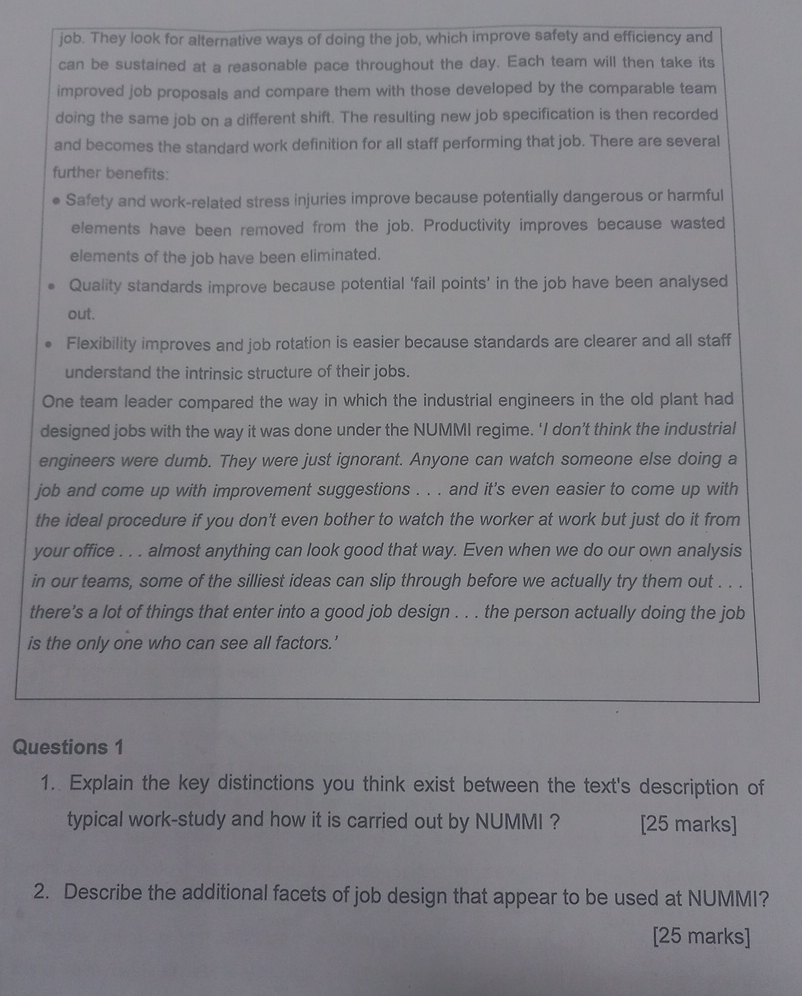
job. They look for alternative ways of doing the job, which improve safety and efficiency and can be sustained at a reasonable pace throughout the day. Each team will then take its improved job proposals and compare them with those developed by the comparable team doing the same job on a different shift. The resulting new job specification is then recorded and becomes the standard work definition for all staff performing that job. There are several further benefits:
Safety and workrelated stress injuries improve because potentially dangerous or harmful elements have been removed from the job. Productivity improves because wasted elements of the job have been eliminated.
Quality standards improve because potential 'fail points' in the job have been analysed out.
Flexibility improves and job rotation is easier because standards are clearer and all staff understand the intrinsic structure of their jobs.
One team leader compared the way in which the industrial engineers in the old plant had designed jobs with the way it was done under the NUMMI regime. 'I don't think the industrial engineers were dumb. They were just ignorant. Anyone can watch someone else doing a job and come up with improvement suggestions and it's even easier to come up with the ideal procedure if you don't even bother to watch the worker at work but just do it from your office almost anything can look good that way. Even when we do our own analysis in our teams, some of the silliest ideas can slip through before we actually try them out there's a lot of things that enter into a good job design the person actually doing the job is the only one who can see all factors.
Questions
Explain the key distinctions you think exist between the text's description of typical workstudy and how it is carried out by NUMMI?
marks
Describe the additional facets of job design that appear to be used at NUMMI?
marks
Step by Step Solution
There are 3 Steps involved in it
1 Expert Approved Answer
Step: 1 Unlock

Question Has Been Solved by an Expert!
Get step-by-step solutions from verified subject matter experts
Step: 2 Unlock
Step: 3 Unlock
 Study Help