







Question: Section 2: Functional Dependencies (15 marks) Question 7 (4 marks) Consider the following relation: CAR_SALE(Carid, Datesold, Salesmanid, Commision%, Discount Assume that a car may be
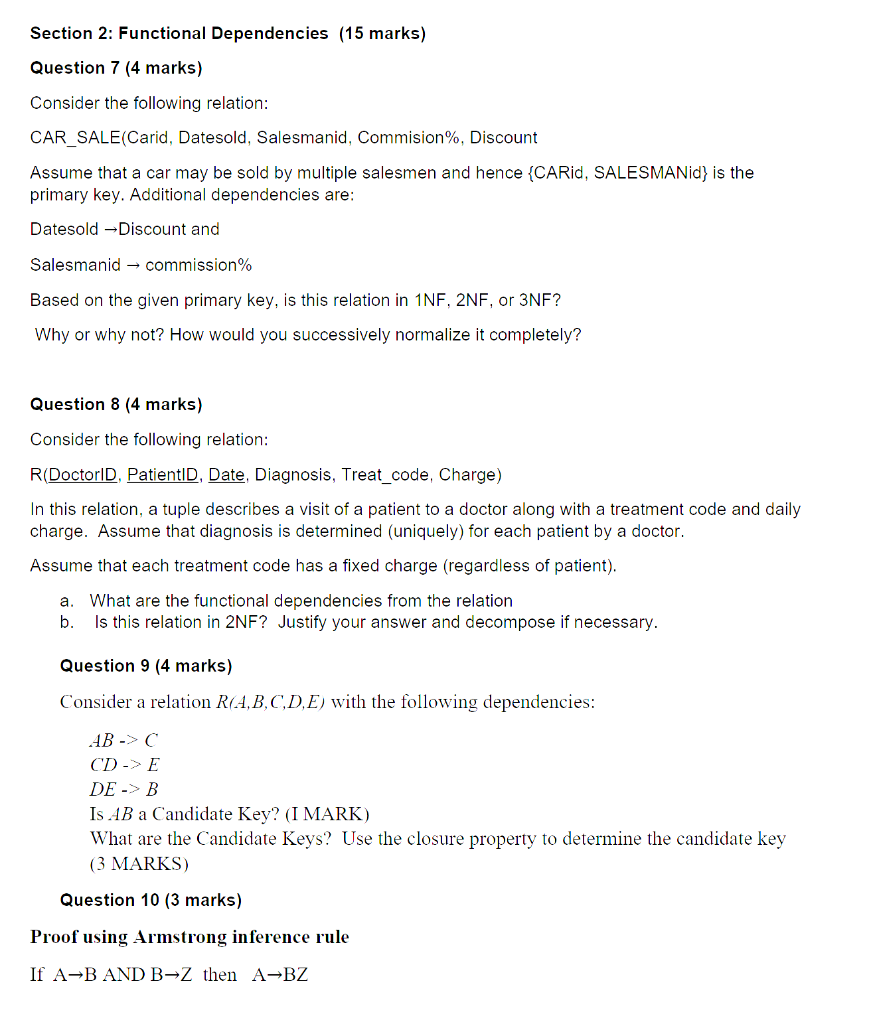
Section 2: Functional Dependencies (15 marks) Question 7 (4 marks) Consider the following relation: CAR_SALE(Carid, Datesold, Salesmanid, Commision\%, Discount Assume that a car may be sold by multiple salesmen and hence \{CARid, SALESMANid is the primary key. Additional dependencies are: Datesold Discount and Salesmanid commission % Based on the given primary key, is this relation in 1NF, 2NF, or 3NF ? Why or why not? How would you successively normalize it completely? Question 8 (4 marks) Consider the following relation: R (DoctorlD, PatientID, Date, Diagnosis, Treat_code, Charge) In this relation, a tuple describes a visit of a patient to a doctor along with a treatment code and daily charge. Assume that diagnosis is determined (uniquely) for each patient by a doctor. Assume that each treatment code has a fixed charge (regardless of patient). a. What are the functional dependencies from the relation b. Is this relation in 2NF? Justify your answer and decompose if necessary. Question 9 (4 marks) Consider a relation R(A,B,C,D,E) with the following dependencies: AB>C CD>E DEB Is AB a Candidate Key? (I MARK) What are the Candidate Keys? Use the closure property to determine the candidate key (3 MARKS) Question 10 (3 marks) Proof using Armstrong inference rule If ABANDBZ then ABZ
Step by Step Solution
There are 3 Steps involved in it

Get step-by-step solutions from verified subject matter experts
 Study Help