







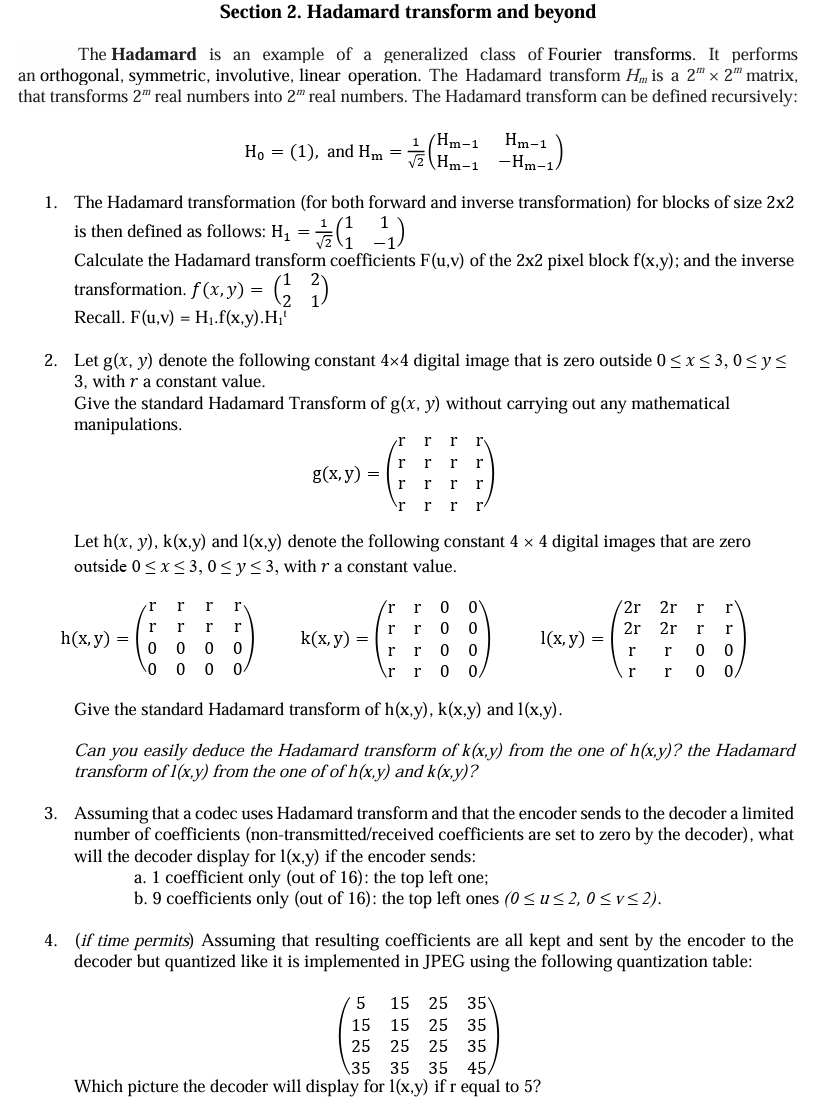
Question: Section 2 . Hadamard transform and beyond The Hadamard is an example of a generalized class of Fourier transforms. It performs an orthogonal, symmetric, involutive,
Section Hadamard transform and beyond
The Hadamard is an example of a generalized class of Fourier transforms. It performs
an orthogonal, symmetric, involutive, linear operation. The Hadamard transform is a matrix,
that transforms real numbers into real numbers. The Hadamard transform can be defined recursively:
and
The Hadamard transformation for both forward and inverse transformation for blocks of size
is then defined as follows:
Calculate the Hadamard transform coefficients of the pixel block ; and the inverse
transformation.
Recall.
Let denote the following constant digital image that is zero outside
with a constant value.
Give the standard Hadamard Transform of without carrying out any mathematical
manipulations.
Let and denote the following constant digital images that are zero
outside with a constant value.
Give the standard Hadamard transform of and
Can you easily deduce the Hadamard transform of from the one of the Hadamard
transform of from the one of and
Assuming that a codec uses Hadamard transform and that the encoder sends to the decoder a limited
number of coefficients nontransmittedreceived coefficients are set to zero by the decoder what
will the decoder display for if the encoder sends:
a coefficient only out of : the top left one;
b coefficients only out of : the top left ones
if time permits Assuming that resulting coefficients are all kept and sent by the encoder to the
decoder but quantized like it is implemented in JPEG using the following quantization table:
Which picture the decoder will display for if equal to
Step by Step Solution
There are 3 Steps involved in it
1 Expert Approved Answer
Step: 1 Unlock

Question Has Been Solved by an Expert!
Get step-by-step solutions from verified subject matter experts
Step: 2 Unlock
Step: 3 Unlock
 Study Help