







Question: Section 2.2: p. 2, 4, 12, 24, 30. Please solve these problems according to the method mentioned in their respective headings. 1-14 GENERAL SOLUTION 27.
Section 2.2: p. 2, 4, 12, 24, 30.
Please solve these problems according to the method mentioned in their respective headings.
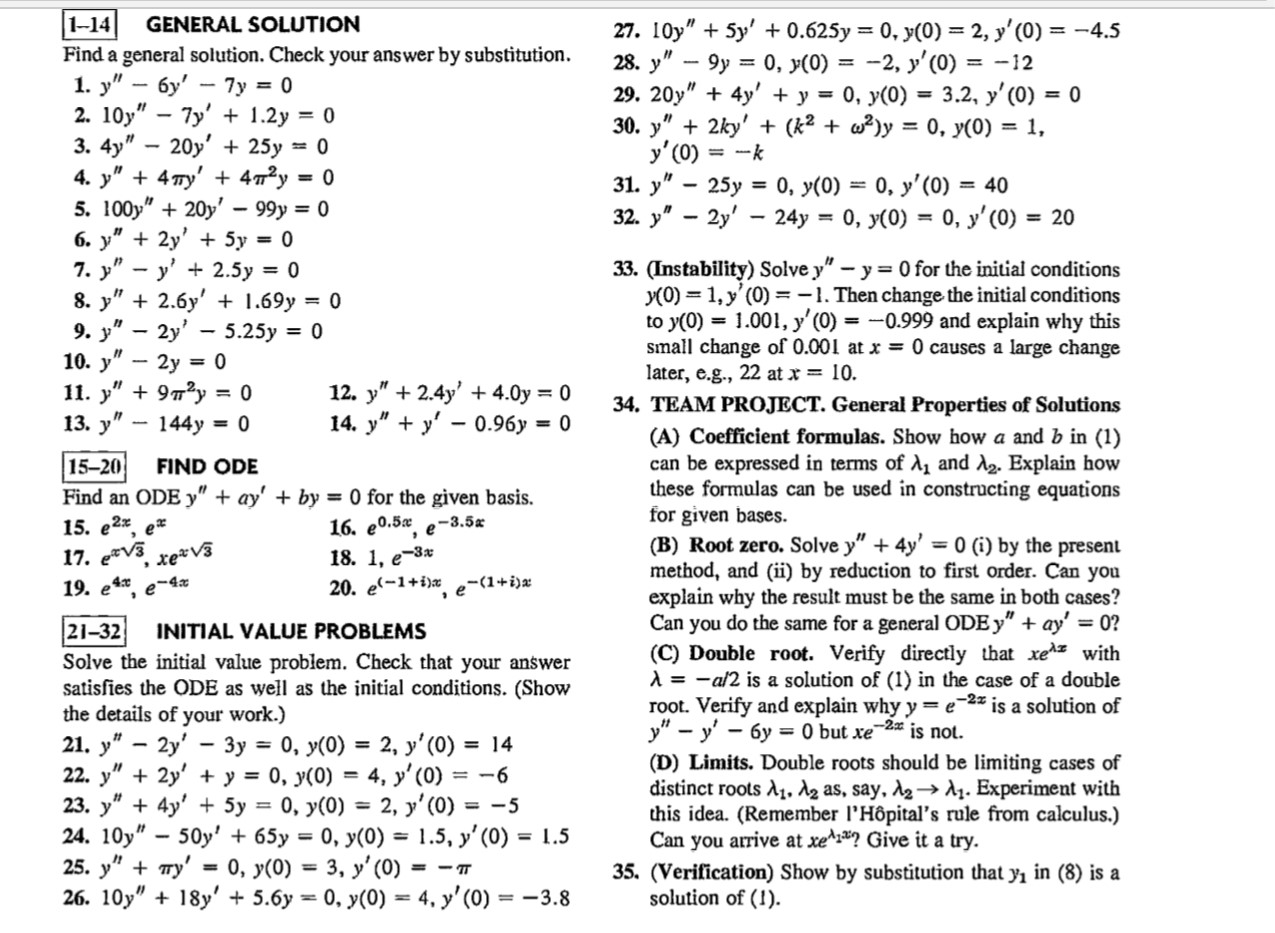
1-14 GENERAL SOLUTION 27. 10y" + 5y' + 0.625y = 0, y(0) = 2, y'(0) = -4.5 Find a general solution. Check your answer by substitution. 28. y" - 9y = 0, y(0) = -2, y''(0) = -12 1. y" - 6y' - 7y = 0 29. 20y" + 4y' + y = 0, y(0) = 3.2, y'(0) = 0 2. 10y" - 7y' + 1.2y = 0 30. y" + 2ky' + (k2 + w? ) y = 0, y(0) = 1, 3. 4y" - 20y' + 25y = 0 y'(0) = -k 4. y" + 4my' + 472y = 0 31. y" - 25y = 0, y(0) = 0, y'(0) = 40 5. 100y" + 20y' - 99y = 0 32. y" - 2y' - 24y = 0, y(0) = 0, y' (0) = 20 6. y" + 2y + 5y = 0 7. y" - y' + 2.5y = 0 33. (Instability) Solve y" - y = 0 for the initial conditions 8. y" + 2.6y' + 1.69y = 0 y(0) = 1, y (0) = -1. Then change the initial conditions 9. y" - 2y' - 5.25y = 0 to y(0) = 1.001, y'(0) = -0.999 and explain why this 10. y" - 2y = 0 small change of 0.001 at x = 0 causes a large change later, e.g., 22 at x = 10. 11. y" + 972y = 0 12. y" + 2.4y' + 4.0y = 0 34. TEAM PROJECT. General Properties of Solutions 13. y" - 144y = 0 14. y" + y' - 0.96y = 0 (A) Coefficient formulas. Show how a and b in (1) 15-20 FIND ODE can be expressed in terms of , and 12. Explain how Find an ODE y" + ay' + by = 0 for the given basis. these formulas can be used in constructing equations 15. e2x x 16. e0.5x -3.5x for given bases. 17. exv3 , xe*V3 18. 1, e-3x (B) Root zero. Solve y" + 4y' = 0 (i) by the present 19. ett, e-4x 20. e(-1+1)x -(1+i)x method, and (ii) by reduction to first order. Can you explain why the result must be the same in both cases? 21-32 INITIAL VALUE PROBLEMS Can you do the same for a general ODEy" + ay' = 0? Solve the initial value problem. Check that your answer (C) Double root. Verify directly that xele with satisfies the ODE as well as the initial conditions. (Show A = -a/2 is a solution of (1) in the case of a double the details of your work.) root. Verify and explain why y = e-27 is a solution of 21. y" - 2y' - 3y = 0, y(0) = 2, y' (0) = 14 y" - y' - by = 0 but xe-2z is not. y" + 2y' + y = 0, y(0) = 4, y'(0) = -6 (D) Limits. Double roots should be limiting cases of y" + 4y' + 5y = 0, y(0) = 2, y'(0) = -5 distinct roots 1. 12 as, say, 12 -> M1. Experiment with this idea. (Remember I'Hopital's rule from calculus.) 24. 10y" - 50y' + 65y = 0, y(0) = 1.5, y'(0) = 1.5 Can you arrive at xed ? Give it a try. 25. y" + Ty' = 0, y(0) = 3, y' (0) = - T 35. (Verification) Show by substitution that y, in (8) is a 26. 10y" + 18y' + 5.6y = 0, y(0) = 4. y' (0) = -3.8 solution of (1)
Step by Step Solution
There are 3 Steps involved in it

Get step-by-step solutions from verified subject matter experts
 Study Help