







Question: Section 3 . Complete the following Table, assuming that the DNA is written with the top left being a 5 ' end and that the
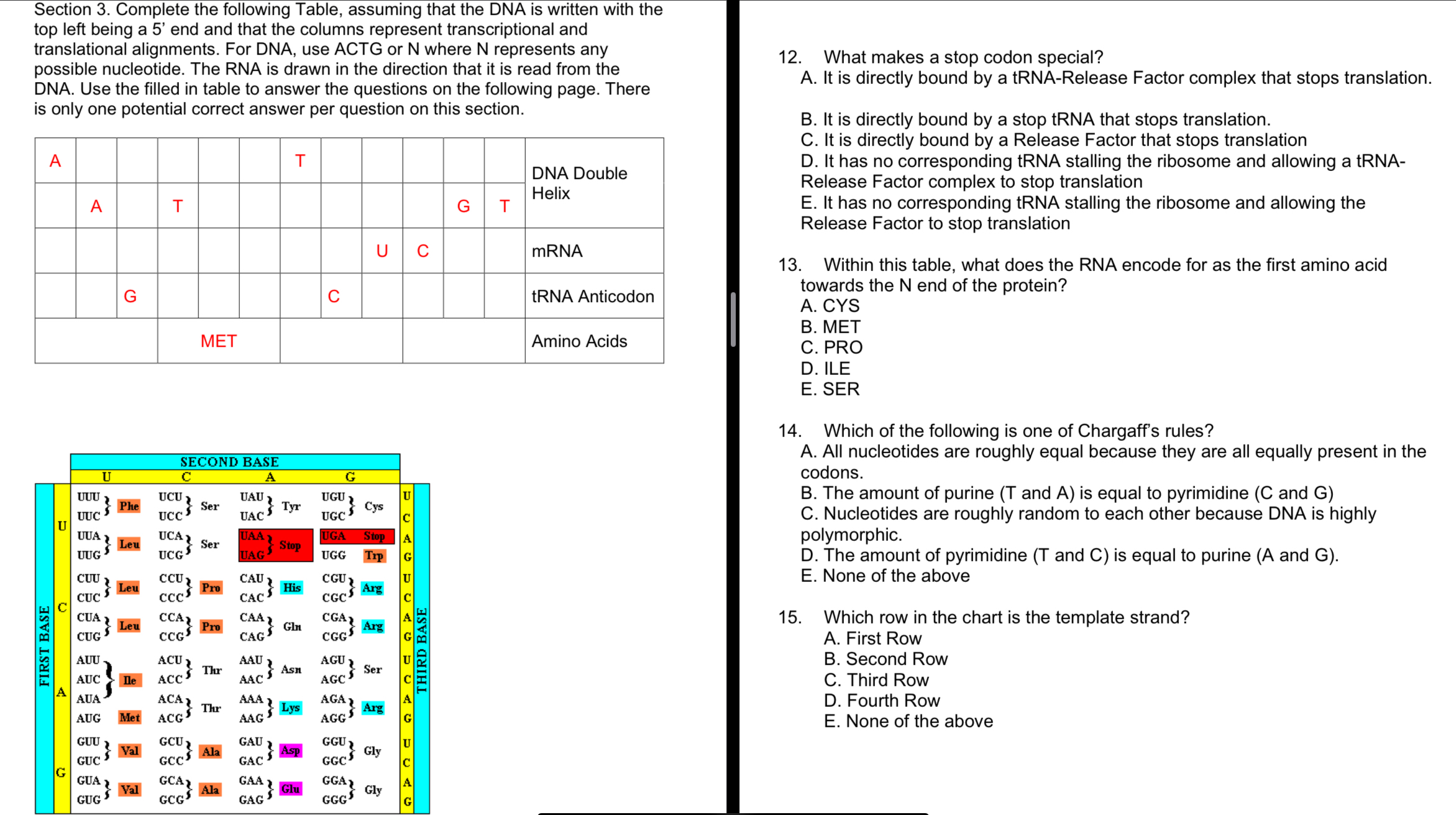
Section Complete the following Table, assuming that the DNA is written with the top left being a end and that the columns represent transcriptional and translational alignments. For DNA, use ACTG or N where N represents any possible nucleotide. The RNA is drawn in the direction that it is read from the DNA. Use the filled in table to answer the questions on the following page. There is only one potential correct answer per question on this section.
tableATDNA Double HelixATGTUCmRNAGCtRNA AnticodonMET,,,Amino Acids
What makes a stop codon special?
A It is directly bound by a tRNARelease Factor complex that stops translation.
B It is directly bound by a stop tRNA that stops translation.
C It is directly bound by a Release Factor that stops translation
D It has no corresponding tRNA stalling the ribosome and allowing a tRNARelease Factor complex to stop translation
E It has no corresponding tRNA stalling the ribosome and allowing the Release Factor to stop translation
Within this table, what does the RNA encode for as the first amino acid towards the N end of the protein?
A CYS
B MET
C PRO
D ILE
E SER
Which of the following is one of Chargaff's rules?
A All nucleotides are roughly equal because they are all equally present in the codons.
B The amount of purine and is equal to pyrimidine and
C Nucleotides are roughly random to each other because DNA is highly polymorphic.
D The amount of pyrimidine and is equal to purine A and
E None of the above
Which row in the chart is the template strand?
A First Row
B Second Row
C Third Row
D Fourth Row
E None of the above
Step by Step Solution
There are 3 Steps involved in it
1 Expert Approved Answer
Step: 1 Unlock

Question Has Been Solved by an Expert!
Get step-by-step solutions from verified subject matter experts
Step: 2 Unlock
Step: 3 Unlock
 Study Help