







Question: SECTION A [100 MARKS] Read the extract below and answer the questions that follow. The strategic leadership of GE CEO Jack Welch The late former
![SECTION A [100 MARKS] Read the extract below and answer the](https://dsd5zvtm8ll6.cloudfront.net/si.experts.images/questions/2024/10/671e2094b9e5d_668671e20940732d.jpg)
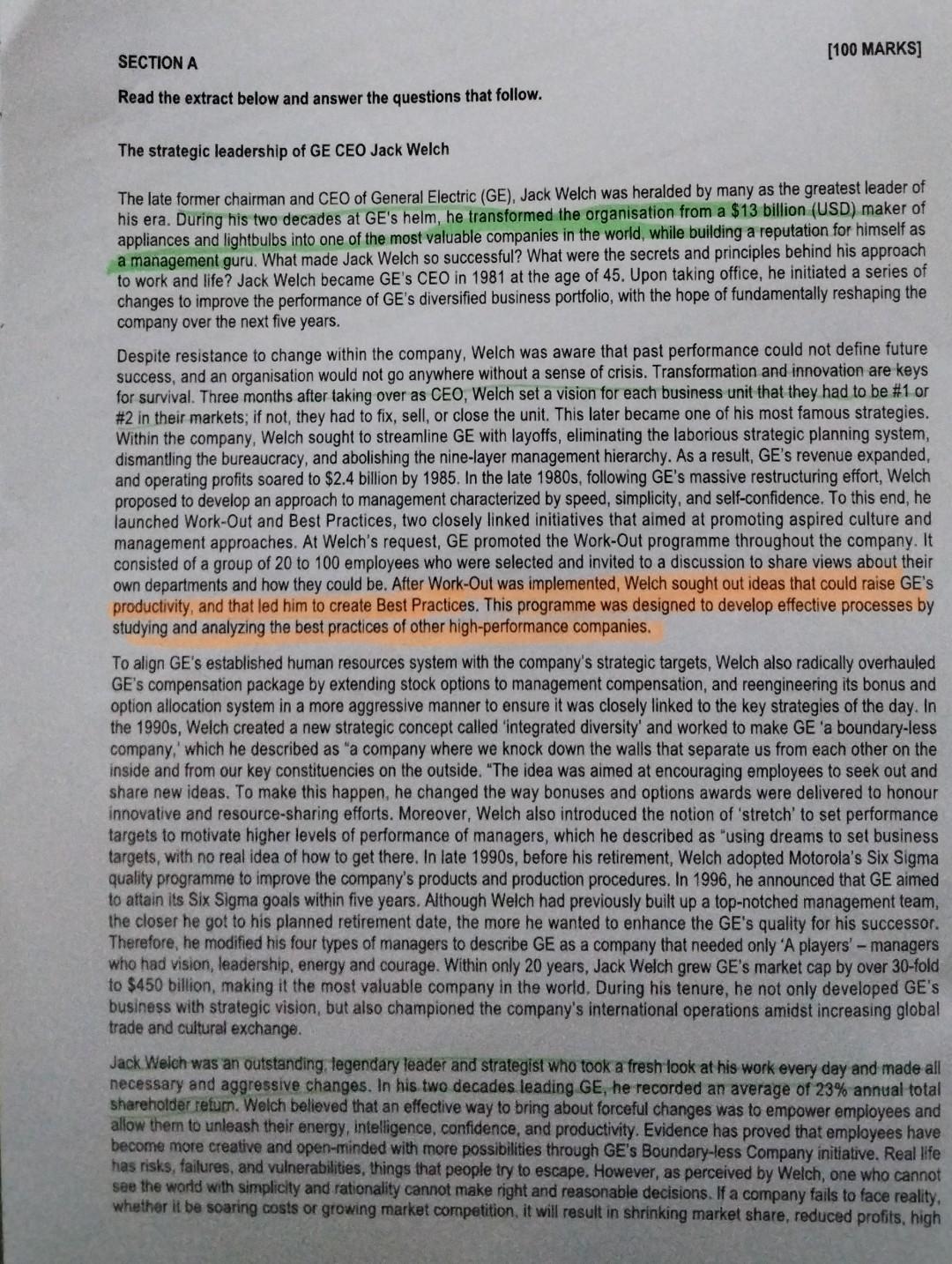

SECTION A [100 MARKS] Read the extract below and answer the questions that follow. The strategic leadership of GE CEO Jack Welch The late former chairman and CEO of General Electric (GE), Jack Welch was heraided by many as the greatest leader of his era. During his two decades at GE's heim, he transformed the organisation from a \$13 billion (USD) maker of appliances and lightbulbs into one of the most valuable companies in the world, while buliding a reputation for himself as a management guru. What made Jack Weich so successful? What were the secrets and principles behind his approach to work and life? Jack Weich became GE s CEO in 1981 at the age of 45. Upon taking office, he intiated a series of changes to improve the performance of GE's diversified business portfolio, with the hope of fundamentally reshaping the company over the next ifve years. Despite resistance to change within the company. Welch was aware that past performance could not define future success, and an organisation would not go anywhere without a sense of crisis. Transformation and innovation are keys for survival. Three months after taking over as CEO, Welch set a vision for each business unit that they had to be #1 or \#2 in their markets; if not, they had to fix, sell, or close the unit. This later became one of his most famous strategies. Within the company. Weich sought to streamline GE with layoffs, eliminating the laborious strategic planning system. dismanting the bureaucracy, and abolishing the nine-layer management hierarchy. As a result. GE s revenue expanded. and operating profits soared to $2.4 billion by 1985 . in the late 1980 s, following GE's massive restructuring effort, Weich proposed to develop an approach to management characterized by speed, simplicity, and self-confidence. To this end. he launched Work-Out and Best Practices, two closely linked initiatives that aimed at promoting aspired culture and management approaches. At Welch's request, GE promoted the Work-Out programme throughout the company it consisted of a group of 20 to 100 employees who were selected and invited to a discussion to share views about their own departments and how they could be. After Work-Out was implemented. Welch sought out ideas that could rase GE's productivity, and that led him to create Best Practices. This programme was designed to develop effective processes by studying and analyzing the best practices of other high-performance companies. To align GE's established human resources system with the company's strategic targets. Welch also radically overhauled GE's compensation package by extending stock options to management compensation, and reengineering its bonus and option allocation system in a more aggressive manner to ensure it was closely linked to the key strategies of the day. in the 1990 s, Welch created a new strategic concept called integrated diversity' and worked to make GE' a boundary-less company, which he described as "a company where we knock down the walls that separate us from each other on the inside and from our key constutuencies on the outside. The idea was aimed at encouraging employees to seek out and share new ideas. To make this happen, he changed the way bonuses and options awards were delivered to honour innovative and resource-sharing efforts. Moreover. Welch also introduced the notion of 'stretch' to set performance targets to motivate higher levels of performance of managers, which he described as "using dreams to set business targets, with no real idea of how to get there. In late 1990 s, before his retirement, Weich adopted Molorola's Six Sigma quality programme to improve the company's products and production procedures. In 1996 , he announced that GE aimed to altain its Six Sigma goals within five years. Although Weich had previously bult up a top-notched management team, the closer he got to his planned retirement date, the more he wanted to enhance the GE's quality for his successor. Therefore, he modified his four types of managers to describe GE as a company that needed only 'A players' - managers Who had vision, leadership, energy and courage. Within only 20 years, Jack Welch grew GE's market cap by over 30-tolo to $450 billion, making it the most valuable company in the world. During his tenure, he not only developed GE's business with strategic vision, but also championed the company's international operations amidst increasing global trade and cultural exchange. Jack Weleh was an ousstanding, legendary leacer and strategist whe took a tresh took at his work every day and made all necessary and aggressive changes. In his two decades leading GE, he recorded an average of 23% annual total shareholdetcietur. Welch believed that an effective way to oring about forceful changes was to empower employees and allow them to unteash their energy, intelligence, confidence, and productivity. Evidenca has proved that employees have become more creative and open-minded with more possibilities through GE's Boundary-less Compary inibative. Real ife has risks, falures, and vuinerablities, things that people try to escape. However, as perceived by Weich one who carnot see the world with simplicity and rationalily cannot make ight and reasonacle decisions. If a company fals to tace reality. whether it be scaing costs or growing markat compettion, it will result in shrising market share, feduced proflts, high empioyee furnovers, and invesiment withdrawal. Weich called for developing a candid culture at GE whero ho encouraged empioyees to reach out directly to leaders to seek advice. For Weich, the toie of leaders was not the wentiol people but rather to guide and lead. Good business ieaders create a vision, articulato the vision, passionaliny own the vision, and relentlessly drive it to comptetion. Answer ALL the questions in this section. QUESTION 1 (25 Marks) Jack Welch has been described by many as a transformational leader. With reference from the exciract. argue for or against this assertion. QUESTION 2 (25 Varks) Drawing from the exiract and using sullable examples, discuss how Jack Welch demonstrales the elements of leadership. QUESTION 3 (25 Marks) As the human resource manager at GE, you have been tasked with employing job enlargement and job enrichment as further stralegies for motivating slaff. You plan to start with the receplion staff whose primary duties include answering, screening, and forwarding incoming phone calls, greeting and welcoming guests, and directing visitors to the approprate persons and office. Based on this - Provide a detaled explanation of how you will enlarge the job of the receptionists. (12.5 Marks) - Provide a detaled explanation of how you will enrich the job of the receptionists. (12.5 Marks) QUESTION 4 (25 Marks) Taking into consideration Jack Welch's leadership at GE and his expectation of the umployees, elaborate on the ype of individuals that you think will be best sulted to work in GE in tems of emolional intefigence, salues, personality, and acility. Ensure that you clearly substantiale your response. END OFPAPER SECTION A [100 MARKS] Read the extract below and answer the questions that follow. The strategic leadership of GE CEO Jack Welch The late former chairman and CEO of General Electric (GE), Jack Welch was heralded by many as the greatest leader of his era. During his two decades at GE's helm, he transformed the organisation from a $13 billion (USD) maker of appliances and lightbulbs into one of the most valuable companies in the world, while building a reputation for himself as a management guru. What made Jack Welch so successful? What were the secrets and principles behind his approach to work and life? Jack Welch became GE's CEO in 1981 at the age of 45. Upon taking office, he initiated a series of changes to improve the performance of GE's diversified business portfolio, with the hope of fundamentally reshaping the company over the next five years. Despite resistance to change within the company, Welch was aware that past performance could not define future success, and an organisation would not go anywhere without a sense of crisis. Transformation and innovation are keys for survival. Three months after taking over as CEO, Welch set a vision for each business unit that they had to be \#1 or \#2 in their markets; if not, they had to fix, sell, or close the unit. This later became one of his most famous strategies. Within the company, Welch sought to streamline GE with layoffs, eliminating the laborious strategic planning system, dismantling the bureaucracy, and abolishing the nine-layer management hierarchy. As a result, GE's revenue expanded, and operating profits soared to $2.4 billion by 1985 . In the late 1980 s, following GE's massive restructuring effort, Welch proposed to develop an approach to management characterized by speed, simplicity, and self-confidence. To this end, he launched Work-Out and Best Practices, two closely linked initiatives that aimed at promoting aspired culture and management approaches. At Welch's request, GE promoted the Work-Out programme throughout the company. It consisted of a group of 20 to 100 employees who were selected and invited to a discussion to share views about their own departments and how they could be. After Work-Out was implemented, Welch sought out ideas that could raise GE's productivity, and that led him to create Best Practices. This programme was designed to develop effective processes by studying and analyzing the best practices of other high-performance companies. To align GE's established human resources system with the company's strategic targets, Welch also radically overhauled GE's compensation package by extending stock options to management compensation, and reengineering its bonus and option allocation system in a more aggressive manner to ensure it was closely linked to the key strategies of the day. In the 1990s, Weich created a new strategic concept called 'integrated diversity' and worked to make GE 'a boundary-less company,' which he described as "a company where we knock down the walls that separate us from each other on the inside and from our key constituencies on the outside. "The idea was aimed at encouraging employees to seek out and share new ideas. To make this happen, he changed the way bonuses and options awards were delivered to honour innovative and resource-sharing efforts. Moreover, Welch also introduced the notion of 'stretch' to set performance targets to motivate higher levels of performance of managers, which he described as "using dreams to set business targets, with no real idea of how to get there. In late 1990s, before his retirement, Welch adopted Motorola's Six Sigma quality programme to improve the company's products and production procedures. In 1996, he announced that GE aimed to aftain its Six Sigma goals within five years. Although Welch had previously built up a top-notched management team, the closer he got to his planned retirement date, the more he wanted to enhance the GE's quality for his successor. Therefore, he modified his four types of managers to describe GE as a company that needed only 'A players' - managers who had vision, leadership, energy and courage. Within only 20 years, Jack Welch grew GE's market cap by over 30 -fold to $450 billion, making it the most valuable company in the world. During his tenure, he not only developed GE's business with strategic vision, but also championed the company's international operations amidst increasing global trade and cultural exchange. Jack Welch was an outstanding, legendary leader and strategist who took a fresh look at his work every day and made all necessary and aggressive changes. In his two decades leading GE, he recorded an average of 23% annual total shareholderieturn. Welch believed that an effective way to bring about forceful changes was to empower employees and allow them to unleash their energy, intelligence, confidence, and productivity. Evidence has proved that employees have become more creative and open-minded with more possibilities through GE's Boundary-less Company initiative. Real life has risks, failures, and vulnerabilities, things that people try to escape. However, as perceived by Welch, one who cannot see the world with simplicity and rationality cannot make right and reasonable decisions. If a company fails to face reality, whether it be soaring costs or growing market cornpetition, it will result in shrinking market share, reduced profits, high QUESTION 4 Taking into consideration Jack Welch's leadership at GE and his expectation of the employees, elaborate on the type of individuals that you think will be best suited to work in GE in terms of emotional intelligence, values, personality, and ability. Ensure that you clearly substantiate your response
Step by Step Solution
There are 3 Steps involved in it

Get step-by-step solutions from verified subject matter experts
 Study Help