







Question: Section A 12 Multiple Choice Questions; Answer all Questions [Total 30 Marks] 1. How much will $1,000 accumulate to after three years if invested today
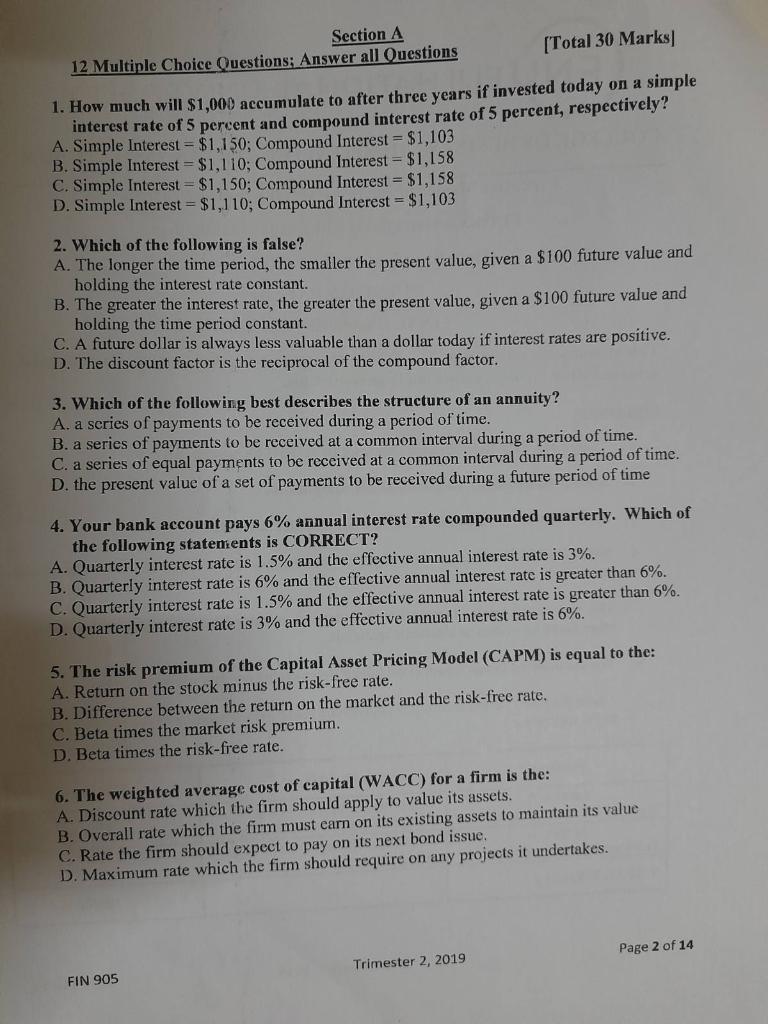
Section A 12 Multiple Choice Questions; Answer all Questions [Total 30 Marks] 1. How much will $1,000 accumulate to after three years if invested today on a simple interest rate of 5 percent and compound interest rate of 5 percent, respectively? A. Simple Interest = $1,150; Compound Interest = $1,103 B. Simple Interest = $1,110; Compound Interest = $1,158 C. Simple Interest - $1,150; Compound Interest = $1,158 D. Simple Interest = $1,110; Compound Interest = $1,103 2. Which of the following is false? A. The longer the time period, the smaller the present value, given a $100 future value and holding the interest rate constant. B. The greater the interest rate, the greater the present value, given a $100 future value and holding the time period constant. C. A future dollar is always less valuable than a dollar today if interest rates are positive. D. The discount factor is the reciprocal of the compound factor. 3. Which of the following best describes the structure of an annuity? A. a series of payments to be received during a period of time. B. a series of payments to be received at a common interval during a period of time. C. a series of equal payments to be received at a common interval during a period of time. D. the present value of a set of payments to be received during a future period of time 4. Your bank account pays 6% annual interest rate compounded quarterly. Which of the following statements is CORRECT? A. Quarterly interest rate is 1.5% and the effective annual interest rate is 3%.. B. Quarterly interest rate is 6% and the effective annual interest rate is greater than 6%. C. Quarterly interest rate is 1.5% and the effective annual interest rate is greater than 6%. D. Quarterly interest rate is 3% and the effective annual interest rate is 6%. 5. The risk premium of the Capital Asset Pricing Model (CAPM) is equal to the: A. Return on the stock minus the risk-free rate. B. Difference between the return on the market and the risk-free rate. C. Beta times the market risk premium. D. Beta times the risk-free rate. 6. The weighted average cost of capital (WACC) for a firm is the: A. Discount rate which the firm should apply to value its assets. B. Overall rate which the firm must earn on its existing assets to maintain its value C. Rate the firm should expect to pay on its next bond issue. D. Maximum rate which the firm should require on any projects it undertakes. Trimester 2, 2019 FIN 905 Page 2 of 14
Step by Step Solution
There are 3 Steps involved in it

Get step-by-step solutions from verified subject matter experts
 Study Help