







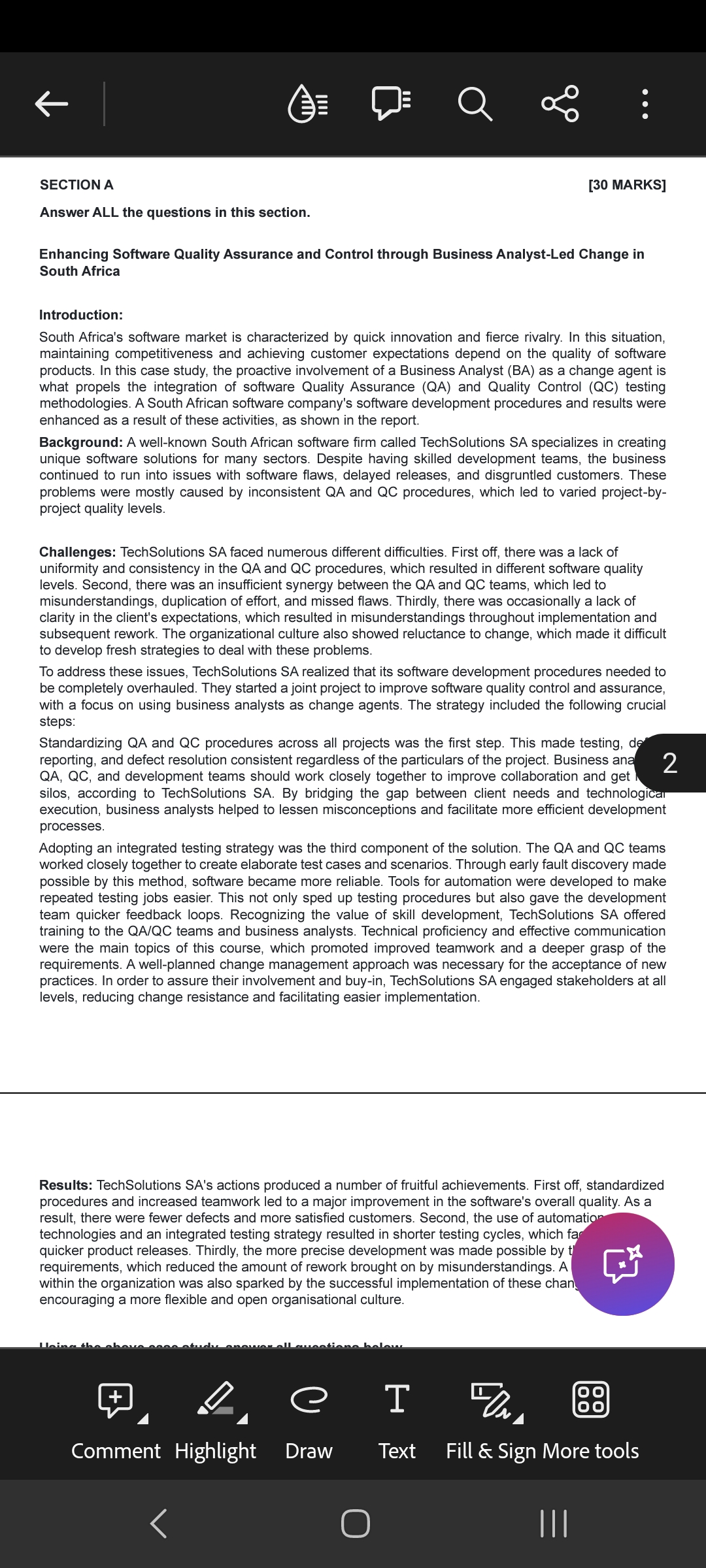
Question: SECTION A Answer ALL the questions in this section. Enhancing Software Quality Assurance and Control through Business Analyst - Led Change in South Africa Introduction:
SECTION A
Answer ALL the questions in this section.
Enhancing Software Quality Assurance and Control through Business AnalystLed Change in
South Africa
Introduction:
South Africa's software market is characterized by quick innovation and fierce rivalry. In this situation,
maintaining competitiveness and achieving customer expectations depend on the quality of software
products. In this case study, the proactive involvement of a Business Analyst BA as a change agent is
what propels the integration of software Quality Assurance QA and Quality Control QC testing
methodologies. A South African software company's software development procedures and results were
enhanced as a result of these activities, as shown in the report.
Background: A wellknown South African software firm called TechSolutions SA specializes in creating
unique software solutions for many sectors Despite having skilled development teams, the business
continued to run into issues with software flaws, delayed releases, and disgruntled customers. These
problems were mostly caused by inconsistent QA and QC procedures, which led to varied projectby
project quality levels.
Challenges: TechSolutions SA faced numerous different difficulties. First off, there was a lack of
uniformity and consistency in the QA and QC procedures, which resulted in different software quality
levels. Second, there was an insufficient synergy between the QA and QC teams, which led to
misunderstandings, duplication of effort, and missed flaws. Thirdly, there was occasionally a lack of
clarity in the client's expectations, which resulted in misunderstandings throughout implementation and
subsequent rework. The organizational culture also showed reluctance to change, which made it difficult
to develop fresh strategies to deal with these problems.
To address these issues, TechSolutions SA realized that its software development procedures needed to
be completely overhauled. They started a joint project to improve software quality control and assurance,
with a focus on using business analysts as change agents. The strategy included the following crucial
steps:
Standardizing QA and QC procedures across all projects was the first step. This made testing,
reporting, and defect resolution consistent regardless of the particulars of the project. Business ana
QA QC and development teams should work closely together to improve collaboration and get
silos, according to TechSolutions SA By bridging the gap between client needs and technologica
execution, business analysts helped to lessen misconceptions and facilitate more efficient development
processes.
Adopting an integrated testing strategy was the third component of the solution. The QA and QC teams
worked closely together to create elaborate test cases and scenarios. Through early fault discovery made
possible by this method, software became more reliable. Tools for automation were developed to make
repeated testing jobs easier. This not only sped up testing procedures but also gave the development
team quicker feedback loops. Recognizing the value of skill development, TechSolutions SA offered
training to the QAQC teams and business analysts. Technical proficiency and effective communication
were the main topics of this course, which promoted improved teamwork and a deeper grasp of the
requirements. A wellplanned change management approach was necessary for the acceptance of new
practices. In order to assure their involvement and buyin TechSolutions SA engaged stakeholders at all
levels, reducing change resistance and facilitating easier implementation.
Results: TechSolutions SA's actions produced a number of fruitful achievements. First off, standardized
procedures and increased teamwork led to a major improvement in the software's overall quality. As a
result, there were fewer defects and more satisfied customers. Second, the use of automation
technologies and an integrated testing strategy resulted in shorter testing cycles, which fa
quicker product releases. Thirdly, the more precise development was made possible by
requirements, which reduced the amount of rework brought on by misunderstandings. A
within the organization was also sparked by the successful implementation of these chan
encouraging a more flexible and open organisational culture.
Step by Step Solution
There are 3 Steps involved in it
1 Expert Approved Answer
Step: 1 Unlock

Question Has Been Solved by an Expert!
Get step-by-step solutions from verified subject matter experts
Step: 2 Unlock
Step: 3 Unlock
 Study Help