







Question: Section A. . Answer the following questions. (30 marks) The local council of a city plans to reduce pollution by imposing a tax on gasoline.
Section A.
. Answer the following questions. (30 marks)
The local council of a city plans to reduce pollution by imposing a tax on gasoline. To avoid any backlash from voters, they decide to impose the tax on gas stations, and not the buyers. Draw a diagram to show how a gasoline tax imposed on gas stations would affect the price of gasoline and the quantity sold. Make sure that your diagram shows the tax, which curve shifts and how, the original equilibrium before the tax (P and Q), and the situation after tax (P and Q from the point of view of buyers and sellers). Discuss whether the council will be successful in avoiding any effects on buyers.
COVID-19 vaccines reduce both the risk of people who get vaccinated to get a serious form of the disease, and the risk of them infecting other people. What economic concept does this positive effect onto other people illustrate?
Imagine that vaccines are sold like many other goods in a competitive market. Draw the diagram to show the market for vaccines and the impact vaccines have onto people who don't necessarily get vaccinated. Show the market equilibrium and the socially optimal equilibrium. Explain in words why in the absence of any government intervention the quantity of vaccines that people would choose to buy would be less than the socially optimal quantity. How can government encourage more people to get vaccinated?
Imagine that there a single formula for COVID_19 vaccine production and that the inventor and manufacturer of that formula can choose the price at which they sell the vaccine to the public. Now imagine that the government buys the formula for the vaccine and gives it for free to all pharmaceutical companies who are interested in producing the vaccine. Beyond the investment in developing the formula, the marginal cost or producing vaccines is constant and small. For simplicity we assume that the demand for vaccines is downward sloping and linear.
Draw a diagram to show the price and quantity of vaccine that the single firm would choose to maximize their profit. On the same diagram, show the price and quantity of vaccines that would be produced if a large number of small manufacturers would compete in this market. Which outcome is efficient and why?
Bonus Question (2 marks): In reality, there are several vaccines for COVID-19 already, with slightly different formulas, costs and price points. What type of market structure best characterizes the market for vaccines? Is this type of market better or worse than having a single producer? Why?
Part B Solve the following problem and answer each question (35 marks)
Assume you have the following information about testing for COVID-19 in a typical laboratory.
The first column shows the number of specialized personnel that could work on testing in any given day (L). The second column shows the number of COVID-19 tests that can be performed daily in the laboratory (Q) given the number of people hired. The TC column shows the total costs of performing the number of tests from column (2).
Please note that all these numbers are hypothetical and created for the purpose of this exam! I have no expertise in this area.
L
Q
MPL
APL
FC
VC
TC
AVC
ATC
MC
0
0
1800
1
50
2750
2
120
3940
3
220
5490
4
360
7520
5
480
9310
6
560
10620
7
630
11810
8
670
12640
9
700
13350
10
710
13820
Complete the table (14 marks)
What do MPL, APL acronyms stand for? Explain the concepts behind them. (2 marks)
Why do the MPL numbers first increase and then increase? (2 marks)
How much is the fixed cost of production? Give two examples of fixed costs that you think a testing lab might incur. (2 marks)
Assume that the lab is run by a government agency. If the government wanted to perform the maximum number of tests every day, how many tests would the lab perform? How many people should they hire? What would be their cost per test? What would be the total cost of testing per day? (4 marks)
If the lab wanted to produce their output with the lowest cost per unit (ATC), how many people would get tested daily? What is the cost per test performed daily in this case? How many people would be hired by the lab? (3 marks)
Now assume the lab is privately owned. The government offers to pay the lab $24 per test. If the lab is looking to maximize its profit (like any other private entity) how many tests should the lab perform daily? How many people should they hire? What is the cost per test performed daily in this case? What is the lab's daily profit? (4 marks)
If the government plans to reduce the price per test they offer, what is the minimum price level for a test at which the lab will continue to perform tests in the short run? Explain.(2 marks)
If the number of labs can easily change (new labs can be easily set up and running) what do you predict will be the price for a test and the daily profit of a lab in the long run? Explain. (2 marks)
ii.
. Explain the difference between the current account and the capital and financial account in the balance of payments.
2. What is a trade deficit?
3. Assume a U.S. firm buys (imports) $5 million (in U.S. dollars) of foreign goods. That transaction by itself increases the trade deficit by $5 million. But, the $5 million will flow back to the United States to purchase either (i) U.S. goods and services or (ii) U.S. assets.
? How does the way the $5 million comes back to the United States determine whether there will be balanced trade or a trade deficit?
? How does the U.S. economy benefit from either transaction (the foreign purchase of U.S. goods and services [exports] or the purchase of U.S. assets)? 4. How does the "global savings glut" help explain the trade deficit?
iii.
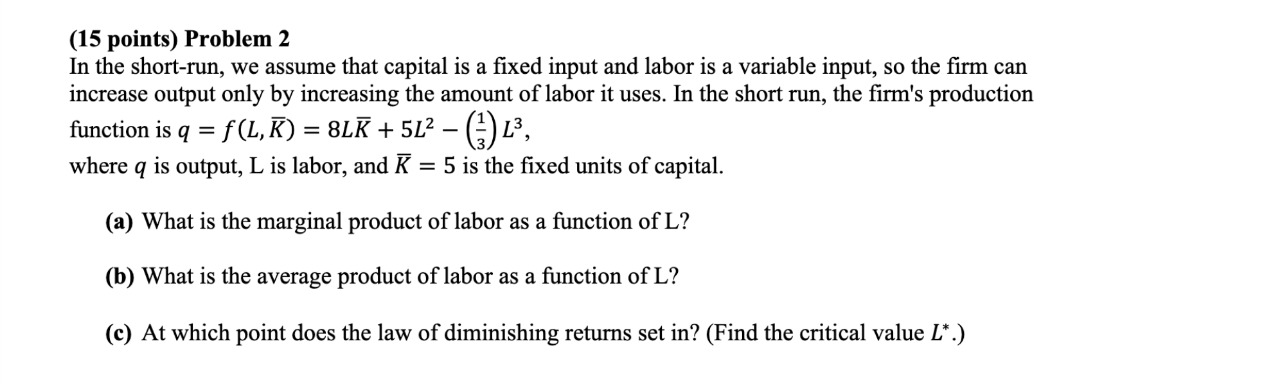
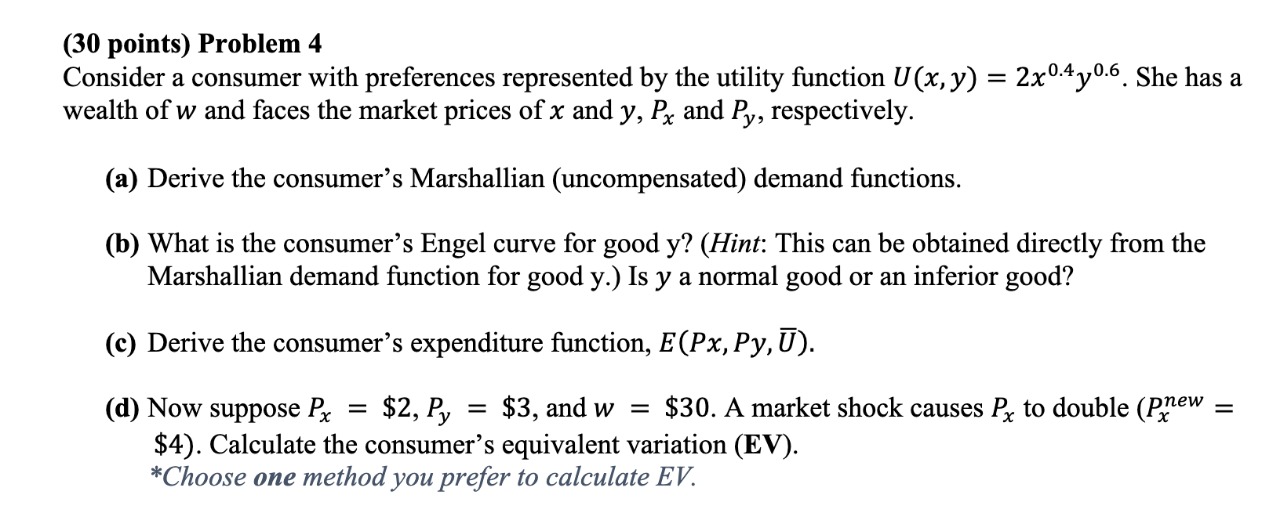
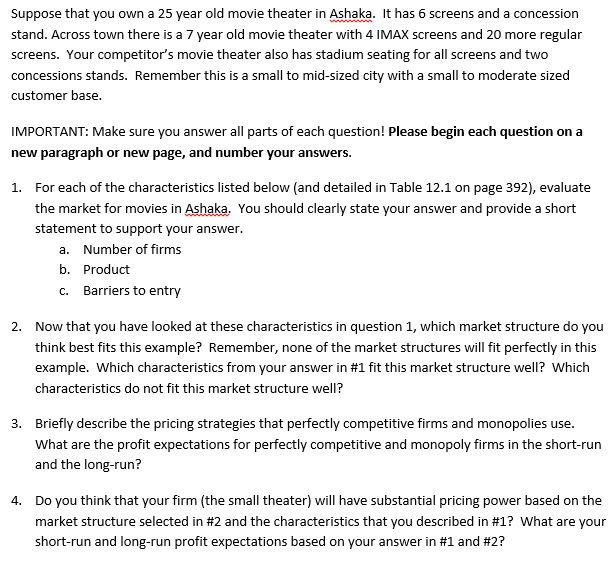
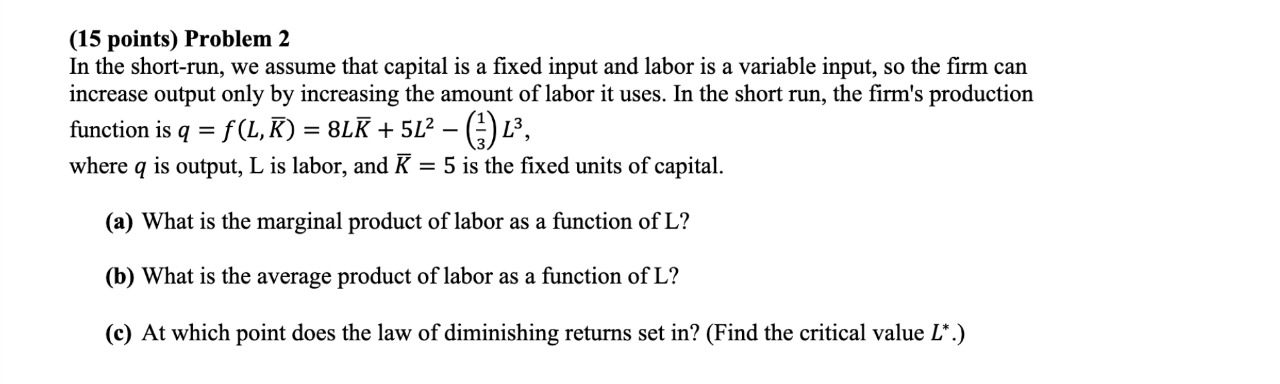
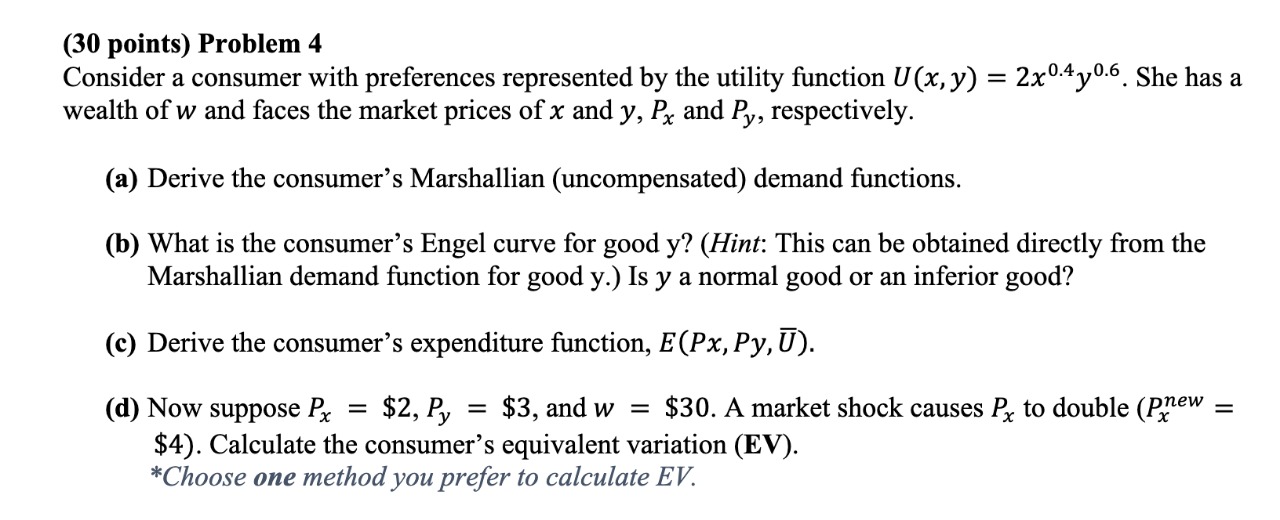
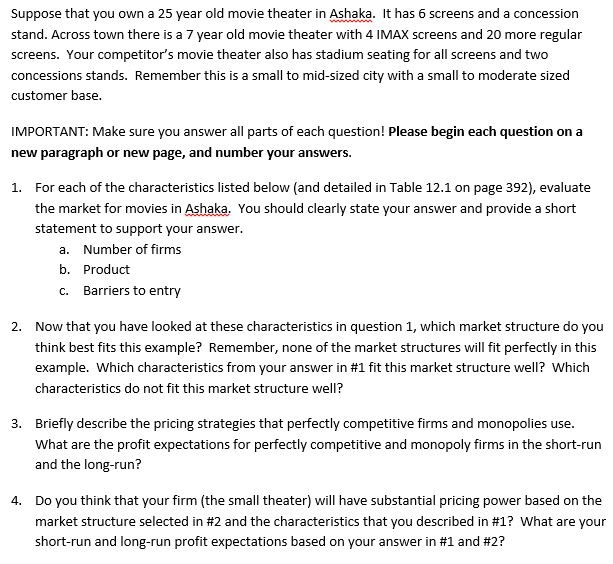
(15 points) Problem 2 In the short-run, we assume that capital is a fixed input and labor is a variable input, so the firm can increase output only by increasing the amount of labor it uses. In the short run, the firm's production function is q = f (L, K) = 8LK + 512 - 2 13, where q is output, L is labor, and K = 5 is the fixed units of capital. (a) What is the marginal product of labor as a function of L? (b) What is the average product of labor as a function of L? (c) At which point does the law of diminishing returns set in? (Find the critical value L*.)(30 points) Problem 4 Consider a consumer with preferences represented by the utility function U (x, y) = 2x'4y0'5. She has a wealth of w and faces the market prices of x and y, Px and P3,, respectively. (a) Derive the consumer's Marshallian (uncompensated) demand functions. (b) What is the consumer's Engel curve for good y? (Hint: This can be obtained directly from the Marshallian demand function for good y.) Is y a normal good or an inferior good? (c) Derive the consumer's expenditure function, E (Px, Py, [7). ((1) Now suppose Px = $2, 1\Suppose that you own a 25 year old movie theater in Ashaka. It has 6 screens and a concession stand. Across town there is a 7 year old movie theater with 4 IMAX screens and 20 more regular screens. Your competitor's movie theater also has stadium seating for all screens and two concessions stands. Remember this is a small to mid-sized city with a small to moderate sized customer base. IMPORTANT: Make sure you answer all parts of each question! Please begin each question on a new paragraph or new page, and number your answers. 1. For each of the characteristics listed below (and detailed in Table 12.1 on page 392), evaluate the market for movies in Ashaka. You should clearly state your answer and provide a short statement to support your answer. a. Number of firms b. Product C. Barriers to entry 2. Now that you have looked at these characteristics in question 1, which market structure do you think best fits this example? Remember, none of the market structures will fit perfectly in this example. Which characteristics from your answer in #1 fit this market structure well? Which characteristics do not fit this market structure well? 3. Briefly describe the pricing strategies that perfectly competitive firms and monopolies use. What are the profit expectations for perfectly competitive and monopoly firms in the short-run and the long-run? 4. Do you think that your firm (the small theater) will have substantial pricing power based on the market structure selected in #2 and the characteristics that you described in #1? What are your short-run and long-run profit expectations based on your answer in #1 and #2
Step by Step Solution
There are 3 Steps involved in it

Get step-by-step solutions from verified subject matter experts
 Study Help