







Question: Section A Question 1: Ramsey Model (30%, each part as shown) Consider a Ramsey model that generates the following system of differential equations: (1) c
Section A
Question 1: Ramsey Model (30%, each part as shown)
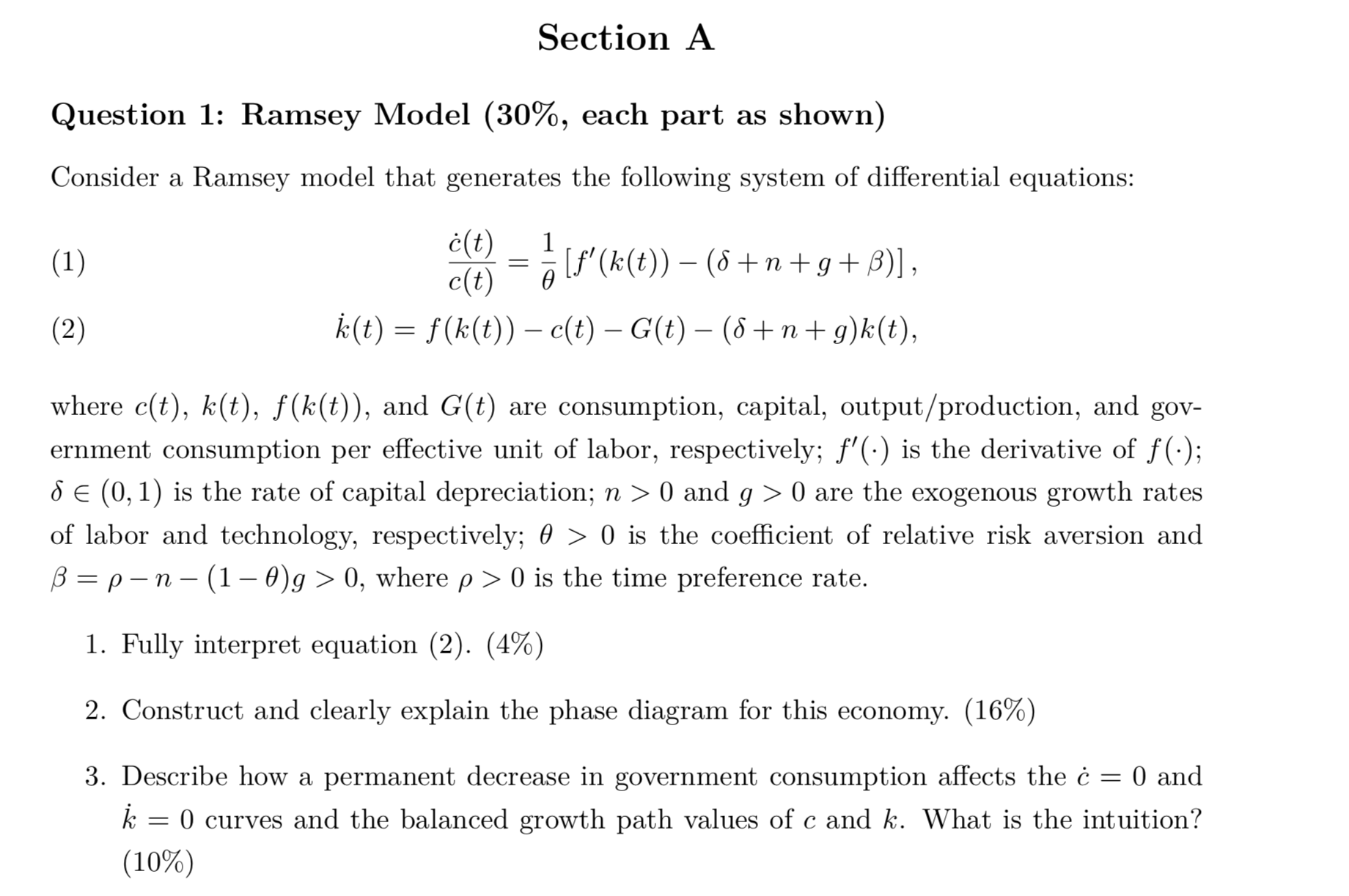
Consider a Ramsey model that generates the following system of differential equations: (1) c ?(t) = 1[f?(k(t))?(?+n+g+?)],
c(t) ?
(2) k ? (t) = f (k(t)) ? c(t) ? G(t) ? (? + n + g)k(t),
where c(t), k(t), f(k(t)), and G(t) are consumption, capital, output/production, and gov- ernment consumption per effective unit of labor, respectively; f?() is the derivative of f(); ? ? (0, 1) is the rate of capital depreciation; n > 0 and g > 0 are the exogenous growth rates of labor and technology, respectively; ? > 0 is the coefficient of relative risk aversion and ? = ??n?(1??)g > 0, where ? > 0 is the time preference rate.
1. Fully interpret equation (2). (4%)
2. Construct and clearly explain the phase diagram for this economy. (16%)
3. Describe how a permanent decrease in government consumption affects the c ? = 0 and k ? = 0 curves and the balanced growth path values of c and k. What is the intuition? (10%)
Section A Question 1: Ramsey Model (30%, each part as shown) Consider a Ramsey model that generates the following system of differential equations: (1) % = gum) (6+n+g+m], (2) km = mew) c(t> G(t) (6+n+g>k(t>, where 005), k(t), f (k(t)), and C(15) are consumption, capital, output/production, and gov- ernment consumption per effective unit of labor, respectively; f'(-) is the derivative of f (), 6 E (0, 1) is the rate of capital depreciation; 'n. > 0 and g > 0 are the exogenous growth rates of labor and technology, respectively; 6 > 0 is the coefcient of relative risk aversion and = p n (1 6)g > 0, where p > 0 is the time preference rate. 1. Fully interpret equation (2). (4%) 2. Construct and clearly explain the phase diagram for this economy. (16%) 3. Describe how a permanent decrease in government consumption affects the c' = 0 and k = 0 curves and the balanced growth path values of c and k. What is the intuition? (10%)
Step by Step Solution
There are 3 Steps involved in it

Get step-by-step solutions from verified subject matter experts
 Study Help