







Question: SECTION B Answer both questions from this section (20 marks each) 7. A firm can produce a quantity q(I, y, z) = (x2 + 42
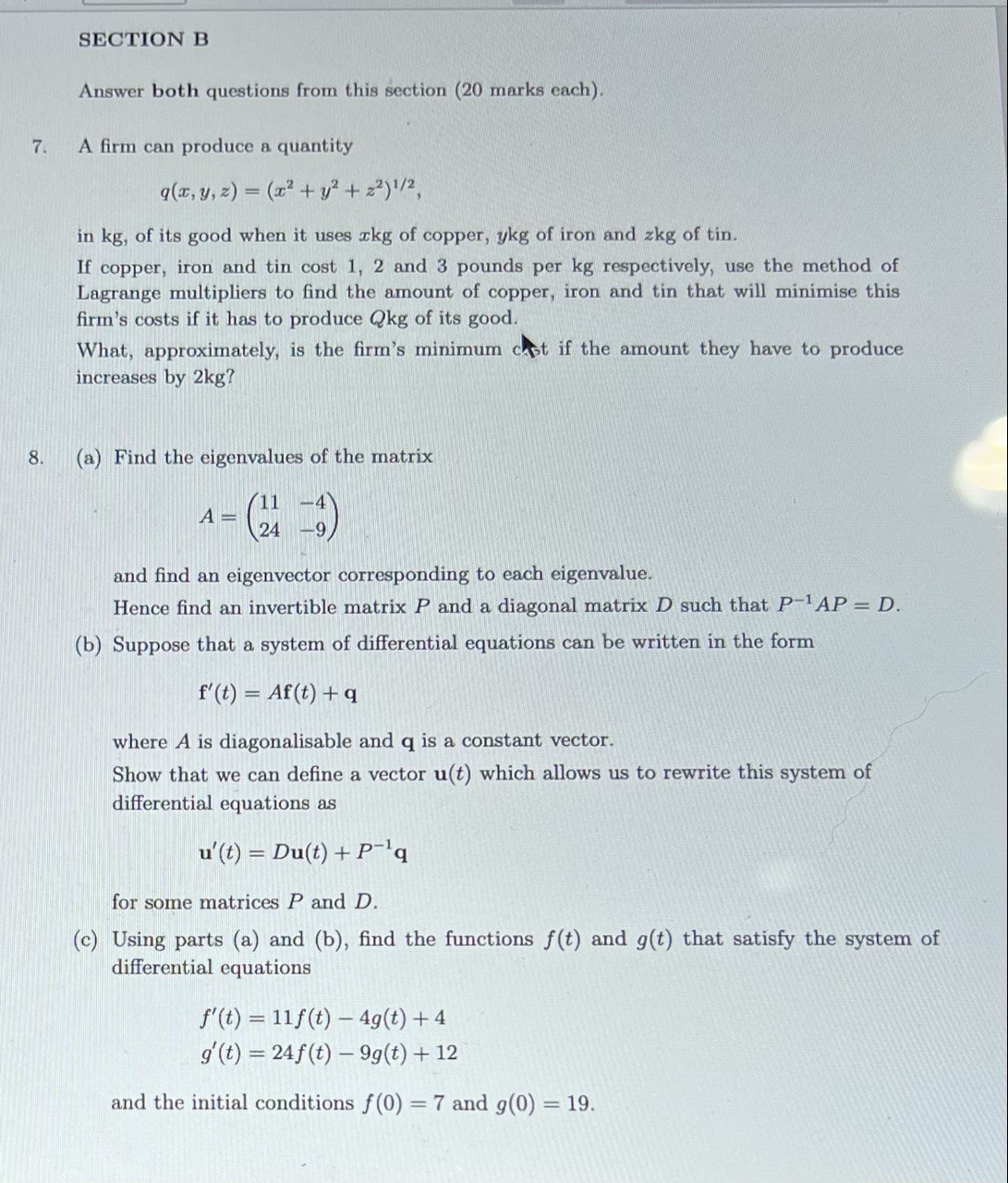
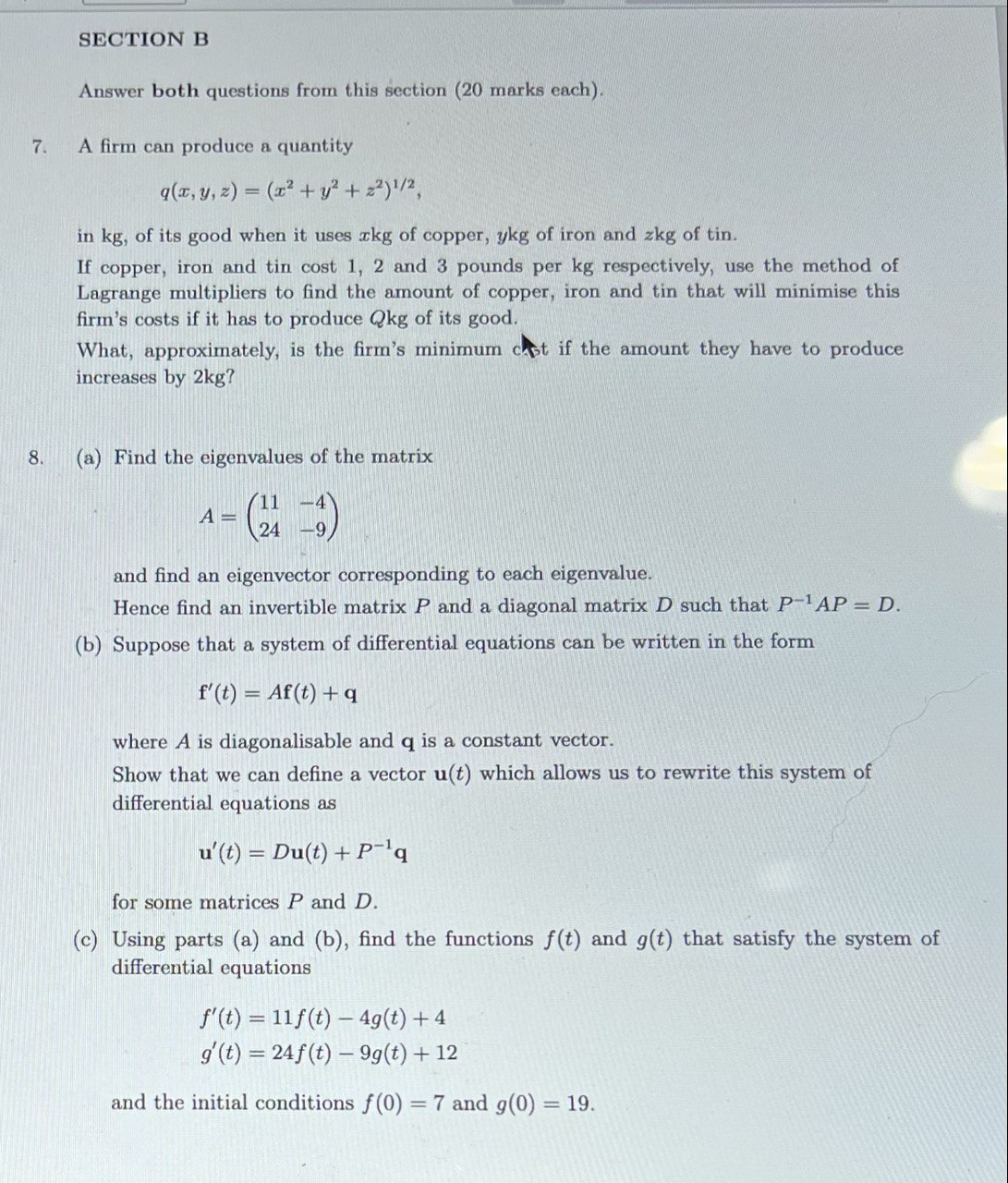
SECTION B Answer both questions from this section (20 marks each) 7. A firm can produce a quantity q(I, y, z) = (x2 + 42 + 22)1/2, in kg, of its good when it uses rkg of copper, ykg of iron and zkg of tin. If copper, iron and tin cost 1, 2 and 3 pounds per kg respectively, use the method of Lagrange multipliers to find the amount of copper, iron and tin that will minimise this firm's costs if it has to produce Qkg of its good. What, approximately, is the firm's minimum cast if the amount they have to produce increases by 2kg? 8. (a) Find the eigenvalues of the matrix A = 24 and find an eigenvector corresponding to each eigenvalue. Hence find an invertible matrix P and a diagonal matrix D such that P-1AP = D. (b) Suppose that a system of differential equations can be written in the form f' (t) = Af(t) + q where A is diagonalisable and q is a constant vector. Show that we can define a vector u(t) which allows us to rewrite this system of differential equations as u'(t) = Du(t) + P-q for some matrices P and D. (c) Using parts (a) and (b), find the functions f(t) and g(t) that satisfy the system of differential equations f'(t) = 11f(t) - 4g(t) + 4 g'(t) = 24f(t) - 9g(t) + 12 and the initial conditions f (0) = 7 and g(0) = 19
Step by Step Solution
There are 3 Steps involved in it

Get step-by-step solutions from verified subject matter experts
 Study Help