Question: Section B Case Study (40 marks) - Max 500 words Answer ALL questions. Hypothetical case - Best Value Inn: Success in Targeting the Right Markets
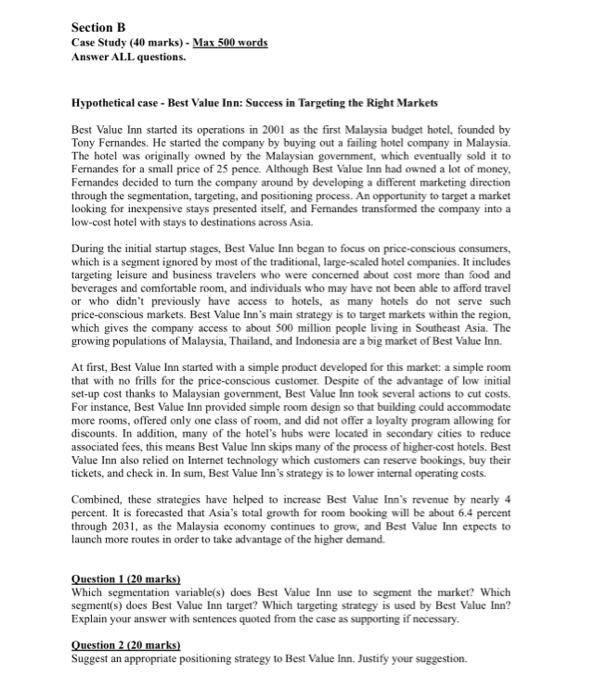
Section B Case Study (40 marks) - Max 500 words Answer ALL questions. Hypothetical case - Best Value Inn: Success in Targeting the Right Markets Best Value Inn started its operations in 2001 as the first Malaysia budget hotel, founded by Tony Fernandes. He started the company by buying out a failing hotel company in Malaysia. The hotel was originally owned by the Malaysian government, which eventually sold it to Fernandes for a small price of 25 pence. Although Best Value Inn had owned a lot of money, Fernandes decided to turn the company around by developing a different marketing direction through the segmentation, targeting, and positioning process. An opportunity to target a market looking for inexpensive stays presented itself, and Femandes transformed the company into a low-cost hotel with stays to destinations across Asia. During the initial startup stages, Best Value Inn began to focus on price-conscious consumers, which is a segment ignored by most of the traditional, large-scaled hotel companies. It includes targeting leisure and business travelers who were concerned about cost more than food and beverages and comfortable room, and individuals who may have not been able to afford travel or who didn't previously have access to hotels, as many hotels do not serve such price-conscious markets. Best Value Inn's main strategy is to target markets within the region, which gives the company access to about 500 million people living in Southeast Asia. The growing populations of Malaysia, Thailand, and Indonesia arc a big market of Best Value Inn. At first, Best Value Inn started with a simple product developed for this market: a simple room that with no frills for the price-conscious customer. Despite of the advantage of low initial set-up cost thanks to Malaysian government, Best Value Inn took several actions to cut costs. For instance, Best Value Inn provided simple room design so that building could accommodate more rooms, offered only one class of room, and did not offer a loyalty program allowing for discounts. In addition, many of the hotel's hubs were located in secondary cities to reduce associated fees, this means Best Value Inn skips many of the process of higher-cost hotels. Best Value Inn also relied on Internet technology which customers can reserve bookings, buy their tickets, and check in. In sum, Best Value Inn's strategy is to lower internal operating costs. Combined, these strategies have helped to increase Best Value Inn's revenue by nearly 4 percent. It is forecasted that Asia's total growth for room booking will be about 6.4 percent through 2031, as the Malaysia economy continues to grow, and Best Value Inn expects to launch more routes in order to take advantage of the higher demand. Question 1 (20 marks) Which segmentation variable(s) does Best Value Inn use to segment the market? Which segment(s) does Best Value Inn target? Which targeting strategy is used by Best Value Inn? Explain your answer with sentences quoted from the case as supporting if necessary. Question 2 (20 marks) Suggest an appropriate positioning strategy to Best Value Inn. Justify your suggestion









 Study Help