







Question: SECTION B Read the Emerging Markets: India's IT Software Sector case study and answer all of the questions (21a, 21b and 21c) that follow.
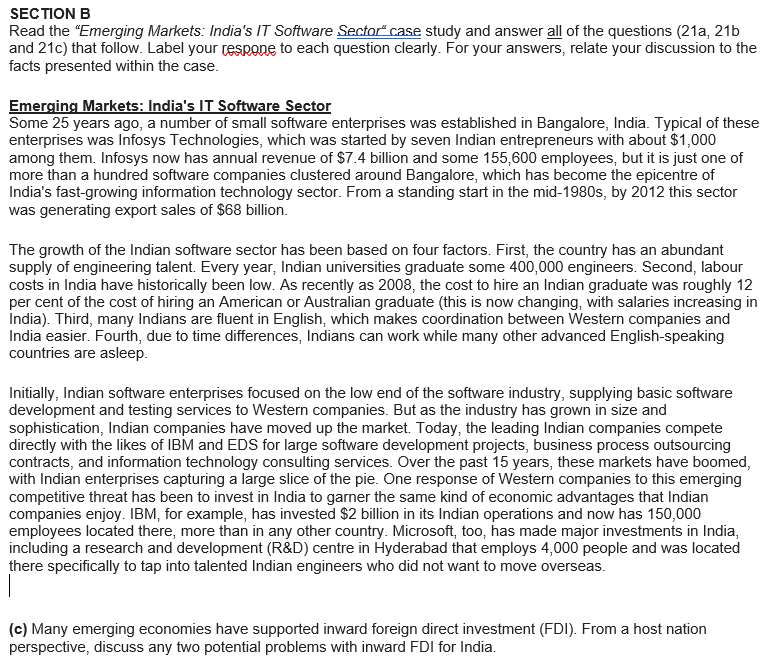
SECTION B Read the "Emerging Markets: India's IT Software Sector" case study and answer all of the questions (21a, 21b and 21c) that follow. Label your respone to each question clearly. For your answers, relate your discussion to the facts presented within the case. Emerging Markets: India's IT Software Sector Some 25 years ago, a number of small software enterprises was established in Bangalore, India. Typical of these enterprises was Infosys Technologies, which was started by seven Indian entrepreneurs with about $1,000 among them. Infosys now has annual revenue of $7.4 billion and some 155,600 employees, but it is just one of more than a hundred software companies clustered around Bangalore, which has become the epicentre of India's fast-growing information technology sector. From a standing start in the mid-1980s, by 2012 this sector was generating export sales of $68 billion. The growth of the Indian software sector has been based on four factors. First, the country has an abundant supply of engineering talent. Every year, Indian universities graduate some 400,000 engineers. Second, labour costs in India have historically been low. As recently as 2008, the cost to hire an Indian graduate was roughly 12 per cent of the cost of hiring an American or Australian graduate (this is now changing, with salaries increasing in India). Third, many Indians are fluent in English, which makes coordination between Western companies and India easier. Fourth, due to time differences, Indians can work while many other advanced English-speaking countries are asleep. Initially, Indian software enterprises focused on the low end of the software industry, supplying basic software development and testing services to Western companies. But as the industry has grown in size and sophistication, Indian companies have moved up the market. Today, the leading Indian companies compete directly with the likes of IBM and EDS for large software development projects, business process outsourcing contracts, and information technology consulting services. Over the past 15 years, these markets have boomed, with Indian enterprises capturing a large slice of the pie. One response of Western companies to this emerging competitive threat has been to invest in India to garner the same kind of economic advantages that Indian companies enjoy. IBM, for example, has invested $2 billion in its Indian operations and now has 150,000 employees located there, more than in any other country. Microsoft, too, has made major investments in India, including a research and development (R&D) centre in Hyderabad that employs 4,000 people and was located there specifically to tap into talented Indian engineers who did not want to move overseas. (c) Many emerging economies have supported inward foreign direct investment (FDI). From a host nation perspective, discuss any two potential problems with inward FDI for India.
Step by Step Solution
There are 3 Steps involved in it

Get step-by-step solutions from verified subject matter experts
 Study Help