







Question: Section II. Short Answers. (Max. Points for Section = 22 Points). This Section contains eleven (11) questions that require Students to fill in the blank
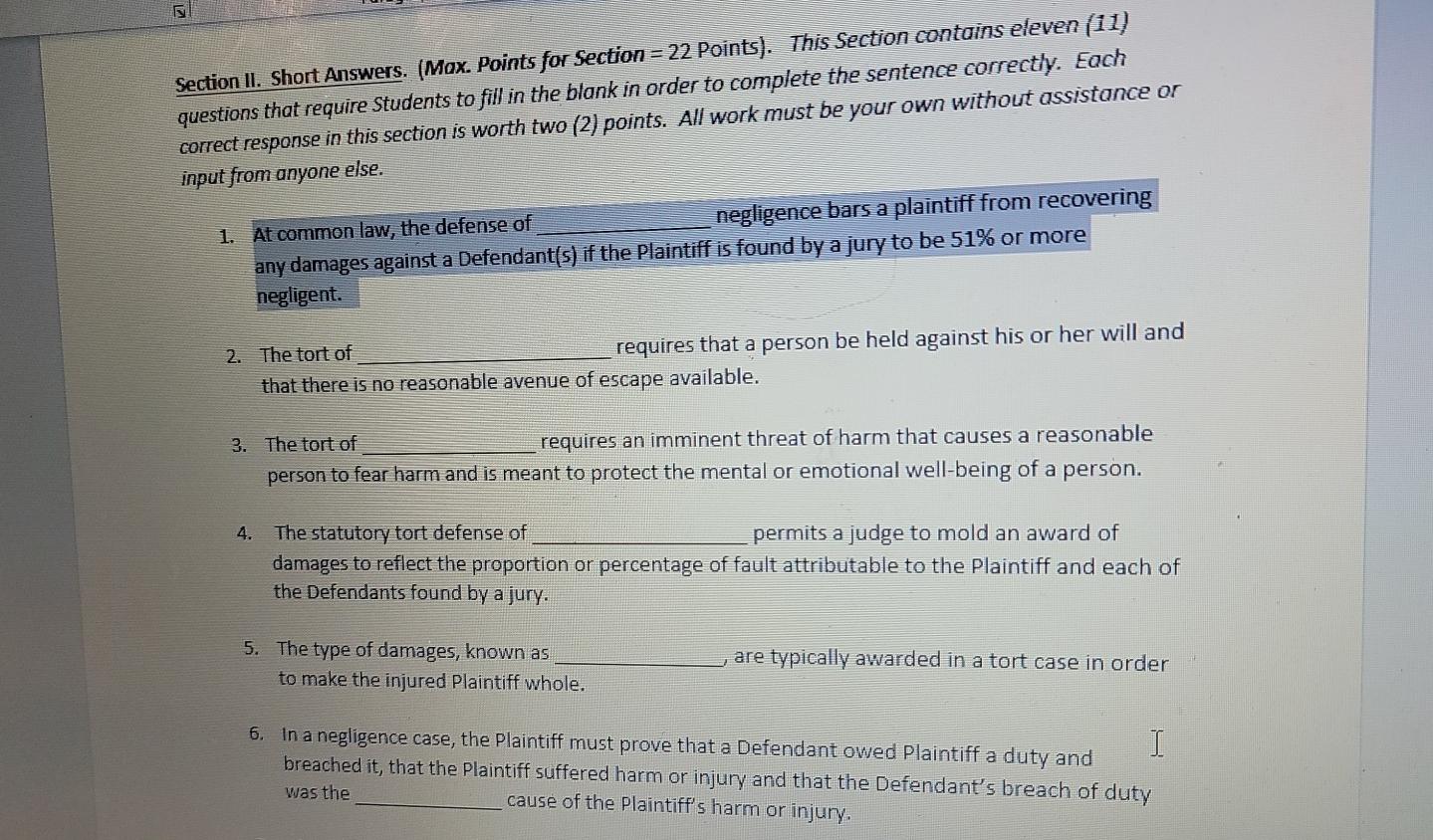
Section II. Short Answers. (Max. Points for Section = 22 Points). This Section contains eleven (11) questions that require Students to fill in the blank in order to complete the sentence correctly. Each correct response in this section is worth two (2) points. All work must be your own without assistance or input from anyone else. 1. At common law, the defense of negligence bars a plaintiff from recovering any damages against a Defendant(s) if the plaintiff is found by a jury to be 51% or more negligent. 2. The tort of requires that a person be held against his or her will and that there is no reasonable avenue of escape available. 3. The tort of requires an imminent threat of harm that causes a reasonable person to fear harm and is meant to protect the mental or emotional well-being of a person. 4. The statutory tort defense of permits a judge to mold an award of damages to reflect the proportion or percentage of fault attributable to the plaintiff and each of the Defendants found by a jury. 5. The type of damages, known as to make the injured Plaintiff whole. are typically awarded in a tort case in order I 6. In a negligence case, the plaintiff must prove that a Defendant owed Plaintiff a duty and breached it, that the plaintiff suffered harm or injury and that the Defendant's breach of duty was the cause of the plaintiff's harm or injury
Step by Step Solution
There are 3 Steps involved in it
Certainly Here are the answers to the questions based on common legal principles At common law the d... View full answer

Get step-by-step solutions from verified subject matter experts
 Study Help