







Question: Section Two Directions: Read the facts fromWriting Assignment #1 in Appendix B in the Workbook.Based on your reading of Chapter 8 in Statsky, list 5
Section Two
Directions:Read the facts fromWriting Assignment #1 in Appendix B in the Workbook.Based on your reading of Chapter 8 in Statsky, list 5 facts that you consider to be of importance. Particularizeany oneof those facts.
Review fact particularization beginning on Pg. 371 of Statsky, prepare and return the list of questions regarding a single fact.
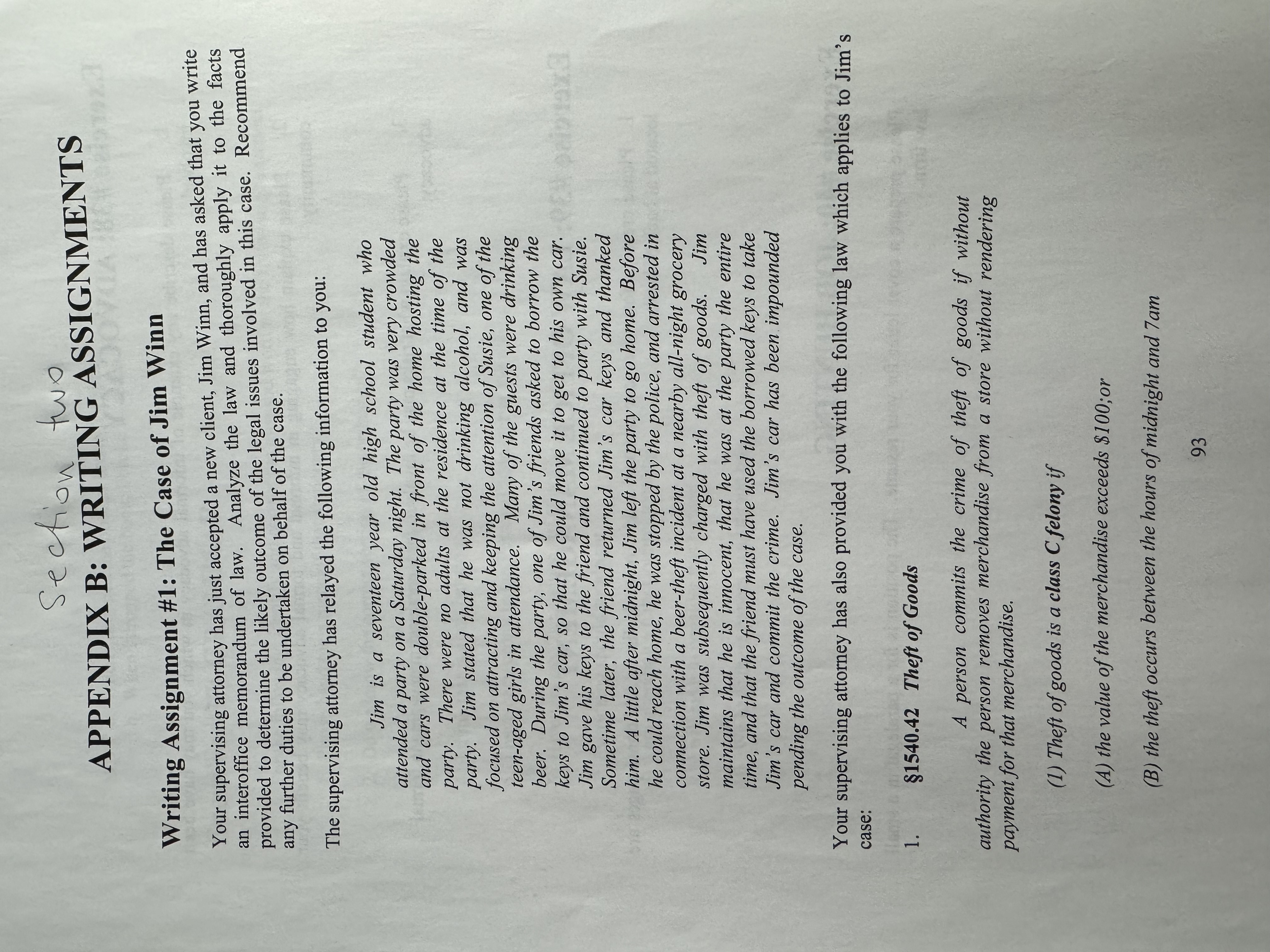
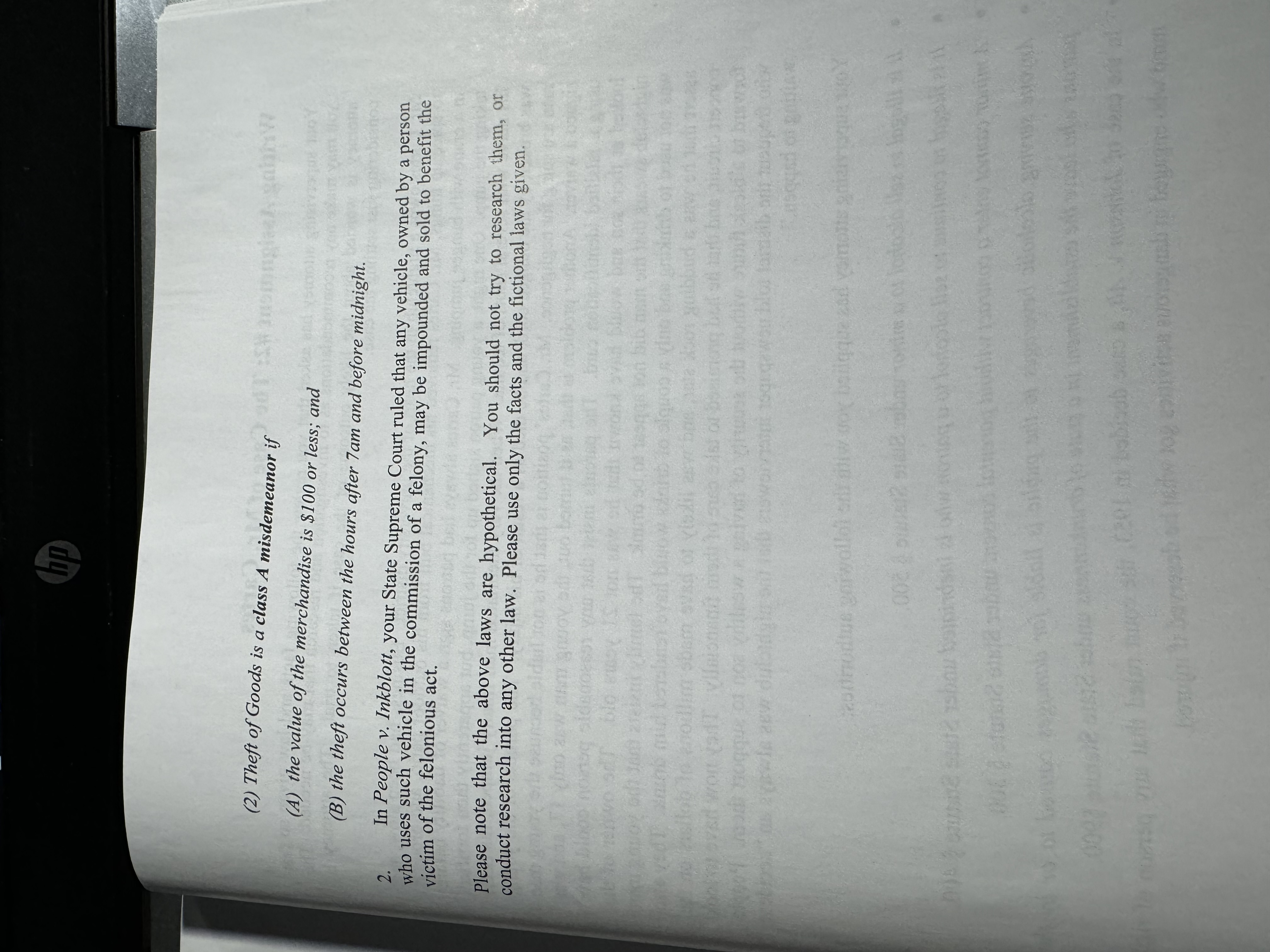
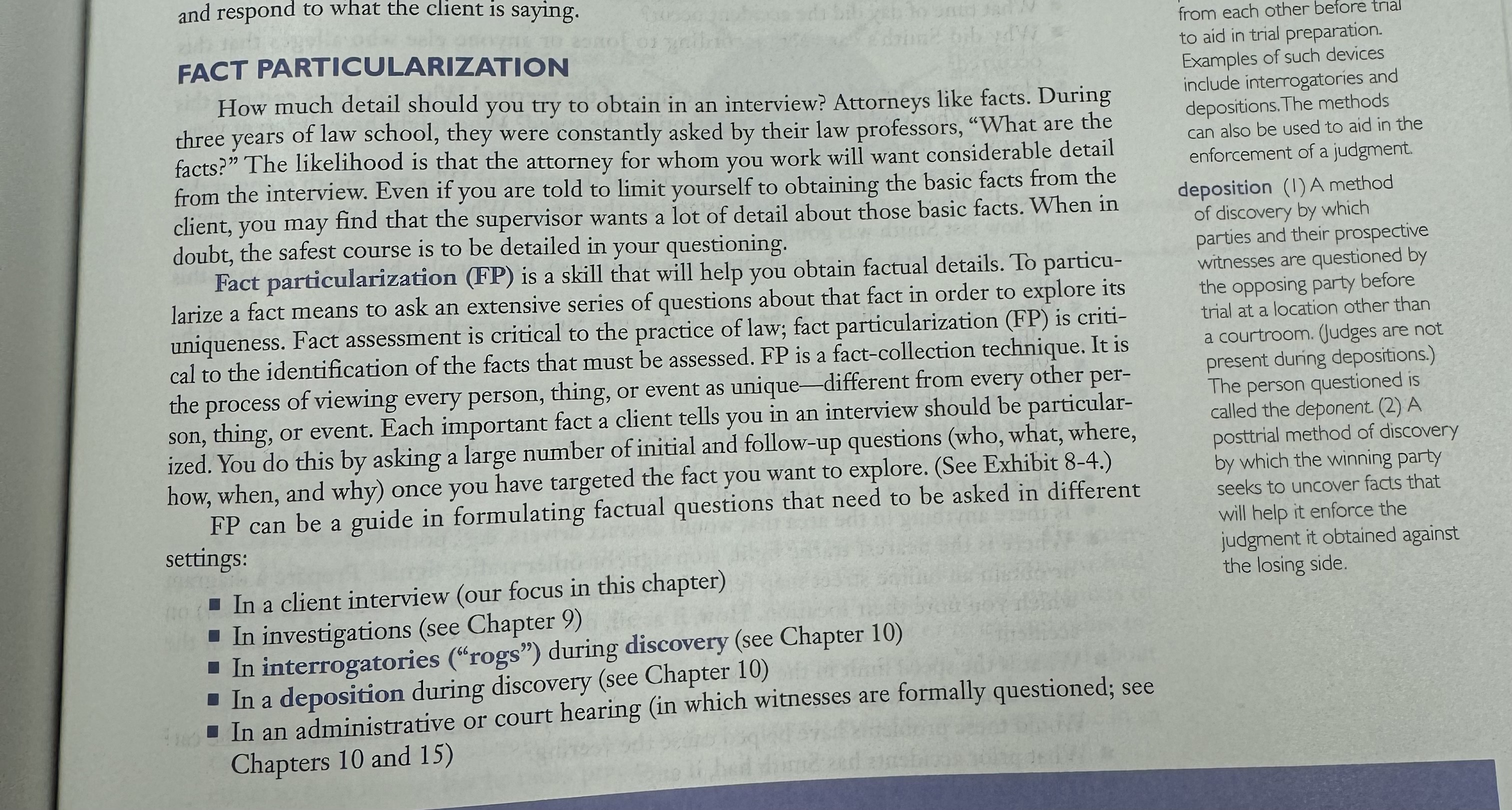
section two APPENDIX B: WRITING ASSIGNMENTS Writing Assignment #1: The Case of Jim Winn Your supervising attorney has just accepted a new client, Jim Winn, and has asked that you write an interoffice memorandum of law. Analyze the law and thoroughly apply it to the facts provided to determine the likely outcome of the legal issues involved in this case. Recommend any further duties to be undertaken on behalf of the case. The supervising attorney has relayed the following information to you: Jim is a seventeen year old high school student who attended a party on a Saturday night. The party was very crowded and cars were double-parked in front of the home hosting the party. There were no adults at the residence at the time of the party. Jim stated that he was not drinking alcohol, and was focused on attracting and keeping the attention of Susie, one of the teen-aged girls in attendance. Many of the guests were drinking beer. During the party, one of Jim's friends asked to borrow the keys to Jim's car, so that he could move it to get to his own car. Jim gave his keys to the friend and continued to party with Susie. Sometime later, the friend returned Jim's car keys and thanked him. A little after midnight, Jim left the party to go home. Before he could reach home, he was stopped by the police, and arrested in connection with a beer-theft incident at a nearby all-night grocery store. Jim was subsequently charged with theft of goods. Jim maintains that he is innocent, that he was at the party the entire time, and that the friend must have used the borrowed keys to take Jim's car and commit the crime. Jim's car has been impounded pending the outcome of the case. Your supervising attorney has also provided you with the following law which applies to Jim's case: 1. $1540.42 Theft of Goods A person commits the crime of theft of goods if without authority the person removes merchandise from a store without rendering payment for that merchandise. (1) Theft of goods is a class C felony if (A) the value of the merchandise exceeds $100; or (B) the theft occurs between the hours of midnight and 7am 93(2) Theft of Goods is a class A misdemeanor if (A) the value of the merchandise is $100 or less; and (B) the theft occurs between the hours after 7am and before midnight. 2 . In People v. Inkblott, your State Supreme Court ruled that any vehicle, owned by a person who uses such vehicle in the commission of a felony, may be impounded and sold to benefit the victim of the felonious act. Please note that the above laws are hypothetical. You should not try to research them, or conduct research into any other law. Please use only the facts and the fictional laws given. Soprodive garwollat any allwe got baliqque cord vomouts edieplaque wroxand respond to what the client is saying. from each other before trial FACT PARTICULARIZATION to aid in trial preparation. Examples of such devices How much detail should you try to obtain in an interview? Attorneys like facts. During include interrogatories and three years of law school, they were constantly asked by their law professors, "What are the depositions. The methods facts?" The likelihood is that the attorney for whom you work will want considerable detail can also be used to aid in the from the interview. Even if you are told to limit yourself to obtaining the basic facts from the enforcement of a judgment. client, you may find that the supervisor wants a lot of detail about those basic facts. When in deposition (1) A method doubt, the safest course is to be detailed in your questioning. of discovery by which Fact particularization (FP) is a skill that will help you obtain factual details. To particu- parties and their prospective witnesses are questioned by larize a fact means to ask an extensive series of questions about that fact in order to explore its the opposing party before uniqueness. Fact assessment is critical to the practice of law; fact particularization (FP) is criti- trial at a location other than cal to the identification of the facts that must be assessed. FP is a fact-collection technique. It is a courtroom. (Judges are not the process of viewing every person, thing, or event as unique-different from every other per- present during depositions.) son, thing, or event. Each important fact a client tells you in an interview should be particular- The person questioned is ized. You do this by asking a large number of initial and follow-up questions (who, what, where, called the deponent. (2) A posttrial method of discovery how, when, and why) once you have targeted the fact you want to explore. (See Exhibit 8-4.) by which the winning party FP can be a guide in formulating factual questions that need to be asked in different seeks to uncover facts that settings : will help it enforce the judgment it obtained against In a client interview (our focus in this chapter) the losing side. In investigations (see Chapter 9) In interrogatories ("rogs") during discovery (see Chapter 10) " In a deposition during discovery (see Chapter 10) In an administrative or court hearing (in which witnesses are formally questioned; see Chapters 10 and 15)and respond to what the client is saying. from each other before trial FACT PARTICULARIZATION to aid in trial preparation. Examples of such devices How much detail should you try to obtain in an interview? Attorneys like facts. During include interrogatories and three years of law school, they were constantly asked by their law professors, "What are the depositions. The methods facts?" The likelihood is that the attorney for whom you work will want considerable detail can also be used to aid in the from the interview. Even if you are told to limit yourself to obtaining the basic facts from the enforcement of a judgment. client, you may find that the supervisor wants a lot of detail about those basic facts. When in deposition (1) A method doubt, the safest course is to be detailed in your questioning. of discovery by which Fact particularization (FP) is a skill that will help you obtain factual details. To particu- parties and their prospective witnesses are questioned by larize a fact means to ask an extensive series of questions about that fact in order to explore its the opposing party before uniqueness. Fact assessment is critical to the practice of law; fact particularization (FP) is criti- trial at a location other than cal to the identification of the facts that must be assessed. FP is a fact-collection technique. It is a courtroom. (Judges are not the process of viewing every person, thing, or event as unique-different from every other per- present during depositions.) son, thing, or event. Each important fact a client tells you in an interview should be particular- The person questioned is ized. You do this by asking a large number of initial and follow-up questions (who, what, where, called the deponent. (2) A posttrial method of discovery how, when, and why) once you have targeted the fact you want to explore. (See Exhibit 8-4.) by which the winning party FP can be a guide in formulating factual questions that need to be asked in different seeks to uncover facts that settings : will help it enforce the judgment it obtained against In a client interview (our focus in this chapter) the losing side. In investigations (see Chapter 9) In interrogatories ("rogs") during discovery (see Chapter 10) " In a deposition during discovery (see Chapter 10) In an administrative or court hearing (in which witnesses are formally questioned; see Chapters 10 and 15)
Step by Step Solution
There are 3 Steps involved in it

Get step-by-step solutions from verified subject matter experts
 Study Help