







Question: Security Algorithm Example challenge-and-response protocol: Assume A and B share a secret key K for a symmetric encryption algorithm using 124 bit blocks and no
Security Algorithm
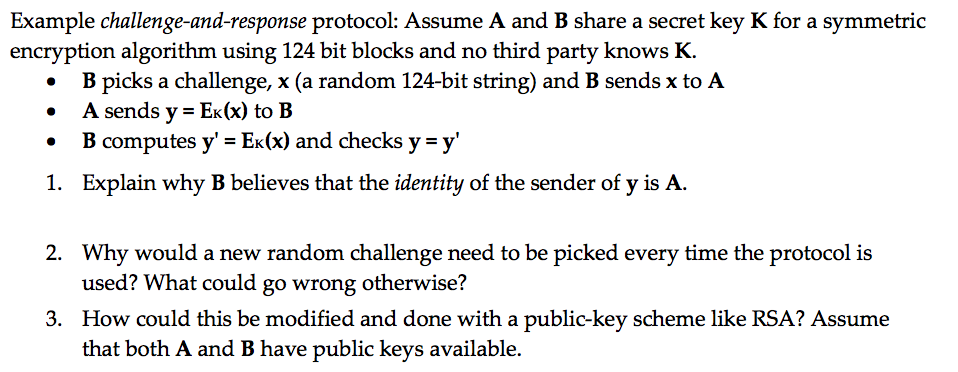
Example challenge-and-response protocol: Assume A and B share a secret key K for a symmetric encryption algorithm using 124 bit blocks and no third party knows K. B picks a challenge, x (a random 124-bit string) and B sends x to A A sends y = E_k(x) to B B computes y' = E_k(x) and checks y = y' Explain why B believes that the identity of the sender of y is A. Why would a new random challenge need to be picked every time the protocol is used? What could go wrong otherwise? How could this be modified and done with a public-key scheme like RSA? Assume that both A and B have public keys available
Step by Step Solution
There are 3 Steps involved in it
1 Expert Approved Answer
Step: 1 Unlock

Question Has Been Solved by an Expert!
Get step-by-step solutions from verified subject matter experts
Step: 2 Unlock
Step: 3 Unlock
 Study Help