







Question: See attached. 4. Question #4 Score (= =+ /3 FRED work: On Inflation Expectations In Week 5 we introduced the concept of price and inflation
See attached.
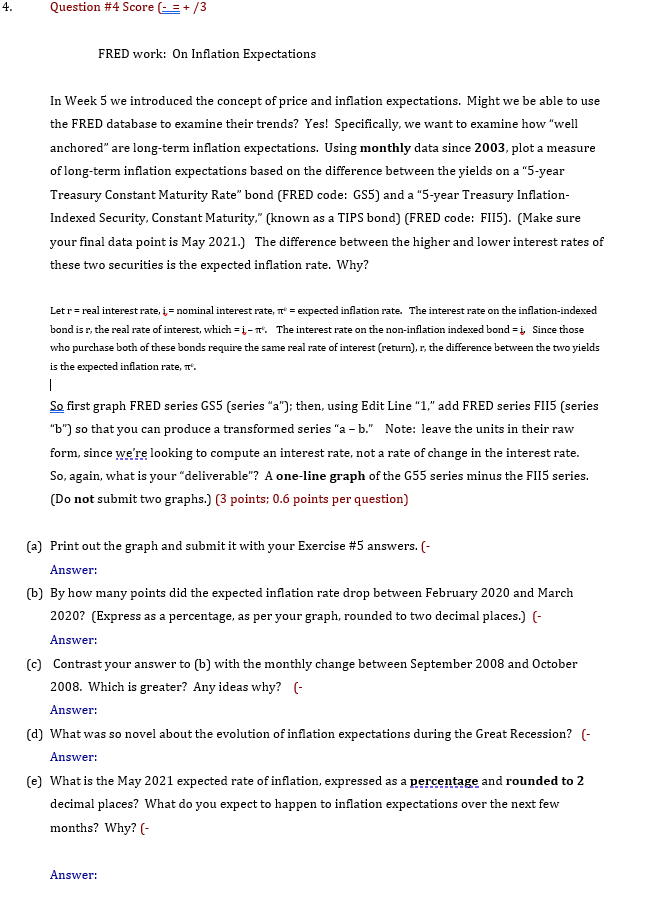
4. Question #4 Score (= =+ /3 FRED work: On Inflation Expectations In Week 5 we introduced the concept of price and inflation expectations. Might we be able to use the FRED database to examine their trends? Yes! Specifically, we want to examine how "well anchored" are long-term inflation expectations. Using monthly data since 2003, plot a measure of long-term inflation expectations based on the difference between the yields on a "5-year Treasury Constant Maturity Rate" bond (FRED code: GS5) and a "5-year Treasury Inflation- Indexed Security, Constant Maturity," (known as a TIPS bond) (FRED code: FIIS). (Make sure your final data point is May 2021.) The difference between the higher and lower interest rates of these two securities is the expected inflation rate. Why? Let r = real interest rate, i = nominal interest rate, " = expected inflation rate. The interest rate on the inflation-indexed bond is r, the real rate of interest, which =i- '. The interest rate on the non-inflation indexed bond = i Since those who purchase both of these bonds require the same real rate of interest (return), n the difference between the two yields is the expected inflation rate, I'. So first graph FRED series GS5 (series "a"); then, using Edit Line "1," add FRED series FII5 (series "b") so that you can produce a transformed series "a - b." Note: leave the units in their raw form, since we're looking to compute an interest rate, not a rate of change in the interest rate. So, again, what is your "deliverable"? A one-line graph of the G55 series minus the FIIS series. (Do not submit two graphs.) (3 points; 0.6 points per question) (a) Print out the graph and submit it with your Exercise #5 answers. (- Answer: (b) By how many points did the expected inflation rate drop between February 2020 and March 2020? (Express as a percentage, as per your graph, rounded to two decimal places.) (- Answer: Contrast your answer to (b) with the monthly change between September 2008 and October 2008. Which is greater? Any ideas why? (- Answer: (d) What was so novel about the evolution of inflation expectations during the Great Recession? (- Answer: (e) What is the May 2021 expected rate of inflation, expressed as a percentage and rounded to 2 decimal places? What do you expect to happen to inflation expectations over the next few months? Why? (
Step by Step Solution
There are 3 Steps involved in it

Get step-by-step solutions from verified subject matter experts
 Study Help