Question: See attached document for reference. State and discuss four lessons learned from Illustration Capsule 12.2 - The Goldman Sachs case, based on the materials in
See attached document for reference.
State and discuss four lessons learned from Illustration Capsule 12.2 - The Goldman Sachs case, based on the materials in the assigned chapter.
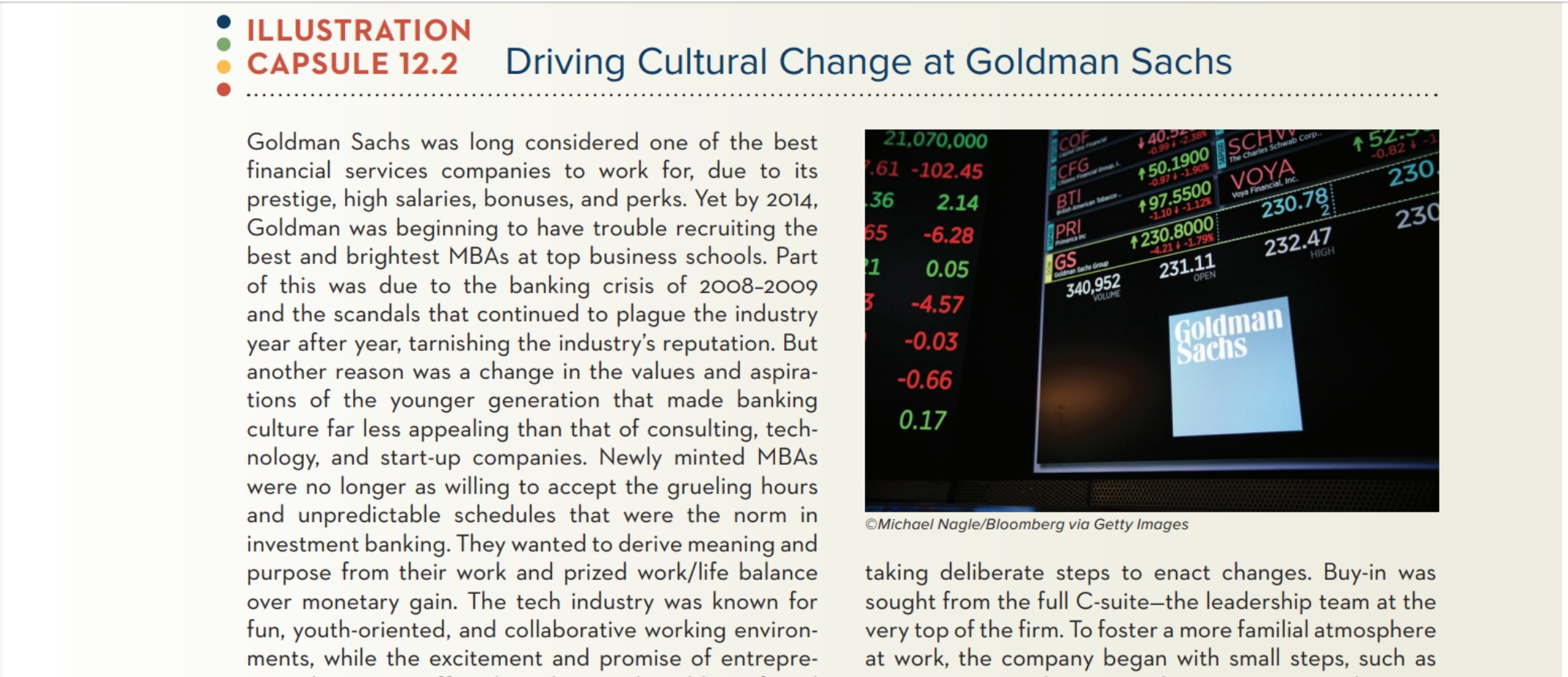
ILLUSTRATION CAPSULE 12.2 Driving Cultural Change at Goldman Sachs COF -0.997-2380 The Charles Schwab Corp. CFG. 152. -0.821-1 230 -0.97 -1.90% 36 Voya Financial, Inc. BTL 40.5a 450.1900 SCHN 197.5500 VOYA 1.10. -1.128 1 230.8000 230.78 -4.21 -1.79% 231.11 232.47 OPEN HIGH 230 21,070,000 61 -102.45 2.14 65 -6.28 1 0.05 3 -4.57 -0.03 -0.66 PRI GS 340,952 Gran Sachs Group VOLUME Goldman Sachs Goldman Sachs was long considered one of the best financial services companies to work for, due to its prestige, high salaries, bonuses, and perks. Yet by 2014, Goldman was beginning to have trouble recruiting the best and brightest MBAs at top business schools. Part of this was due to the banking crisis of 2008-2009 and the scandals that continued to plague the industry year after year, tarnishing the industry's reputation. But another reason was a change in the values and aspira- tions of the younger generation that made banking culture far less appealing than that of consulting, tech- nology, and start-up companies. Newly minted MBAs were no longer as willing to accept the grueling hours and unpredictable schedules that were the norm in investment banking. They wanted to derive meaning and purpose from their work and prized work/life balance over monetary gain. The tech industry was known for fun, youth-oriented, and collaborative working environ- ments, while the excitement and promise of entrepre- 0.17 Michael Nagle/Bloomberg via Getty Images taking deliberate steps to enact changes. Buy-in was sought from the full C-suite-the leadership team at the very top of the firm. To foster a more familial atmosphere at work, the company began with small steps, such as neurial ventures offered much appeal. Goldman found itself competing with Amazon, Google, Microsoft, and Facebook as well as with start-ups for the best young talent-and losing out. Goldman's problem was compounded by the fact that its culture was regarded as stuffy and stodgy-qualities not likely to appeal to the young, particularly when con- trasted with the hip cultures of tech and start-up com- panies. Further, it had always been slow-moving in terms of implementing organizational change. Recognizing the problem, the leadership at Goldman attempted to pivot sharply, asking its executives to think of Goldman as a tech company, complete with the associated values. The Chief Learning Office at Goldman Sachs was put in charge of the effort to transform its culture and began setting up sports leagues and encouraging regular team happy hours. More significantly, they instituted more employee-friendly work schedules and policies, more accommodating of work-life balance. They liberalized their parental leave policies, provided greater flexibility in work schedules, and enacted protections for interns and junior bankers designed to limit their working hours. They also overhauled their performance review and pro- motion systems as well as their recruiting practices and policies regarding diversity. Although cultural change never comes swiftly, by 2017 results were apparent even to outside observers. That year, the career website Vault.com named Goldman Sachs as the best banking firm to work for, noting that when it came to workplace policies, Goldman led the industry









 Study Help