







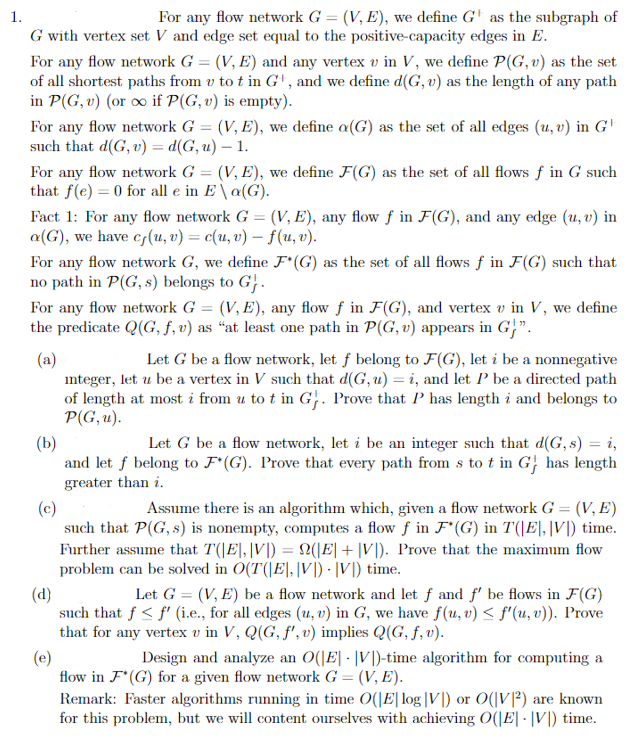
Question: * * SEE ATTACHED IMAGE FOR QUESTION PARTS * * For any flow network G = ( V , E ) , we define G
SEE ATTACHED IMAGE FOR QUESTION PARTS
For any flow network we define as the subgraph of
with vertex set and edge set equal to the positivecapacity edges in
For any flow network and any vertex in we define as the set
of all shortest paths from to in and we define as the length of any path
in or if is empty
For any flow network we define as the set of all edges in
such that
For any flow network we define as the set of all flows in such
that for all in
Fact : For any flow network any flow in and any edge in
we have
For any flow network we define as the set of all flows in such that
no path in belongs to
For any flow network any flow in and vertex in we define
the predicate as at least one path in appears in
Step by Step Solution
There are 3 Steps involved in it
1 Expert Approved Answer
Step: 1 Unlock

Question Has Been Solved by an Expert!
Get step-by-step solutions from verified subject matter experts
Step: 2 Unlock
Step: 3 Unlock
 Study Help