







Question: See image below for question. 10.4. (The multinomial distribution) We generalize the binomial distribution: Suppose we have n independent and identical trials where each trial
See image below for question.
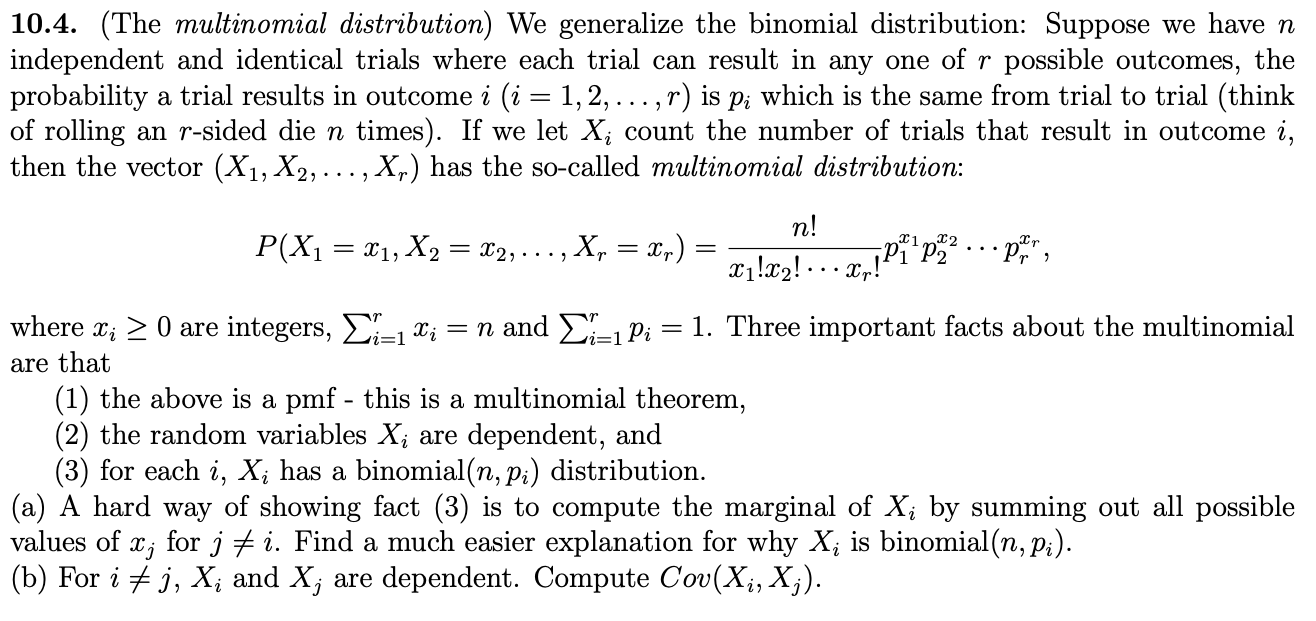
10.4. (The multinomial distribution) We generalize the binomial distribution: Suppose we have n independent and identical trials where each trial can result in any one of 5" possible outcomes, the probability a trial results in outcome i (i = 1,2,... ,r) is p,- which is the same from trial to trial (think of rolling an r-sided die 'n, times). If we let X, count the number of trials that result in outcome i, then the vector (X1,X2, . . . ,X,) has the socalled multinomial distribution: n! P(X1=$1,X2=1E2,...,XT=$r)= I I 371.1132n\" $1 $2 ... 1'\" $7.123]. p2 pr ? where cc,- 2 0 are integers, 2;, x,- = n and 217:1 p, = 1. Three important facts about the multinomial are that (l) the above is a pmf - this is a multinomial theorem, (2) the random variables X,- are dependent, and (3) for each 2', X, has a binomial(n,p,) distribution. (a) A hard way of showing fact (3) is to compute the marginal of X, by summing out all possible values of 9:,- for j 7 2'. Find a much easier explanation for why X, is binomial(n, 39,). (b) For i 5% j, X, and X,- are dependent. Compute Cov(X,-,X,-)
Step by Step Solution
There are 3 Steps involved in it

Get step-by-step solutions from verified subject matter experts
 Study Help