



Question: see question below Part 11: Case Questions (25 points) Please read the attached case (Flochem) and answer the following questions. 1. Suggest at least 3
see question below
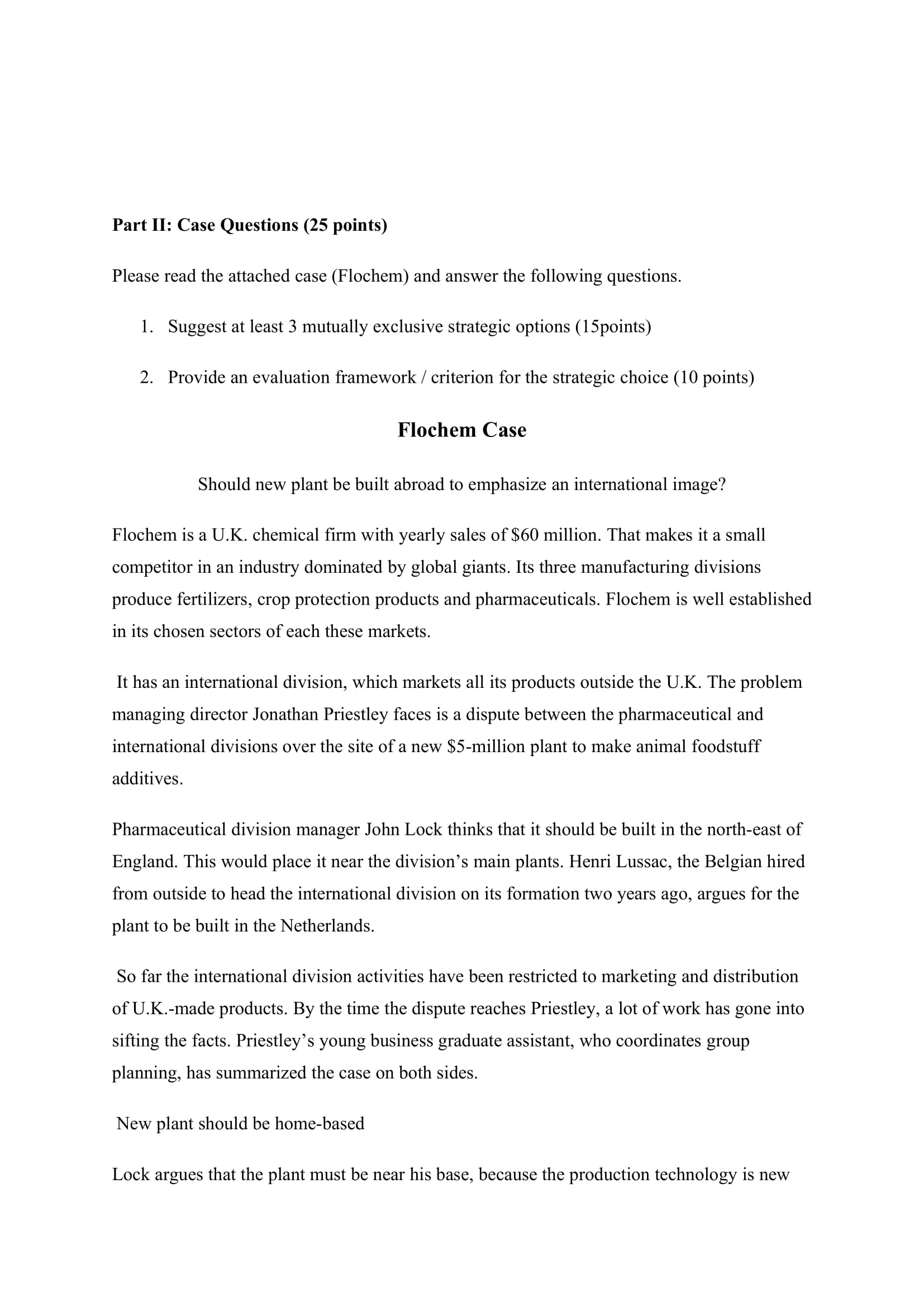
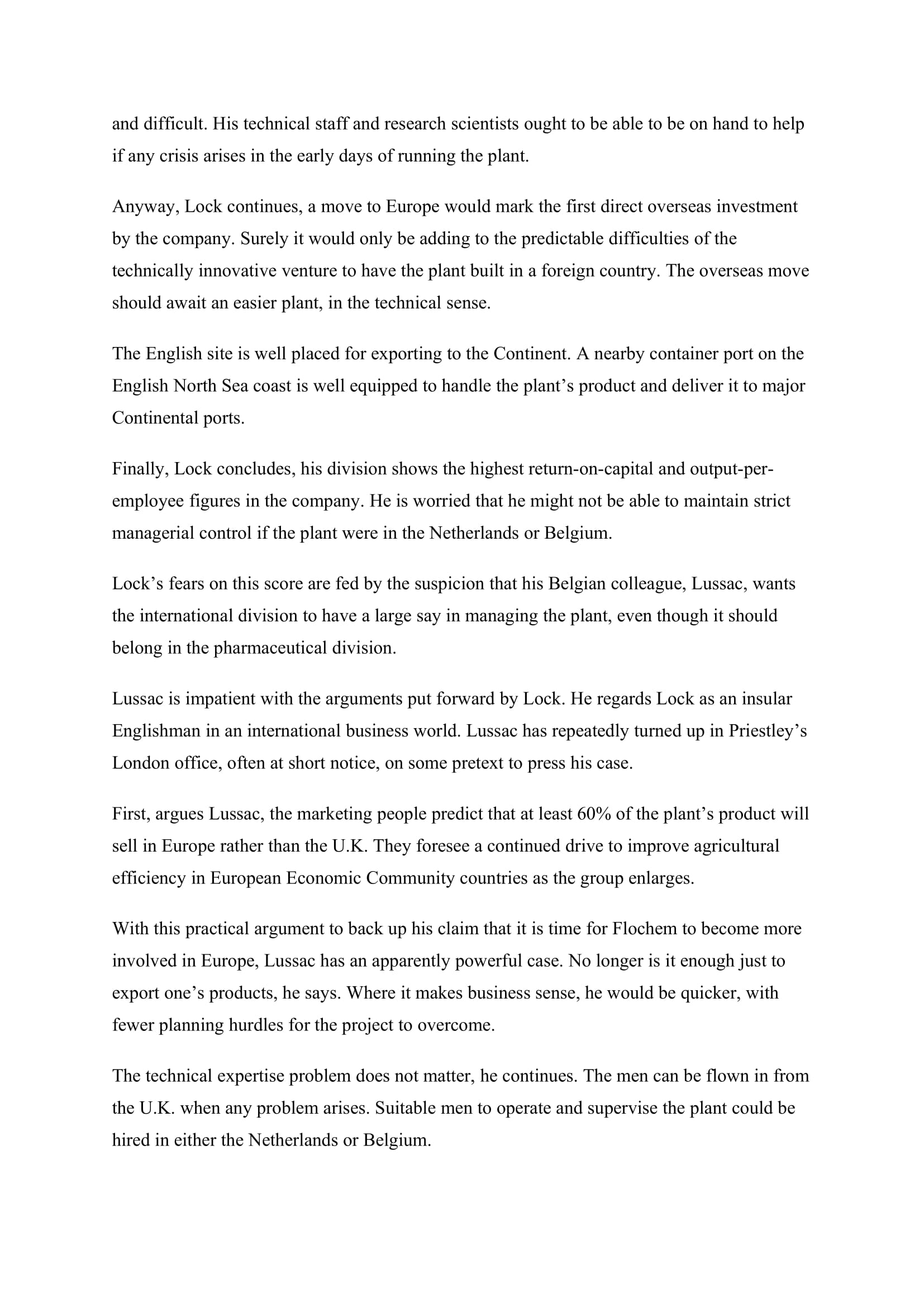
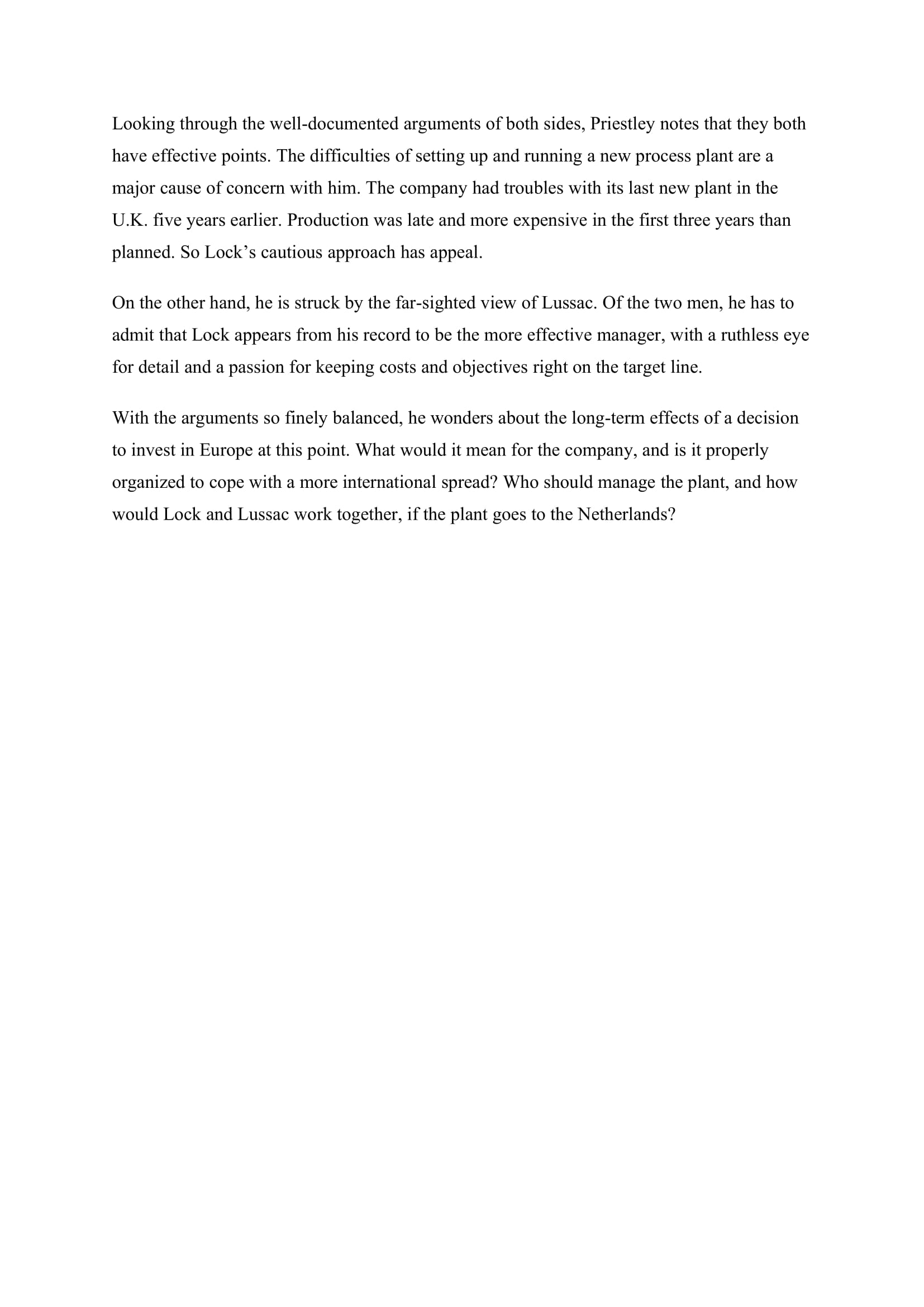
Part 11: Case Questions (25 points) Please read the attached case (Flochem) and answer the following questions. 1. Suggest at least 3 mutually exclusive strategic options (15points) 2. Provide an evaluation framework / criterion for the strategic choice (10 points) Flochem Case Should new plant be built abroad to emphasize an international image? Flochem is a UK. chemical rm with yearly sales of $60 million. That makes it a small competitor in an industry dominated by global giants. Its three manufacturing divisions produce fertilizers, crop protection products and pharmaceuticals. Flochem is well established in its chosen sectors of each these markets. It has an international division, which markets all its products outside the UK. The problem managing director Jonathan Priestley faces is a dispute between the pharmaceutical and international divisions over the site of a new SSS-million plant to make animal foodstuff additives. Pharmaceutical division manager John Lock thinks that it should be built in the northeast of England. This would place it near the division's main plants. Henri Lussac, the Belgian hired from outside to head the international division on its formation two years ago, argues for the plant to be built in the Netherlands. So far the international division activities have been restricted to marketing and distribution of U.K.-made products. By the time the diSpute reaches Priestley, a lot of work has gone into sifting the facts. Priestley's young business graduate assistant, who coordinates group planning, has Summarized the case on both sides. New plant should be home-based Lock argues that the plant must be near his base, because the production technology is new and difcult. His technical staff and research scientists ought to be able to be on hand to help if any crisis arises in the early days of running the plant. Anyway, Lock continues, a move to Europe would mark the rst direct overseas investment by the company. Surely it would only be adding to the predictable difculties of the technically innovative venture to have the plant built in a foreign country. The overseas move should await an easier plant, in the technical sense. The English site is well placed for exporting to the Continent. A nearby container port on the English North Sea coast is well equipped to handle the plant's product and deliver it to major Continental ports. Finally, Lock concludes, his division shows the highest return-oncapital and output-per- employee gures in the company. He is worried that he might not be able to maintain strict managerial control if the plant were in the Netherlands or Belgium. Lock's fears on this score are fed by the suspicion that his Belgian colleague, Lussac, wants the international division to have a large say in managing the plant, even though it should belong in the pharmaceutical division. Lussac is impatient with the arguments put forward by Lock. He regards Lock as an insular Englishman in an international business world. Lussac has repeatedly turned up in Priestley's London ofce, often at short notice, on some pretext to press his case. First, argues Lussac, the marketing people predict that at least 60% of the plant's product will sell in Europe rather than the UK. They foresee a continued drive to improve agricultural efciency in European Economic Community countries as the group enlarges. With this practical argument to back up his claim that it is time for Flochem to become more involved in Europe, Lussac has an apparently powerful case. No longer is it enough just to export one's products, he says. Where it makes business sense, he would be quicker, with fewer planning hurdles for the project to overcome. The technical expertise problem does not matter, he continues. The men can be own in from the UK. when any problem arises. Suitable men to operate and supervise the plant could be hired in either the Netherlands or Belgium. Looking through the well-documented arguments of both sides, Priestley notes that they both have effective points. The difficulties of setting up and running a new process plant are a major cause of concern with him. The company had troubles with its last new plant in the U.K. five years earlier. Production was late and more expensive in the first three years than planned. So Lock's cautious approach has appeal. On the other hand, he is struck by the far-sighted view of Lussac. Of the two men, he has to admit that Lock appears from his record to be the more effective manager, with a ruthless eye for detail and a passion for keeping costs and objectives right on the target line. With the arguments so finely balanced, he wonders about the long-term effects of a decision to invest in Europe at this point. What would it mean for the company, and is it properly organized to cope with a more international spread? Who should manage the plant, and how would Lock and Lussac work together, if the plant goes to the Netherlands
Step by Step Solution
There are 3 Steps involved in it

Get step-by-step solutions from verified subject matter experts