







Question: see the case below Group Case Assignment Part 3: TLG Solutions One Year Later Chapter 11: Team Interventions In Part 3 of this case we

see the case below
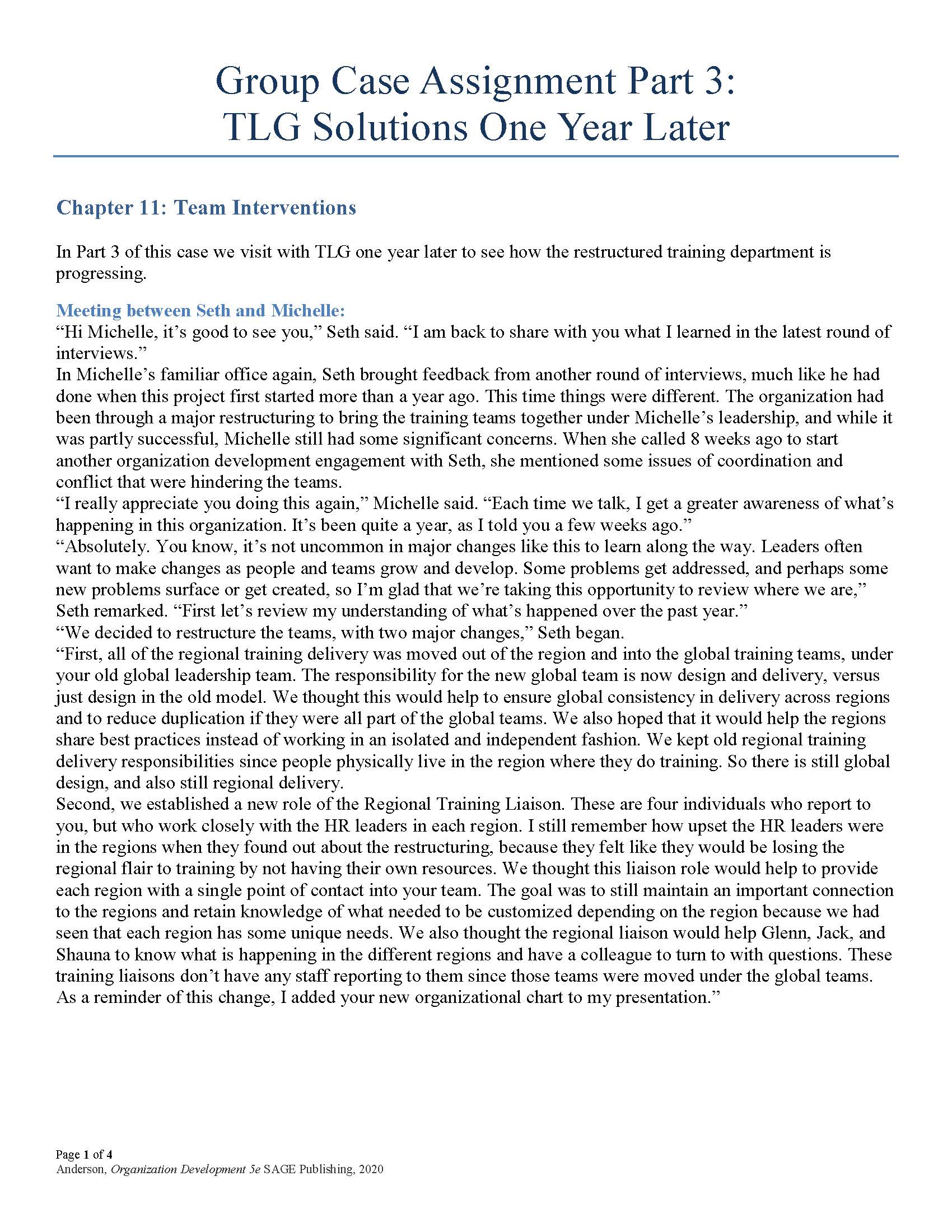
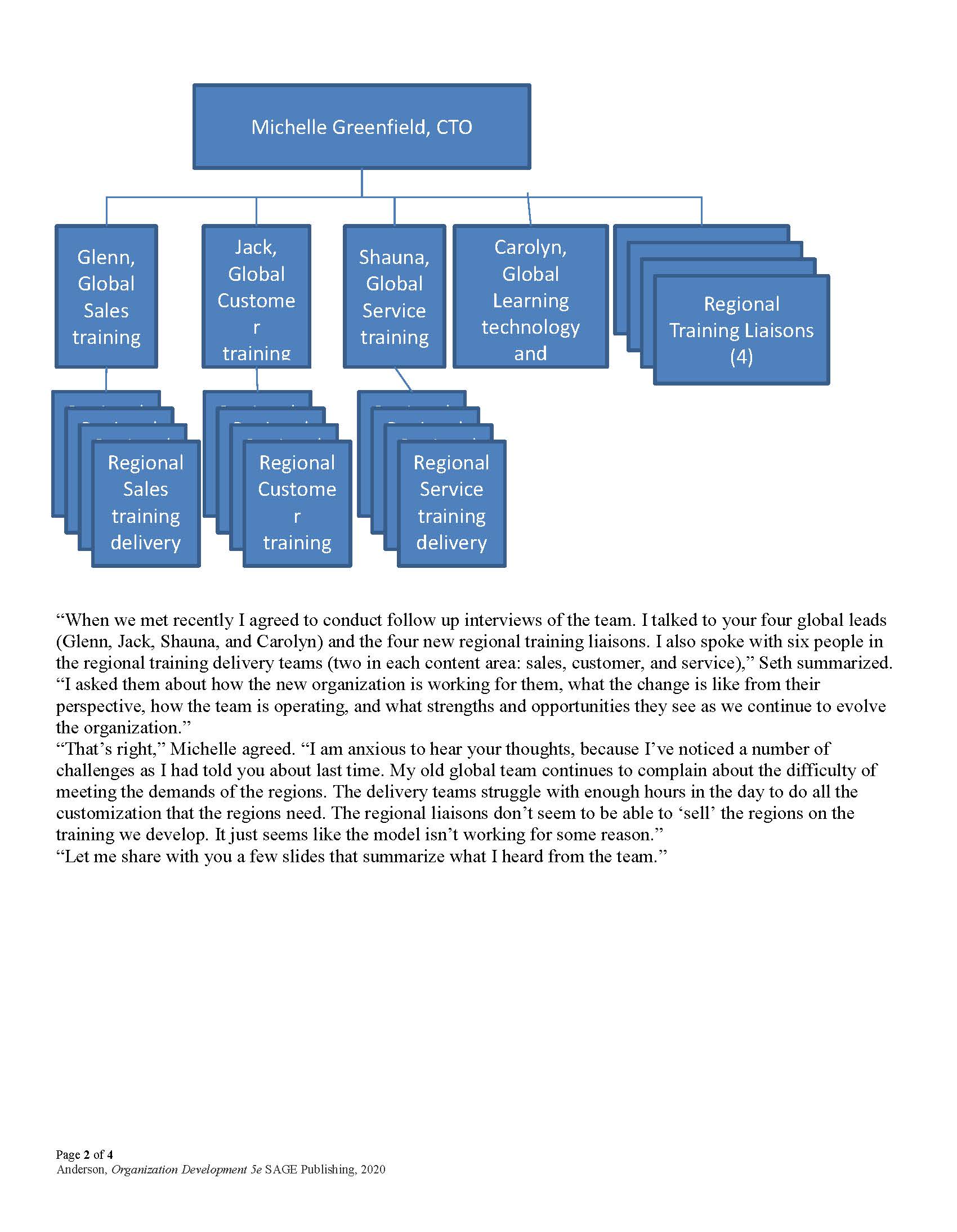
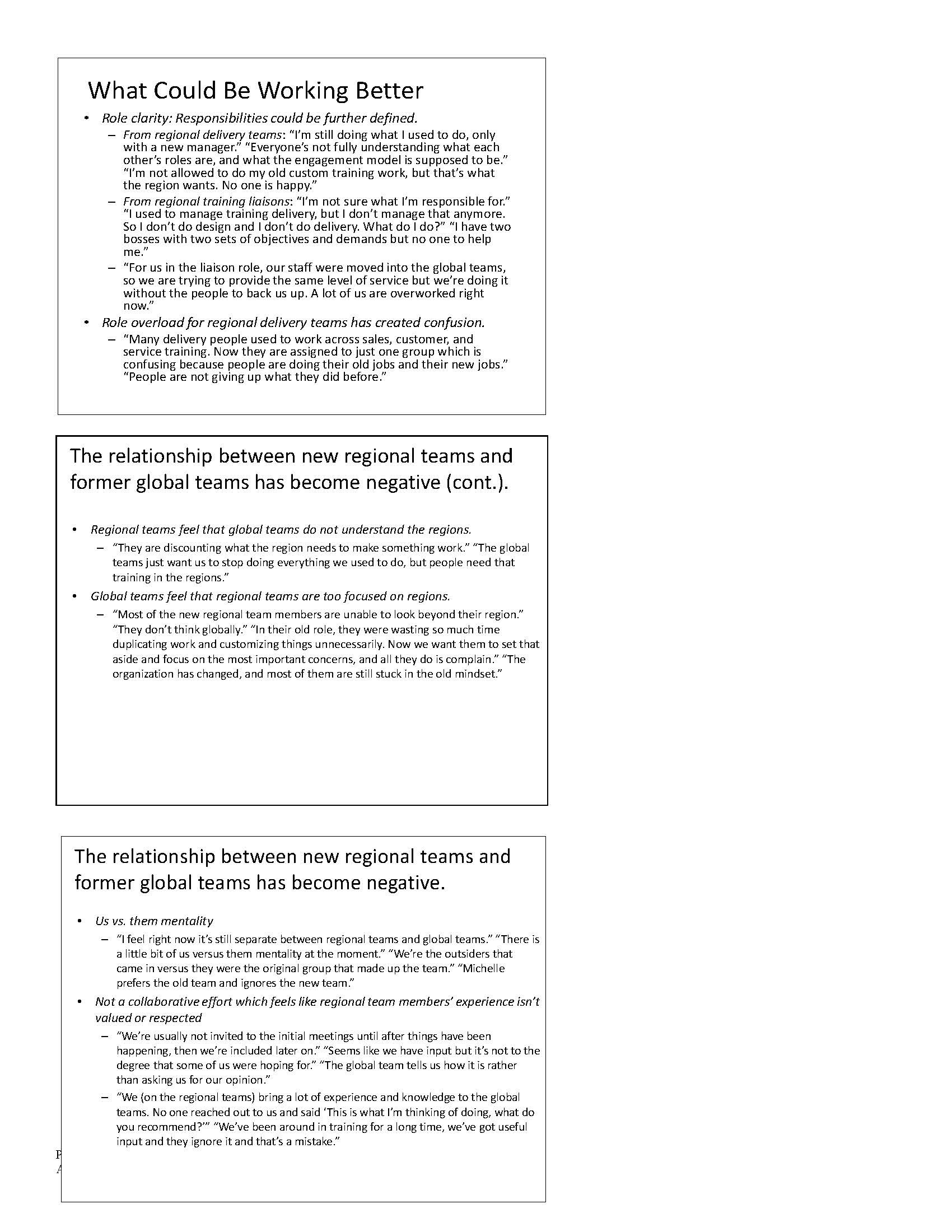

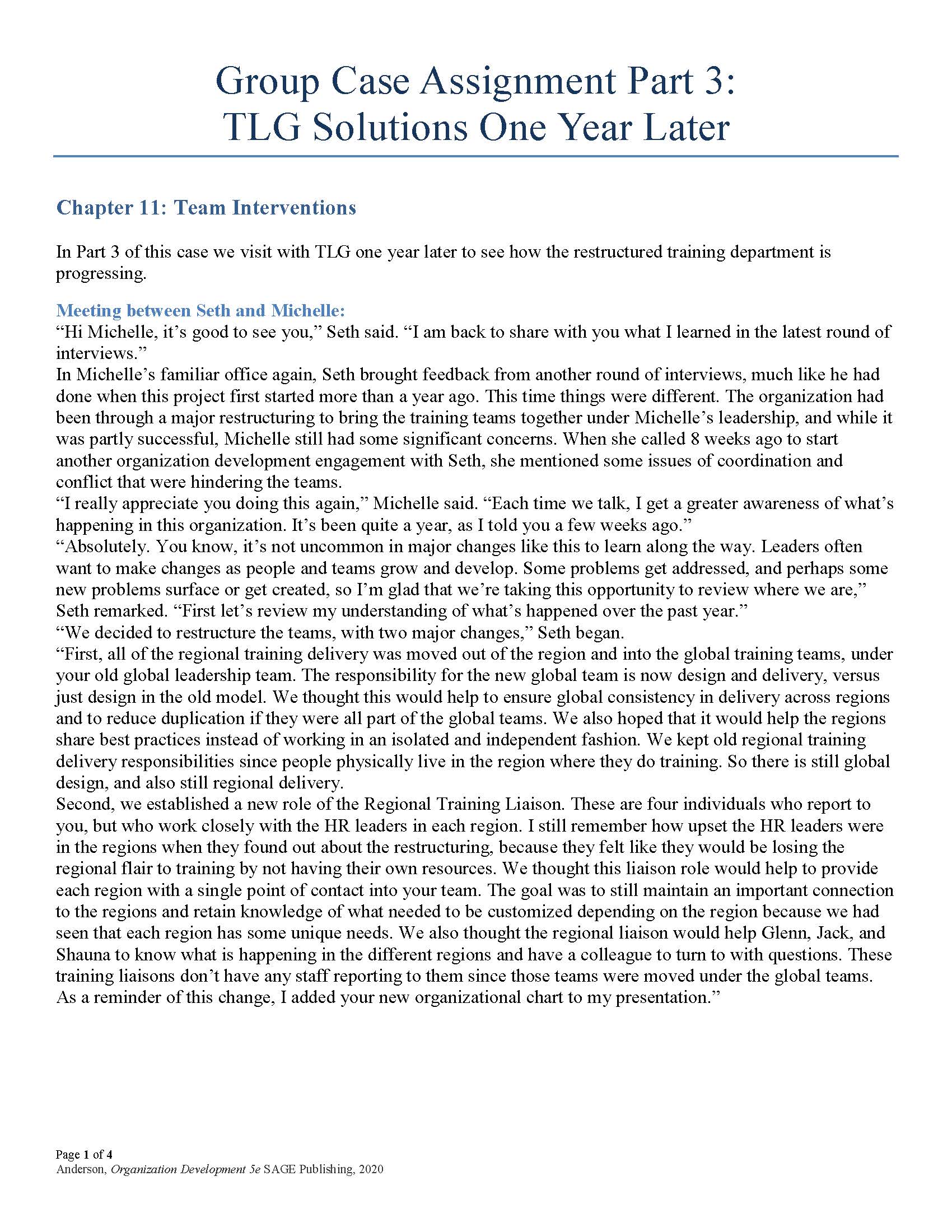
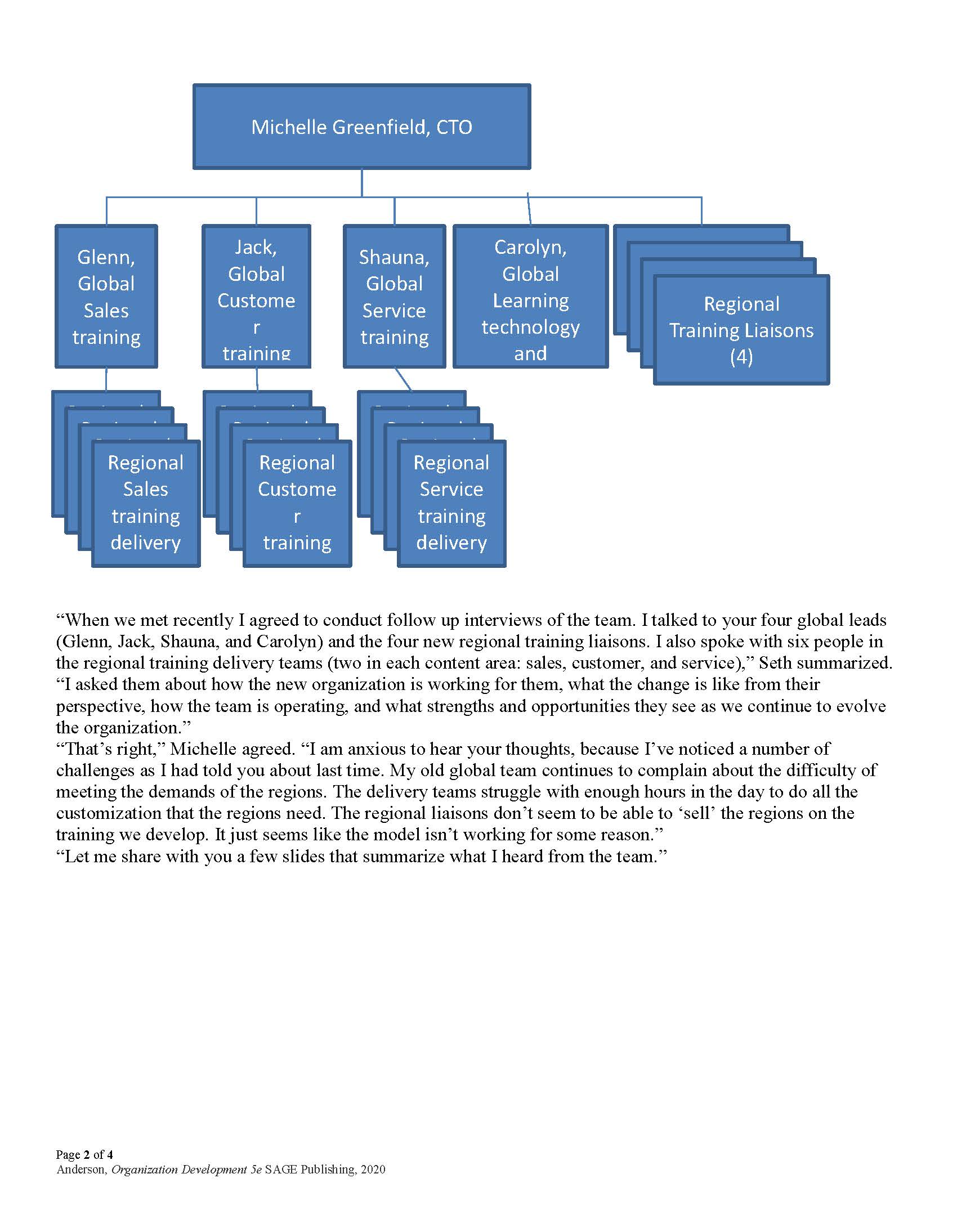
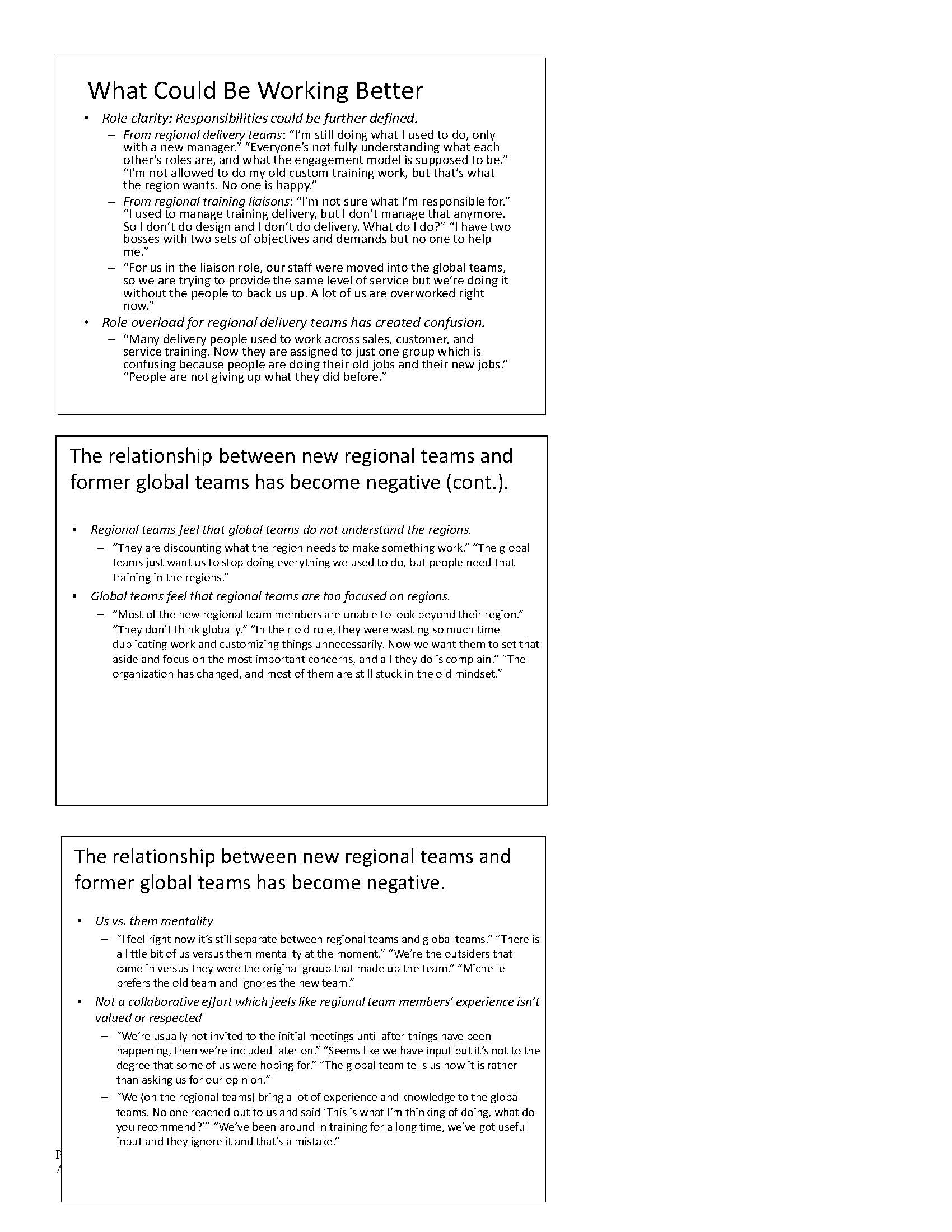
Group Case Assignment Part 3: TLG Solutions One Year Later Chapter 11: Team Interventions In Part 3 of this case we visit with TLG one vear later to see how the restructured training department is progressing. Meeting between Seth and Michelle: \"Hi Michelle, it's good to see you,\" Seth said. \"I am back to share with you what I learned in the latest round of interviews.\" In Michelle's familiar office again, Seth brought feedback from another round of interviews, much like he had done when this project first started more than a year ago. This time things were different. The organization had been through a major restructuring to bring the training teams together under Michelle's leadership, and while it was partly successful, Michelle still had some significant concerns. When she called 8 weeks ago to start another organization development engagement with Seth, she mentioned some issues of coordination and conflict that were hindering the teams. \"I really appreciate you doing this again,\" Michelle said. \"Each time we talk, [ get a greater awareness of what's happening in this organization. It's been quite a year, as I told you a few weeks ago.\" \"Absolutely. You know, it's not uncommon in major changes like this to learn along the way. Leaders often want to make changes as people and teams grow and develop. Some problems get addressed, and perhaps some new problems surface or get created, so I'm glad that we're taking this opportunity to review where we are,\" Seth remarked. \"First let's review my understanding of what's happened over the past year.\" \"We decided to restructure the teams, with two major changes,\" Seth began. \"First, all of the regional training delivery was moved out of the region and into the global training teams, under vour old global leadership team. The responsibility for the new global team is now design and delivery, versus just design in the old model. We thought this would help to ensure global consistency in delivery across regions and to reduce duplication if they were all part of the global teams. We also hoped that it would help the regions share best practices instead of working in an isolated and independent fashion. We kept old regional training delivery responsibilities since people physically live in the region where they do training. So there is still global design, and also still regional delivery. Second, we established a new role of the Regional Training Liaison. These are four individuals who report to vou, but who work closely with the HR leaders in each region. I still remember how upset the HR leaders were in the regions when they found out about the restructuring, because they felt like they would be losing the regional flair to training by not having their own resources. We thought this liaison role would help to provide each region with a single point of contact into your team. The goal was to still maintain an important connection to the regions and retain knowledge of what needed to be customized depending on the region because we had seen that each region has some unique needs. We also thought the regional liaison would help Glenn, Jack, and Shauna to know what is happening in the different regions and have a colleague to turn to with questions. These training liaisons don't have any staff reporting to them since those teams were moved under the global teams. As a reminder of this change, I added your new organizational chart to my presentation.\" Page 1 of 4 Anderson, Organization Development Se SAGE Publishing, 2020 Michelle Greenfield, CTO Jack, Shauna, Carolyn, Glenn, Global Global Global Global Regional Sales Custome Service Learning training training technology Training Liaisons training and (4) Regional Regional Regional Sales Custome Service training training delivery training delivery "When we met recently I agreed to conduct follow up interviews of the team. I talked to your four global leads (Glenn, Jack, Shauna, and Carolyn) and the four new regional training liaisons. I also spoke with six people in the regional training delivery teams (two in each content area: sales, customer, and service)," Seth summarized. "I asked them about how the new organization is working for them, what the change is like from their perspective, how the team is operating, and what strengths and opportunities they see as we continue to evolve the organization." 'That's right," Michelle agreed. "I am anxious to hear your thoughts, because I've noticed a number of challenges as I had told you about last time. My old global team continues to complain about the difficulty of meeting the demands of the regions. The delivery teams struggle with enough hours in the day to do all the customization that the regions need. The regional liaisons don't seem to be able to 'sell' the regions on the training we develop. It just seems like the model isn't working for some reason." "Let me share with you a few slides that summarize what I heard from the team." Page 2 of 4 Anderson, Organization Development Se SAGE Publishing, 2020What Could Be Working Better Role clarity: Responsibilities could be further defined. From regional delivery teams: "I'm still doing what I used to do, only with a new manager." "Everyone's not fully understanding what each other's roles are, and what the engagement model is supposed to be." "I'm not allowed to do my old custom training work, but that's what the region wants. No one is happy." From regional training liaisons: "I'm not sure what I'm responsible for." 'I used to manage training delivery, but I don't manage that anymore. So I don't do design and I don't do delivery. What do I do?" "I have two bosses with two sets of objectives and demands but no one to help me." "For us in the liaison role, our staff were moved into the global teams, so we are trying to provide the same level of service but we're doing it without the people to back us up. A lot of us are overworked right now." Role overload for regional delivery teams has created confusion. "Many delivery people used to work across sales, customer, and ervice training. Now they are assigned to just one group which is confusing because people are doing their old jobs and their new jobs." "People are not giving up what they did before." The relationship between new regional teams and former global teams has become negative (cont.). Regional teams feel that global teams do not understand the regions. "They are discounting what the region needs to make something work." "The global teams just want us to stop doing everything we used to do, but people need that training in the regions." Global teams feel that regional teams are too focused on regions. "Most of the new regional team members are unable to look beyond their region." 'They don't think globally." "In their old role, they were wasting so much time duplicating work and customizing things unnecessarily. Now we want them to set that aside and focus on the most important concerns, and all they do is complain." "The organization has changed, and most of them are still stuck in the old mindset." The relationship between new regional teams and former global teams has become negative. Us vs. them mentality - "I feel right now it's still separate between regional teams and global teams." "There is a little bit of us versus them mentality at the moment." "We're the outsiders that came in versus they were the original group that made up the team." "Michelle prefers the old team and ignores the new team." Not a collaborative effort which feels like regional team members' experience isn't valued or respected - "We're usually not invited to the initial meetings until after things have been happening, then we're included later on." "Seems like we have input but it's not to the degree that some of us were hoping for." "The global team tells us how it is rather than asking us for our opinion." "We (on the regional teams) bring a lot of experience and knowledge to the global teams. No one reached out to us and said 'This is what I'm thinking of doing, what do you recommend?" "We've been around in training for a long time, we've got useful input and they ignore it and that's a mistake."\"This is eye opening,\" Michelle finally said. \"I think I felt all of this at some level, but this puts it into a picture that Thadn't seen before.\" \"So the question I have for you is what do you think we should do now? Use the feedback presentation notes to answer the questions in Part 3 of the Group Case Assignment. Page 4 of 4 Anderson, Organization Development Se SAGE Publishing, 2020
Step by Step Solution
There are 3 Steps involved in it

Get step-by-step solutions from verified subject matter experts
 Study Help