







Question: seems wrong please check Both bond A and bond B have 8.2 percent coupons and are priced at par value. Bond A has 6 years
seems wrong please check
Both bond A and bond B have 8.2 percent coupons and are priced at par value. Bond A has 6 years to maturity, while bond B has 18 years to maturity. a. If interest rates suddenly rise by 1 percent, what is the percentage change in price of bond A and bond B?
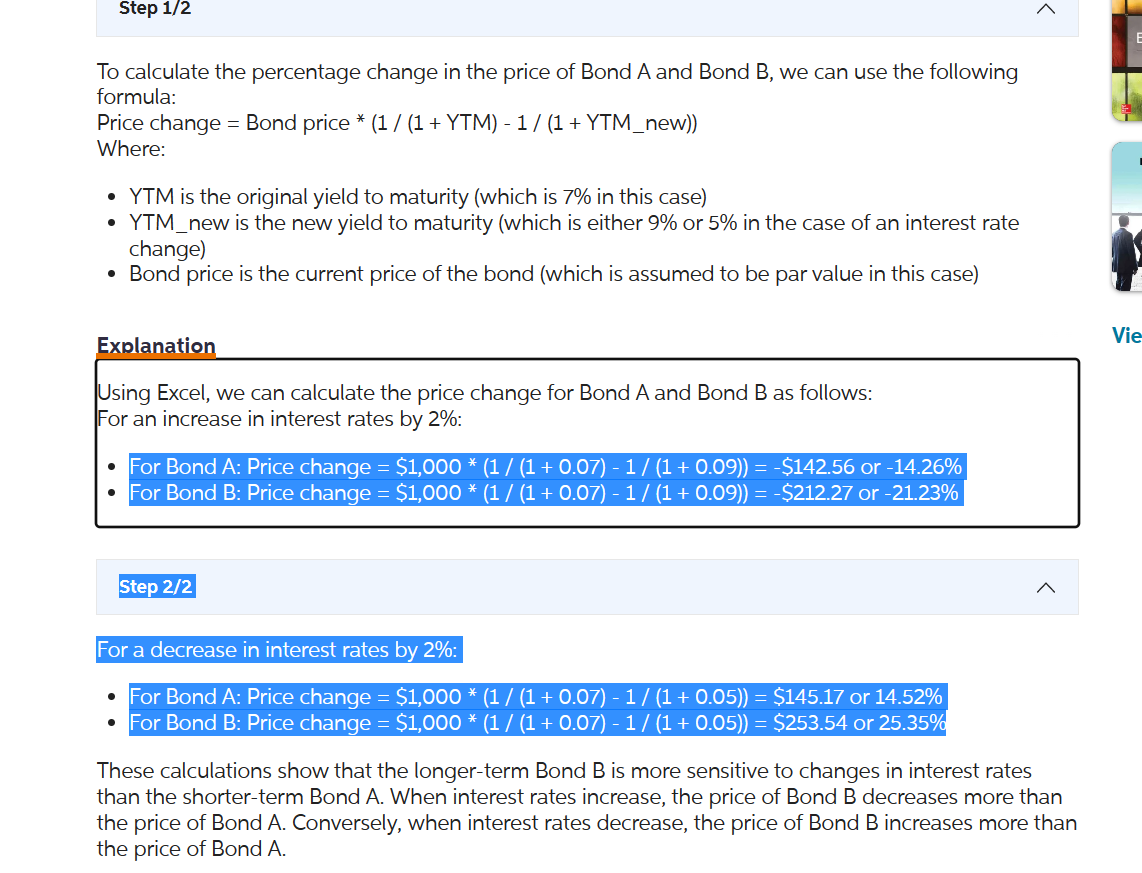
To calculate the percentage change in the price of Bond A and Bond B, we can use the following formula: Price change = Bond price (1/(1+ YTM )1/(1+ YTM_new )) Where: - YTM is the original yield to maturity (which is 7% in this case) - YTM_new is the new yield to maturity (which is either 9% or 5% in the case of an interest rate change) - Bond price is the current price of the bond (which is assumed to be par value in this case) Explanation Using Excel, we can calculate the price change for Bond A and Bond B as follows: For an increase in interest rates by 2% : - For Bond A: Price change =$1,000(1/(1+0.07)1/(1+0.09))=$142.56 or 14.26% - For Bond B: Price change =$1,000(1/(1+0.07)1/(1+0.09))=$212.27 or 21.23% For a decrease in interest rates by 2% : - For Bond A: Price change =$1,000(1/(1+0.07)1/(1+0.05))=$145.17 or 14.52% - For Bond B: Price change =$1,000(1/(1+0.07)1/(1+0.05))=$253.54 or 25.35% These calculations show that the longer-term Bond B is more sensitive to changes in interest rates than the shorter-term Bond A. When interest rates increase, the price of Bond B decreases more than the price of Bond A. Conversely, when interest rates decrease, the price of Bond B increases more than the price of Bond A
Step by Step Solution
There are 3 Steps involved in it

Get step-by-step solutions from verified subject matter experts
 Study Help