







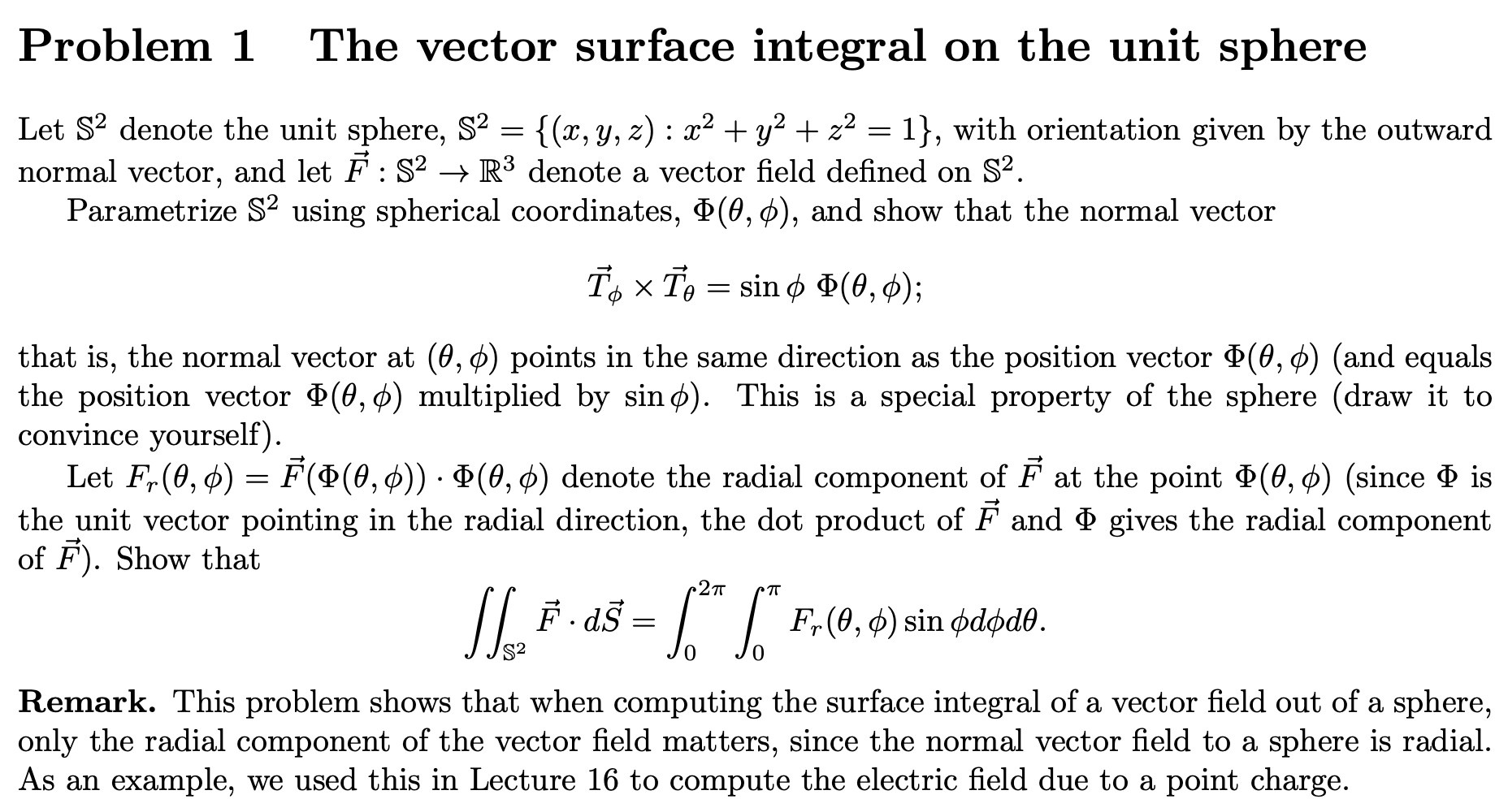
Question: Seen in image Problem 1 The vector surface integral on the unit sphere Let S2 denote the unit sphere, $2 = {(x, y, z) :
Seen in image
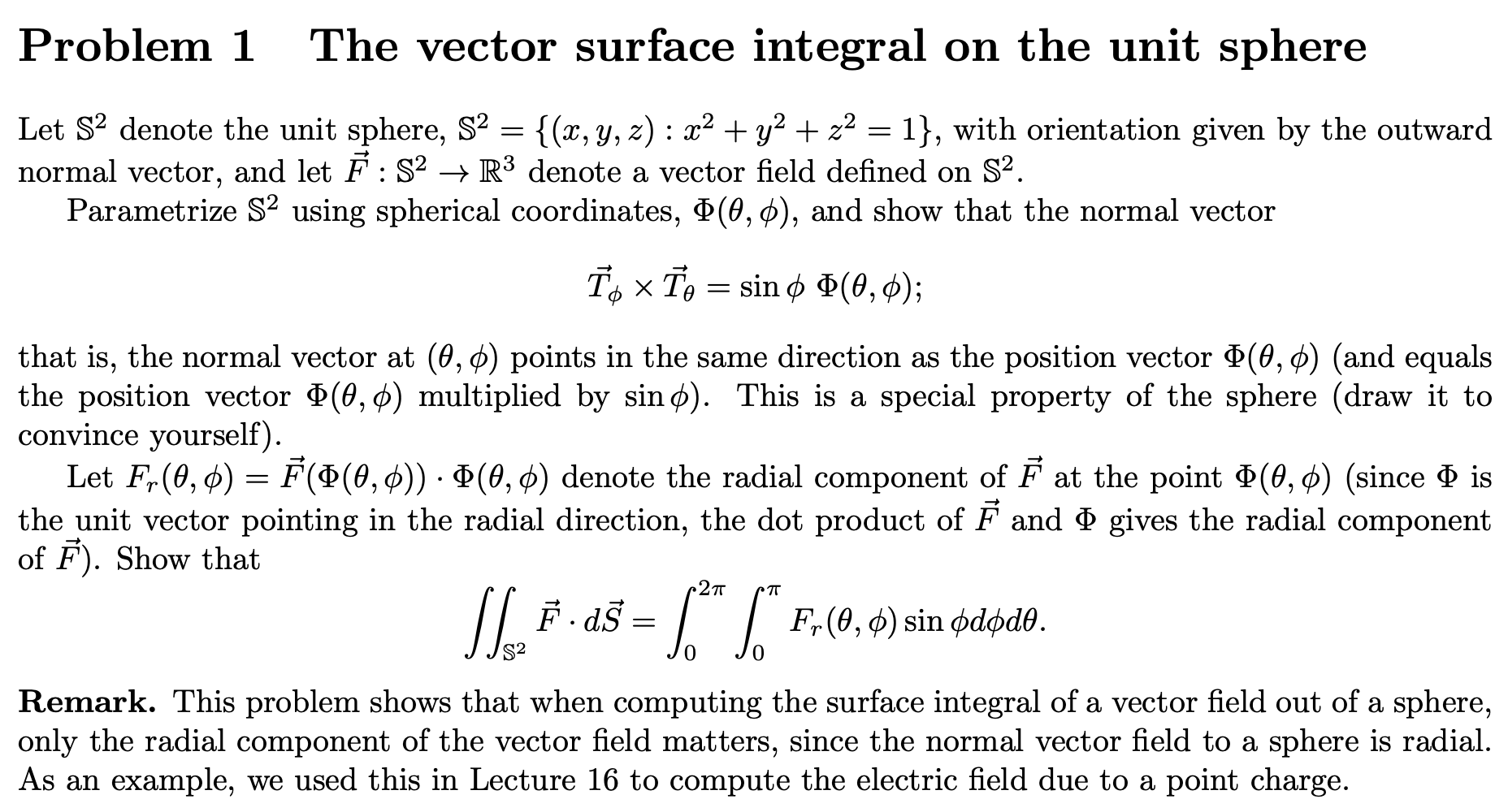
Problem 1 The vector surface integral on the unit sphere Let S2 denote the unit sphere, $2 = {(x, y, z) : x2 + y2 + 22 =1}, with orientation given by the outward normal vector, and let F : S2 -> R3 denote a vector field defined on $2. Parametrization spherical coordinates, (0, (), and show that the normal vector To X To = sind &(0, $); that is, the normal vector at (0, ) points in the same direction as the position vector (0, ) (and equals the position vector (0, ) multiplied by sing). This is a special property of the sphere (draw it to convince yourself ) . Let Fr(0, d) = F(D(0, 4)) . &(0, ) denote the radial component of F at the point (0, ) (since & is the unit vector pointing in the radial direction, the dot product of F and & gives the radial component of F). Show that I Was= J F.(0,0) sin ododb. Remark. This problem shows that when computing the surface integral of a vector field out of a sphere, only the radial component of the vector field matters, since the normal vector field to a sphere is radial. As an example, we used this in Lecture 16 to compute the electric field due to a point charge
Step by Step Solution
There are 3 Steps involved in it

Get step-by-step solutions from verified subject matter experts
 Study Help