







Question: Select 1: operation cycle, cash conversion cycle, payable deferrals period Select 2: inventory turnover ratio, inventory conversion period Select 3: average collection period, receivables turnover
Select 1: operation cycle, cash conversion cycle, payable deferrals period
Select 2: inventory turnover ratio, inventory conversion period
Select 3: average collection period, receivables turnover ratio, aging schedule
Select 4: monthly cash budget, cash conversion cycle, payables deferral period
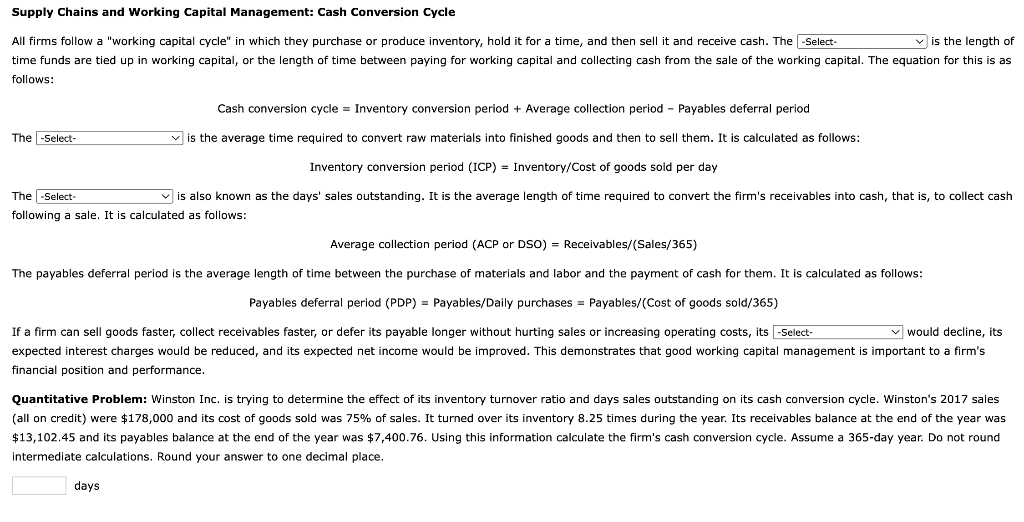
Supply Chains and Working Capital Management: Cash Conversion Cycle All firms follow a "working capital cycle" in which they purchase or produce inventory, hold it for a time, and then sell it and receive cash. The is the length of time funds are tied up in working capital, or the length of time between paying for working capital and collecting cash from the sale of the working capital. The equation for this is follows: Cash conversion cycle = Inventory conversion period + Average collection period - Payables deferral period The is the average time required to convert raw materials into finished goods and then to sell them. It is calculated as follows: Inventory conversion period (ICP) = Inventory/Cost of goods sold per day The is also known as the days' sales outstanding. It is the average length of time required to convert the firm's receivables into cash, that is, to collect cash following a sale. It is calculated as follows: Averagecollectionperiod(ACPorDSO)=Receivables/(Sales/365) The payables deferral period is the average length of time between the purchase of materials and labor and the payment of cash for them. It is calculated as follows: Payablesdeferralperiod(PDP)=Payables/Dailypurchases=Payables/(Costofgoodssold/365) If a firm can sell goods faster, collect receivables faster, or defer its payable longer without hurting sales or increasing operating costs, its would decline, its expected interest charges would be reduced, and its expected net income would be improved. This demonstrates that good working capital management is important to a firm's financial position and performance. Quantitative Problem: Winston Inc. is trying to determine the effect of its inventory turnover ratio and days sales outstanding on its cash conversion cycle. Winston's 2017 sales (all on credit) were $178,000 and its cost of goods sold was 75% of sales. It turned over its inventory 8.25 times during the year. Its receivables balance at the end of the was $13,102.45 and its payables balance at the end of the year was $7,400.76. Using this information calculate the firm's cash conversion cycle. Assume a 365 -day year. Do not round intermediate calculations. Round your answer to one decimal place. days
Step by Step Solution
There are 3 Steps involved in it

Get step-by-step solutions from verified subject matter experts
 Study Help