







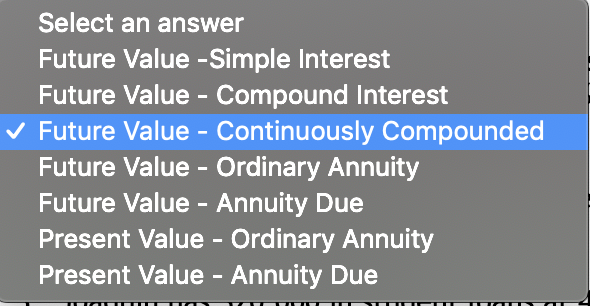
Question: Select an answer Future Value -Simple Interest Future Value - Compound Interest Future Value - Continuously Compounded Future Value - Ordinary Annuity Future Value
 \
\
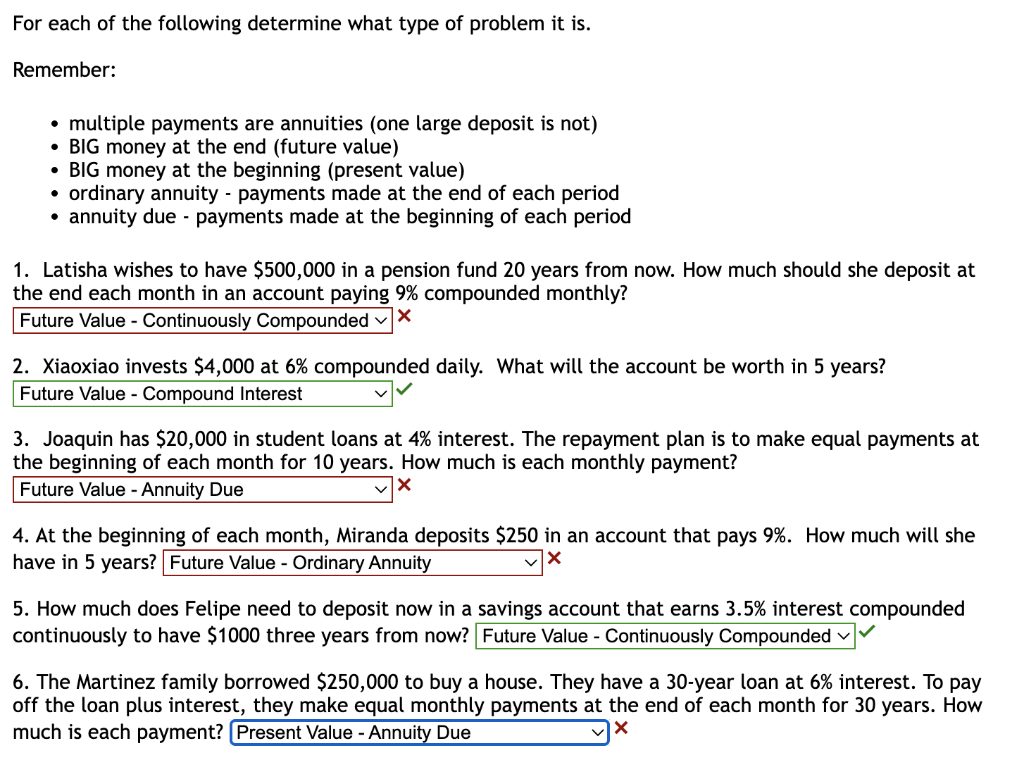
Select an answer Future Value -Simple Interest Future Value - Compound Interest Future Value - Continuously Compounded Future Value - Ordinary Annuity Future Value - Annuity Due Present Value - Ordinary Annuity Present Value - Annuity Due For each of the following determine what type of problem it is. Remember: - multiple payments are annuities (one large deposit is not) - BIG money at the end (future value) - BIG money at the beginning (present value) - ordinary annuity - payments made at the end of each period - annuity due - payments made at the beginning of each period 1. Latisha wishes to have $500,000 in a pension fund 20 years from now. How much should she deposit at the end each month in an account paying 9% compounded monthly? 2. Xiaoxiao invests $4,000 at 6% compounded daily. What will the account be worth in 5 years? 3. Joaquin has $20,000 in student loans at 4% interest. The repayment plan is to make equal payments at the beginning of each month for 10 years. How much is each monthly payment? x 4. At the beginning of each month, Miranda deposits $250 in an account that pays 9%. How much will she have in 5 years? 5. How much does Felipe need to deposit now in a savings account that earns 3.5% interest compounded continuously to have $1000 three years from now? 6. The Martinez family borrowed $250,000 to buy a house. They have a 30 -year loan at 6% interest. To pay off the loan plus interest, they make equal monthly payments at the end of each month for 30 years. How much is each payment
Step by Step Solution
There are 3 Steps involved in it

Get step-by-step solutions from verified subject matter experts
 Study Help