Question: select answer options are all ( ) STAR Co. provides paper to smaller companies whose volumes are not large enough to warrant dealing directly with
 select answer options are all (
 )
)
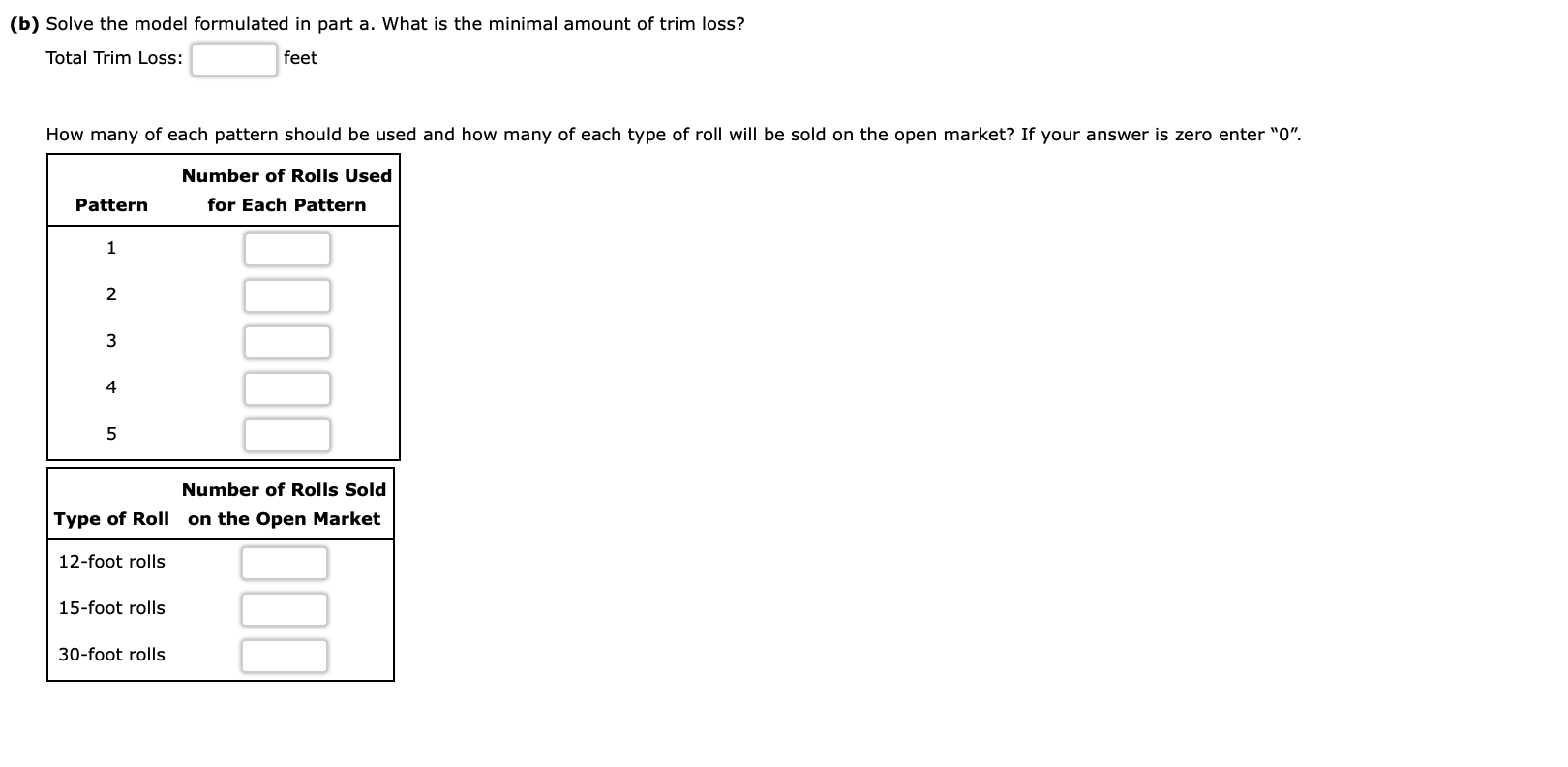
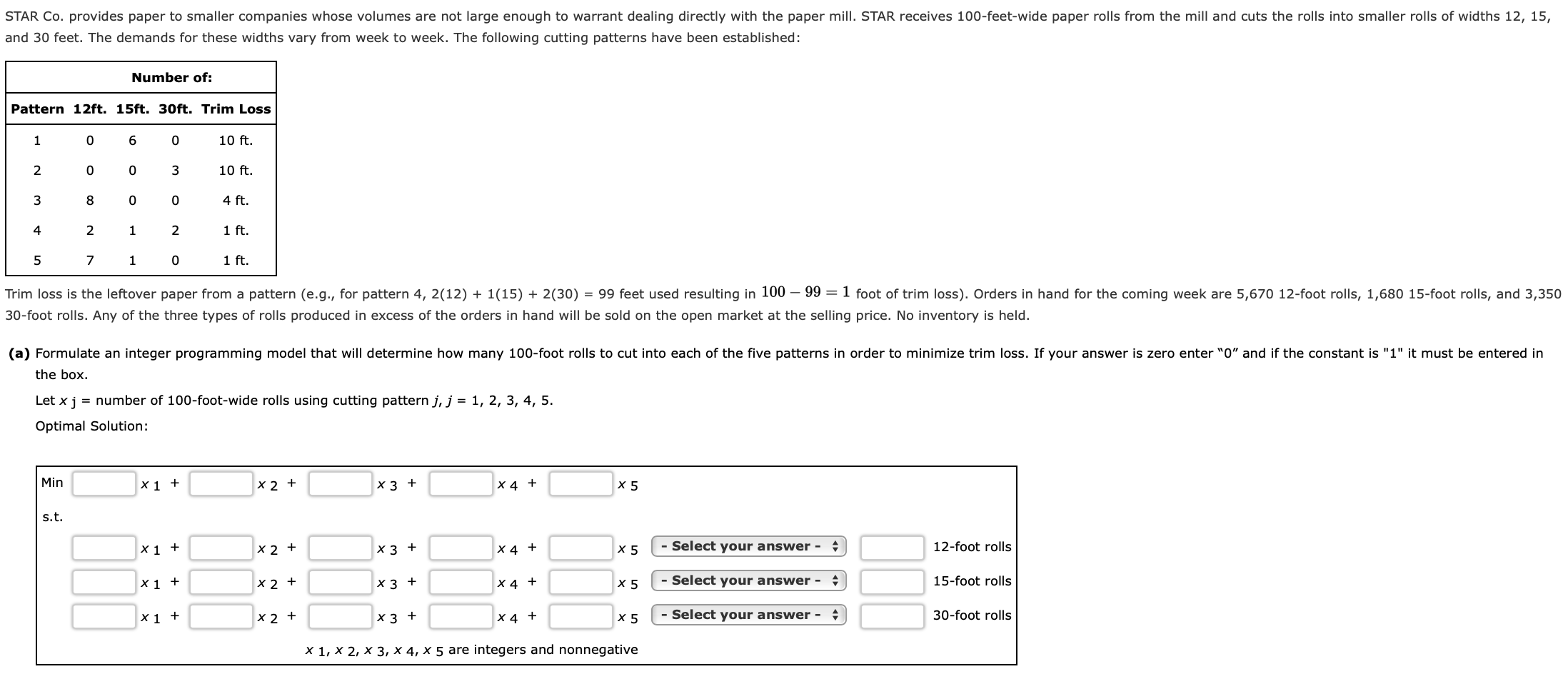
STAR Co. provides paper to smaller companies whose volumes are not large enough to warrant dealing directly with the paper mill. STAR receives 100-feet-wide paper rolls from the mill and cuts the rolls into smaller rolls of widths 12, 15, and 30 feet. The demands for these widths vary from week to week. The following cutting patterns have been established: Number of: Pattern 12ft. 15ft. 30ft. Trim Loss 1 0 6 0 10 ft. 2 0 0 3 10 ft. 3 8 0 0 4 ft. 4 2 1 2 1 ft. 5 7 1 0 1 ft. Trim loss is the leftover paper from a pattern (e.g., for pattern 4, 2(12) + 1(15) + 2(30) = 99 feet used resulting in 100 99 = 1 foot of trim loss). Orders in hand for the coming week are 5,670 12-foot rolls, 1,680 15-foot rolls, and 3,350 30-foot rolls. Any of the three types of rolls produced in excess of the orders in hand will be sold on the open market at the selling price. No inventory is held. (a) Formulate an integer programming model that will determine how many 100-foot rolls to cut into each of the five patterns in order to minimize trim loss. If your answer is zero enter "0" and if the constant is "1" it must be entered in the box. Let x j = number of 100-foot-wide rolls using cutting pattern j, j = 1, 2, 3, 4, 5. Optimal Solution: Min Xi + X 2 + X3 + X4 + X 5 s.t. X1 + X 2 + X3 + X4 + X 5 - Select your answer - 4 12-foot rolls X1 + X 2 + X3 + X4 + X 5 - Select your answer - 4 15-foot rolls X1 + X 2 + x3 + X 4 + X 5 - Select your answer - 4 30-foot rolls X 1, X 2, X3, X 4, X 5 are integers and nonnegative OR = (b) Solve the model formulated in part a. What is the minimal amount of trim loss? Total Trim Loss: feet How many of each pattern should be used and how many of each type of roll will be sold on the open market? If your answer is zero enter "0". Number of Rolls Used Pattern for Each Pattern 1 2 3 4 5 Number of Rolls Sold Type of Roll on the Open Market 12-foot rolls 15-foot rolls 30-foot rolls STAR Co. provides paper to smaller companies whose volumes are not large enough to warrant dealing directly with the paper mill. STAR receives 100-feet-wide paper rolls from the mill and cuts the rolls into smaller rolls of widths 12, 15, and 30 feet. The demands for these widths vary from week to week. The following cutting patterns have been established: Number of: Pattern 12ft. 15ft. 30ft. Trim Loss 1 0 6 0 10 ft. 2 0 0 3 10 ft. 3 8 0 0 4 ft. 4 2 1 2 1 ft. 5 7 1 0 1 ft. Trim loss is the leftover paper from a pattern (e.g., for pattern 4, 2(12) + 1(15) + 2(30) = 99 feet used resulting in 100 99 = 1 foot of trim loss). Orders in hand for the coming week are 5,670 12-foot rolls, 1,680 15-foot rolls, and 3,350 30-foot rolls. Any of the three types of rolls produced in excess of the orders in hand will be sold on the open market at the selling price. No inventory is held. (a) Formulate an integer programming model that will determine how many 100-foot rolls to cut into each of the five patterns in order to minimize trim loss. If your answer is zero enter "0" and if the constant is "1" it must be entered in the box. Let x j = number of 100-foot-wide rolls using cutting pattern j, j = 1, 2, 3, 4, 5. Optimal Solution: Min Xi + X 2 + X3 + X4 + X 5 s.t. X1 + X 2 + X3 + X4 + X 5 - Select your answer - 4 12-foot rolls X1 + X 2 + X3 + X4 + X 5 - Select your answer - 4 15-foot rolls X1 + X 2 + x3 + X 4 + X 5 - Select your answer - 4 30-foot rolls X 1, X 2, X3, X 4, X 5 are integers and nonnegative OR = (b) Solve the model formulated in part a. What is the minimal amount of trim loss? Total Trim Loss: feet How many of each pattern should be used and how many of each type of roll will be sold on the open market? If your answer is zero enter "0". Number of Rolls Used Pattern for Each Pattern 1 2 3 4 5 Number of Rolls Sold Type of Roll on the Open Market 12-foot rolls 15-foot rolls 30-foot rolls









 Study Help