







Question: Select Budgets that make up the Master Budget. The budgets are linked with Excel formulas. Data Year 1 by Quarter Year 2, 1st 2 Quarters
| Select Budgets that make up the Master Budget. The budgets are linked with Excel formulas. | ||||||||
| Data | Year 1 by Quarter | Year 2, 1st 2 Quarters | ||||||
| 1 | 2 | 3 | 4 | 1 | 2 | |||
| Budgeted unit sales | 42,000 | 46,500 | 40,000 | 38,000 | 46,000 | 48,000 | ||
| Selling price per unit | $27.16 | per unit | ||||||
| Accounts receivable, beginning balance | $65,000 | |||||||
| Sales collected in the quarter sales are made | 75% | |||||||
| Sales collected in the quarter after sales are made | 25% | |||||||
| Desired ending finished goods inventory is | 30% | of the budgeted unit sales of the next quarter | ||||||
| Finished goods inventory, beginning | 12,000 | units | ||||||
| Raw materials required to produce one unit | 5.00 | pounds | ||||||
| Desired ending inventory of raw materials is | 10% | of the next quarter's production needs | ||||||
| Raw materials inventory, beginning | 23,000 | pounds | ||||||
| Raw material costs | $0.80 | per pound | ||||||
| Raw materials purchases are paid | 60% | in the quarter the purchases are made | ||||||
| and | 40% | in the quarter following purchase | ||||||
| Accounts payable for raw materials, beginning balance | $81,500 | |||||||
| Budgeted labor hours per unit produced | 6.00 | hours | ||||||
| Labor wage rate | $16.25 | per hour | ||||||
| Construct the sales budget | Year 1 by Quarter | Year 2, 1st 2 Quarters | ||||||
| 1 | 2 | 3 | 4 | Year | 1 | 2 | ||
| Budgeted unit sales | 42,000 | 46,500 | 40,000 | 38,000 | 166,500 | 46,000 | 48,000 | |
| Selling price per unit | $27.16 | $27.16 | $27.16 | $27.16 | $27.16 | $27.16 | $27.16 | |
| Total sales | $1,140,720 | $1,262,940 | $1,086,400 | $1,032,080 | $4,522,140 | $1,249,360 | $1,303,680 | |
| Construct the schedule of expected cash collections | Year 1 by Quarter | |||||||
| 1 | 2 | 3 | 4 | Year | ||||
| Accounts receivable, beginning balance | $ 65,000 | $ 65,000 | ||||||
| First-quarter sales | 855,540 | $ 285,180 | $ 1,140,720 | |||||
| Second-quarter sales | 947,205 | $ 315,735 | $ 1,262,940 | |||||
| Third-quarter sales | 814,800 | $ 271,600 | $ 1,086,400 | |||||
| Fourth-quarter sales | 774,060 | $ 774,060 | ||||||
| Total cash collections | $ 920,540 | $ 1,232,385 | $ 1,130,535 | $ 1,045,660 | $ 4,329,120 | |||
| Construct the production budget | Year 1 by Quarter | Year 2, 1st 2 Quarters | ||||||
| 1 | 2 | 3 | 4 | Year | 1 | 2 | ||
| Budgeted unit sales | 42,000 | 46,500 | 40,000 | 38,000 | 166,500 | 46,000 | 48,000 | |
| Add desired finished goods inventory | 13,950 | 12,000 | 11,400 | 13,800 | 13,800 | 14,400 | ||
| Total needs | 55,950 | 58,500 | 51,400 | 51,800 | 180,300 | 60,400 | ||
| Less beginning inventory | 12,000 | 13,950 | 12,000 | 11,400 | 12,000 | 13,800 | ||
| Required production | 43,950 | 44,550 | 39,400 | 40,400 | 168,300 | 46,600 | ||
| Construct the raw materials purchases budget | Year 1 by Quarter | Year 2, 1st Quarter | ||||||
| 1 | 2 | 3 | 4 | Year | 1 | |||
| Required production (units) | 43,950 | 44,550 | 39,400 | 40,400 | 168,300 | 46,600 | ||
| Raw materials required to produce one unit | 5.00 | 5.00 | 5.00 | 5.00 | 5.00 | 5.00 | ||
| Production needs (pounds) | 219,750 | 222,750 | 197,000 | 202,000 | 841,500 | 233,000 | ||
| Add desired ending inventory of raw materials (pounds) | 22,275 | 19,700 | 20,200 | 23,300 | 23,300 | |||
| Total needs (pounds) | 242,025 | 242,450 | 217,200 | 225,300 | 864,800 | |||
| Less beginning inventory of raw materials (pounds) | 23,000 | 22,275 | 19,700 | 20,200 | 23,000 | |||
| Raw materials to be purchased | 219,025 | 220,175 | 197,500 | 205,100 | 841,800 | |||
| Cost of raw materials per pound | $0.80 | 0.80 | 0.80 | 0.80 | 0.80 | 0.80 | ||
| Cost of raw materials to be purchased | $175,220 | $176,140 | $158,000 | $164,080 | $673,440 | |||
| Construct the schedule of expected cash payments | Year 1 by Quarter | |||||||
| 1 | 2 | 3 | 4 | Year | ||||
| Accounts payable, beginning balance | $ 81,500 | $ 81,500 | ||||||
| First-quarter purchases | 105,132 | $ 70,088 | $ 175,220 | |||||
| Second-quarter purchases | 105,684 | $ 70,456 | $ 176,140 | |||||
| Third-quarter purchases | 94,800 | $ 63,200 | $ 158,000 | |||||
| Fourth-quarter purchases | 98,448 | $ 98,448 | ||||||
| Total cash disbursements | $ 186,632 | $ 175,772 | $ 165,256 | $ 161,648 | $ 689,308 | |||
| Construct the direct labor budget | Year 1 by Quarter | |||||||
| 1 | 2 | 3 | 4 | Year | ||||
| Planned Production in Units | 43,950 | 44,550 | 39,400 | 40,400 | 168,300 | |||
| x Direct Labor Hours per Unit | 6.00 | 6.00 | 6.00 | 6.00 | 6.00 | |||
| Budgeted Direct Labor Hours | 263,700 | 267,300 | 236,400 | 242,400 | 1,009,800 | |||
| x Cost per Direct Labor Hour | $16.25 | $16.25 | $16.25 | $16.25 | $16.25 | |||
| Budgeted Direct Labor Cost | $ 4,285,125 | $ 4,343,625 | $ 3,841,500 | $ 3,939,000 | $ 16,409,250 | |||
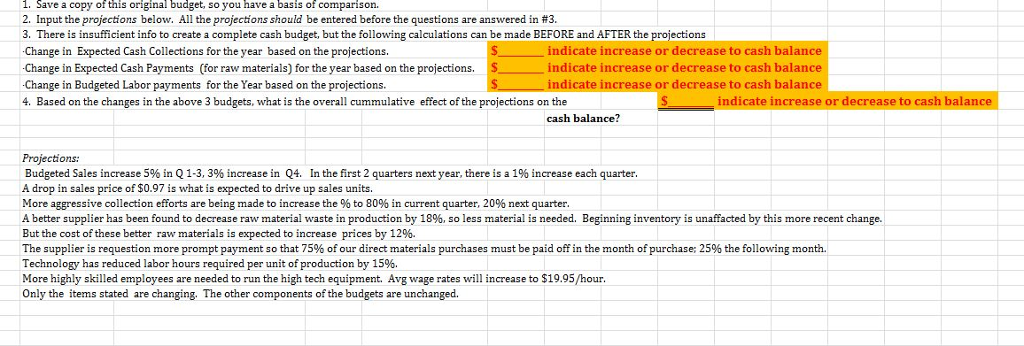
1. Save a copy of this original budget, so you have a basis of comparison. 2. Input the projections below. All the projections should be entered before the questions are answered in H3. 3. There is insufficient info to create a complete cash budget, but the following calculations can be made BEFORE and AFTER the projections indicate increase or decrease to cash balance Change in Expected Cash Collections for the year based on the projections. -Change in Expected Cash Payments (for raw materials) for the year based on the projections. indicate increase or decrease to cash balance Change in Budgeted Labor payments for the Year based on the projections indicate increase or decrease to cash balance indicate increase or decrease to cash balance 4. Based on the changes in the above 3 budgets, what is the overall cummulative effect of the projections on the cash balance? Projections: Budgeted Sales increase 5% in Q1-3, 3% increase in Q4. In the first 2 quarters next year, there is a 1% increase each quarter. A drop in sales price of $0.97 is what is expected to drive up sales units. More aggressive collection efforts are being made to increase the to 80% in current quarter, 20% next quarter Abetter supplier has been found to decrease raw material waste in production by 18%, so less material is needed. Beginning inventory is unaffacted by this more recent change. But the cost of these better raw materials is expected to increase prices by 12%. The supplier is requestion more prompt payment so that 75% of our direct materials purchases must be paid off in the month of purchase 25% the following month. Technology has reduced labor hours required per unit of production by 15% More highly skilled employees are needed to run the high tech equipment. Avg wage rates will increase to $19.95/hour only the items stated are changing. The other components of the budgets are unchanged
Step by Step Solution
There are 3 Steps involved in it

Get step-by-step solutions from verified subject matter experts
 Study Help