







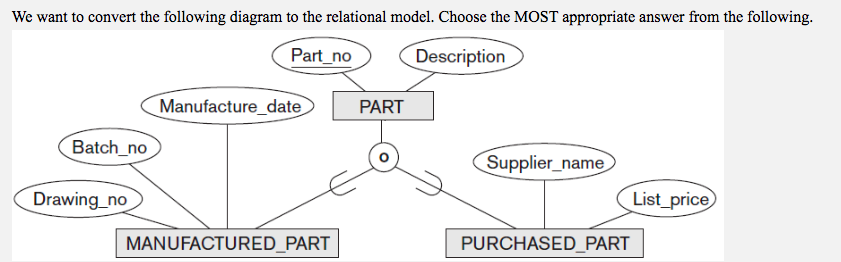
Question: Select one alternative: Select one alternative: We want to convert the following diagram to the relational model. Choose the MOST appropriate answer from the following.
Select one alternative:
Select one alternative:

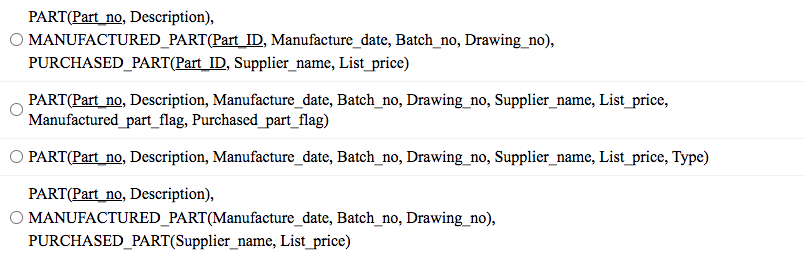
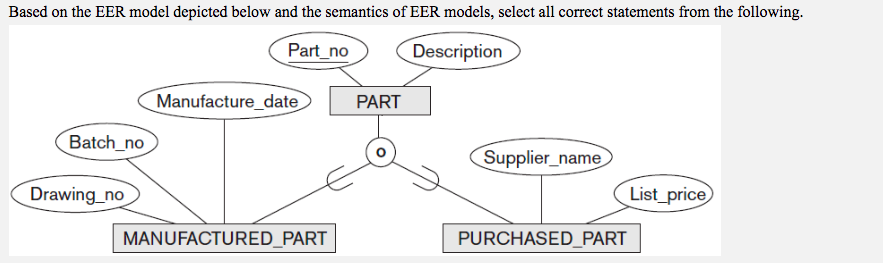
We want to convert the following diagram to the relational model. Choose the MOST appropriate answer from the following. Part_no Description Manufacture_date PART Batch_no Supplier_name Drawing_no List_price MANUFACTURED_PART PURCHASED_PART PART(Part_no, Description), O MANUFACTURED_PART(Part_ID, Manufacture_date, Batch_no, Drawing_no), PURCHASED_PART(Part_ID, Supplier_name, List_price) PART(Part_no, Description, Manufacture_date, Batch_no, Drawing_no, Supplier_name, List_price, Manufactured_part_flag, Purchased_part_flag) PART(Part_no, Description, Manufacture_date, Batch_no, Drawing_no, Supplier_name, List_price, Type) PART(Part_no, Description), O MANUFACTURED_PART(Manufacture_date, Batch_no, Drawing_no), PURCHASED_PART(Supplier_name, List_price) Based on the EER model depicted below and the semantics of EER models, select all correct statements from the following. Part_no Description Manufacture_date PART Batch_no Supplier_name Drawing_no List_price MANUFACTURED_PART PURCHASED_PART U PURCHASED_PART cannot inherit a primary key from PART. All entity types have an attribute called "Description" An entity type PART may be none of the indicated sub-classes An entity type PURCHASED_PART is also necessarily a MANUFACTURED_PART
Step by Step Solution
There are 3 Steps involved in it

Get step-by-step solutions from verified subject matter experts
 Study Help