







Question: Select the correct answer regarding the case Chae Chan Ping v. U.S. Question 1 (0.5 points) Chae Chan Ping v. US. The petitioner is a
Select the correct answer regarding the case Chae Chan Ping v. U.S.
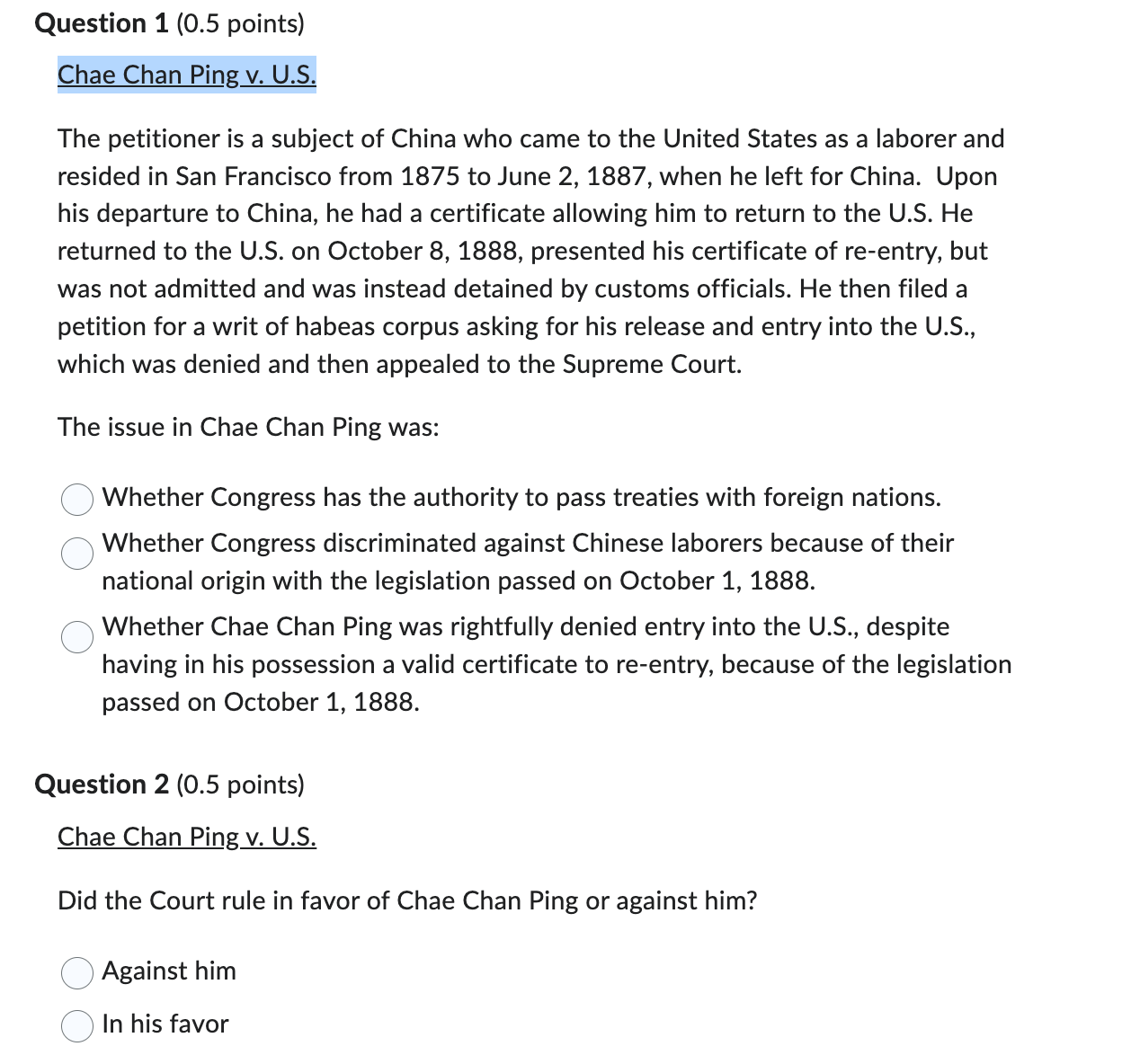
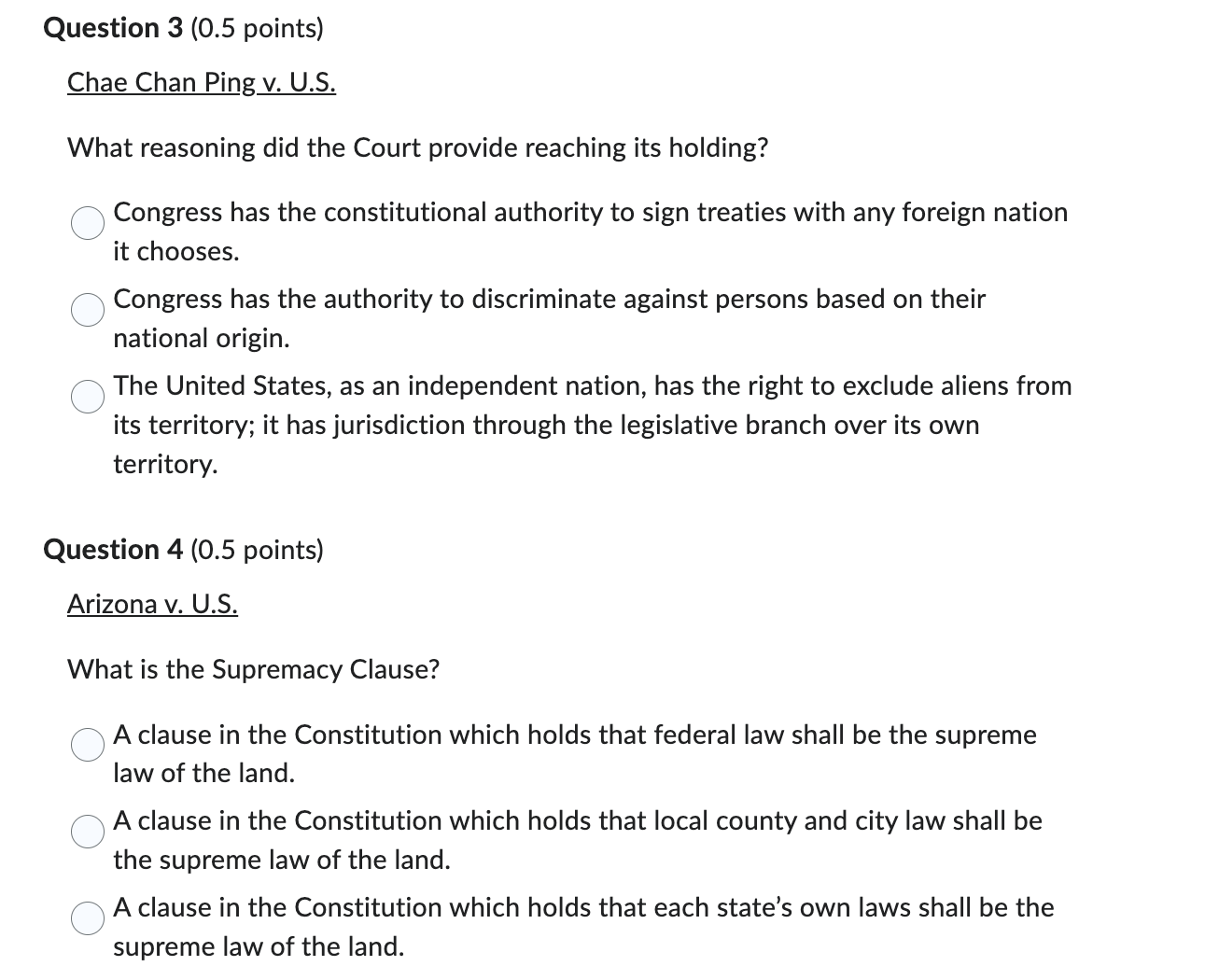
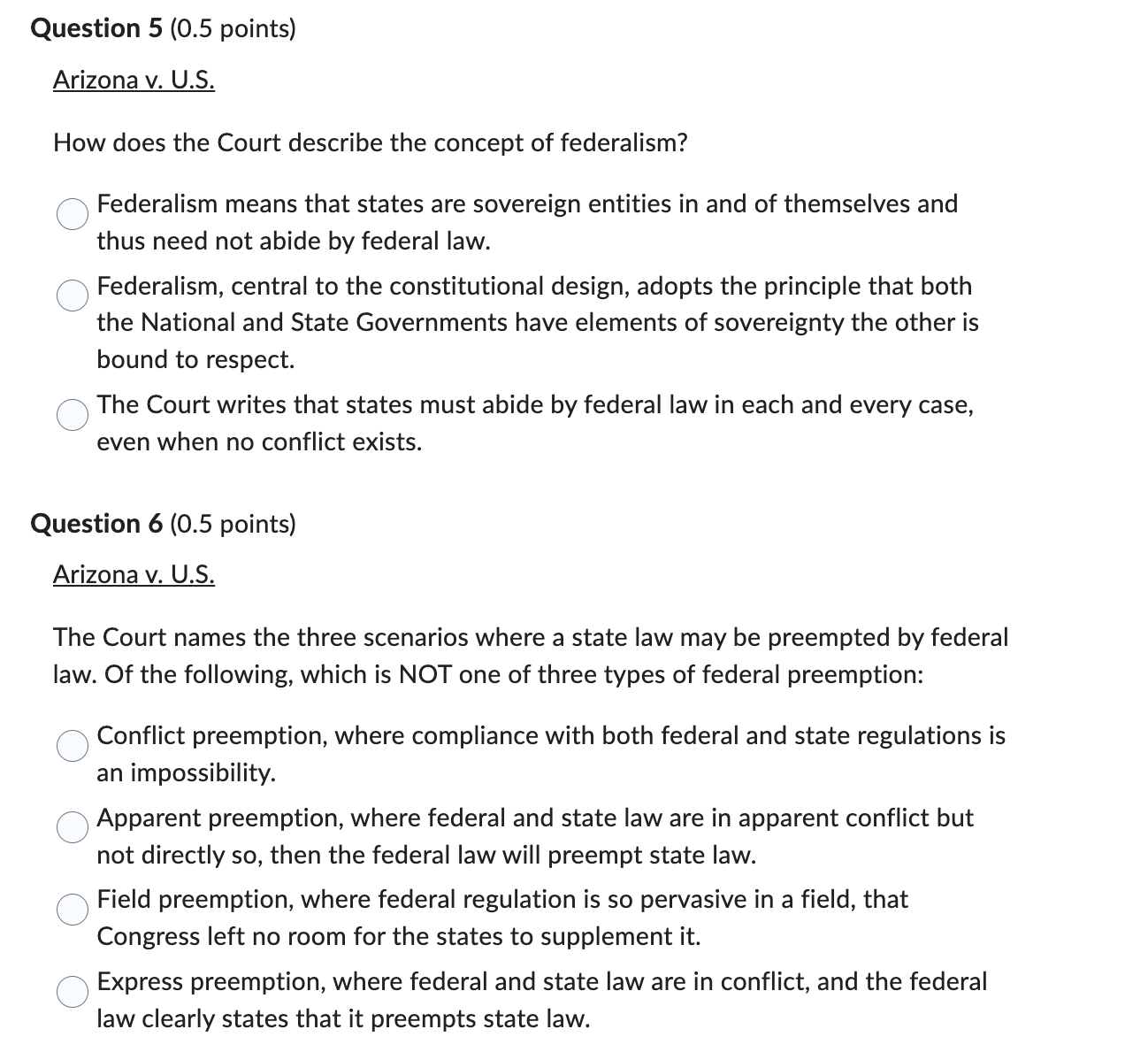
Question 1 (0.5 points) Chae Chan Ping v. US. The petitioner is a subject of China who came to the United States as a laborer and resided in San Francisco from 1875 to June 2, 1887, when he left for China. Upon his departure to China, he had a certificate allowing him to return to the US. He returned to the US. on October 8, 1888, presented his certificate of re-entry, but was not admitted and was instead detained by customs officials. He then filed a petition for a writ of habeas corpus asking for his release and entry into the U.S., which was denied and then appealed to the Supreme Court. The issue in Chae Chan Ping was: Whether Congress has the authority to pass treaties with foreign nations. Whether Congress discriminated against Chinese laborers because of their '1 national origin with the legislation passed on October 1, 1888. Whether Chae Chan Ping was rightfully denied entry into the US, despite having in his possession a valid certificate to re-entry, because of the legislation passed on October 1, 1888. Question 2 (0.5 points) Chae Chan Ping v. US. Did the Court rule in favor of Chae Chan Ping or against him? Against him In his favor Question 3 (0.5 points) Chae Chan Ping v. US. What reasoning did the Court provide reaching its holding? 5' Congress has the constitutional authority to sign treaties with any foreign nation _ it chooses. i, Congress has the authority to discriminate against persons based on their national origin. ( \"y The United States, as an independent nation, has the right to exclude aliens from its territory; it has jurisdiction through the legislative branch over its own territory. Question 4 (0.5 points) Arizona v. US. What is the Supremacy Clause? A clause in the Constitution which holds that federal law shall be the supreme law of the land. 5' A clause in the Constitution which holds that local county and city law shall be I the supreme law of the land. A clause in the Constitution which holds that each state's own laws shall be the supreme law of the land. Question 5 (0.5 points) Arizona v. US. How does the Court describe the concept of federalism? Federalism means that states are sovereign entities in and of themselves and thus need not abide by federal law. Federalism, central to the constitutional design, adopts the principle that both the National and State Governments have elements of sovereignty the other is bound to respect. The Court writes that states must abide by federal law in each and every case, even when no conflict exists. Question 6 (0.5 points) Arizona v. U.S. The Court names the three scenarios where a state law may be preempted by federal law. Of the following, which is NOT one of three types of federal preemption: Conflict preemption, where compliance with both federal and state regulations is 1 an impossibility. Apparent preemption, where federal and state law are in apparent conflict but not directly so, then the federal law will preempt state law. Field preemption, where federal regulation is so pervasive in a field, that 1 Congress left no room for the states to supplement it. Express preemption, where federal and state law are in conflict, and the federal J law clearly states that it preempts state law
Step by Step Solution
There are 3 Steps involved in it

Get step-by-step solutions from verified subject matter experts
 Study Help