







Question: Select the most specific invariant for the loop in the following function. def sum(nums:list[float ])> float: total =0 for idx in range(len(nums)): total = total
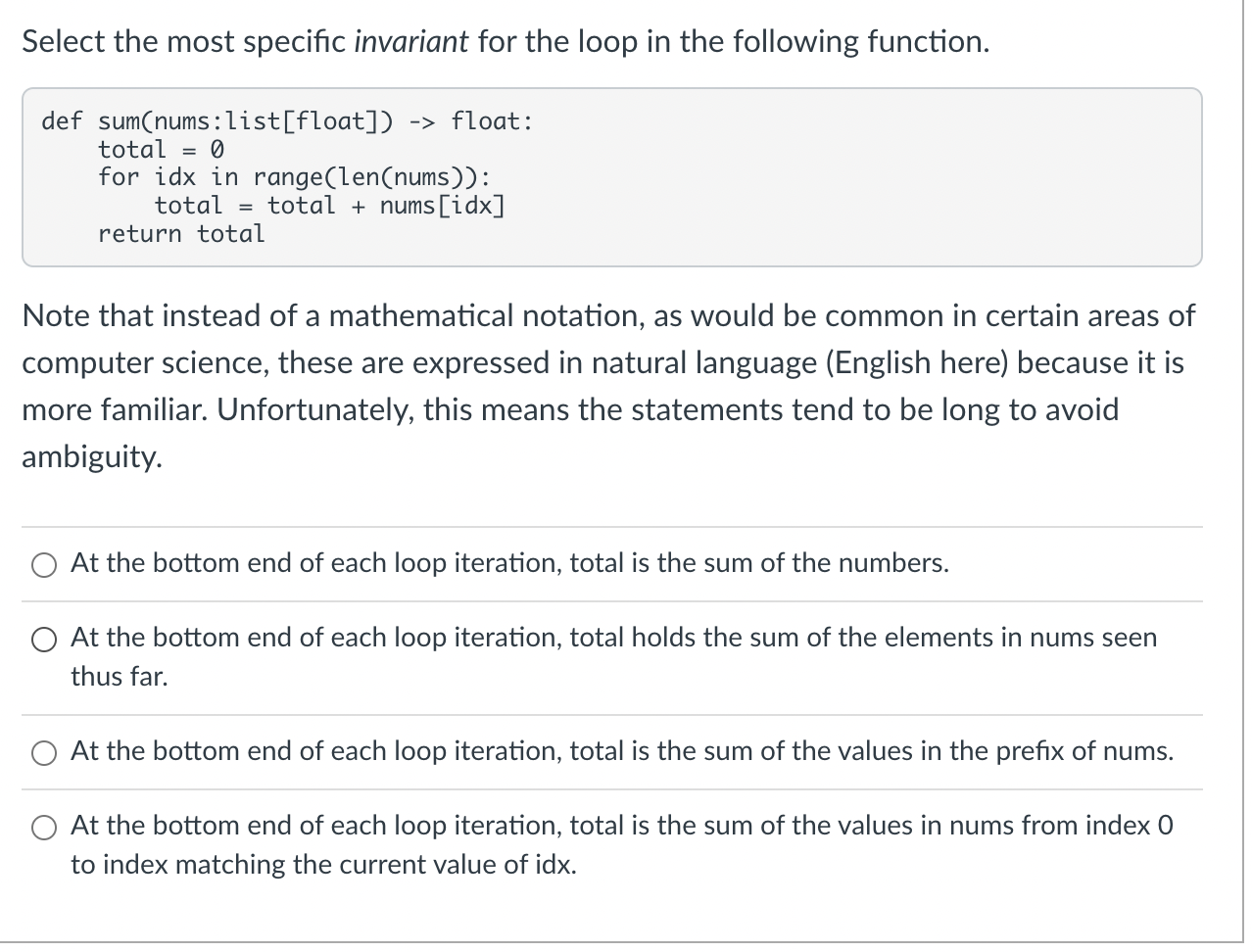
Select the most specific invariant for the loop in the following function. def sum(nums:list[float ])> float: total =0 for idx in range(len(nums)): total = total + nums [idx] return total Note that instead of a mathematical notation, as would be common in certain areas of computer science, these are expressed in natural language (English here) because it is more familiar. Unfortunately, this means the statements tend to be long to avoid ambiguity. At the bottom end of each loop iteration, total is the sum of the numbers. At the bottom end of each loop iteration, total holds the sum of the elements in nums seen thus far. At the bottom end of each loop iteration, total is the sum of the values in the prefix of nums. At the bottom end of each loop iteration, total is the sum of the values in nums from index 0 to index matching the current value of idx
Step by Step Solution
There are 3 Steps involved in it

Get step-by-step solutions from verified subject matter experts
 Study Help