







Question: Sequencing problems Sequencing: ground commanding vs , autonomy for a LEO with a dedicated ground station A low - earth - orbiting spacecraft in an
Sequencing problems
Sequencing: ground commanding vs autonomy for a LEO with a dedicated ground station
A lowearthorbiting spacecraft in an almost polar orbit has an orbital period of
minutes. The spacecraft collects megabits of data per orbit and automatically
stores the data for later retrieval. There is sufficient storage for two days worth of
data.
It makes contact with a single dedicated equatorial ground station every hours. It
does not use any other communications networks. Passes over the ground station range
in time depending on how much of the circular field of view the spacecraft cuts
across, and average minutes. Lockup occurs on the first frame, and no wasted
downlink frames are required to establish contact.
The maximum data transmission rate is bitsec A backup lowrate speed of
is also available, but is notSequencing problems
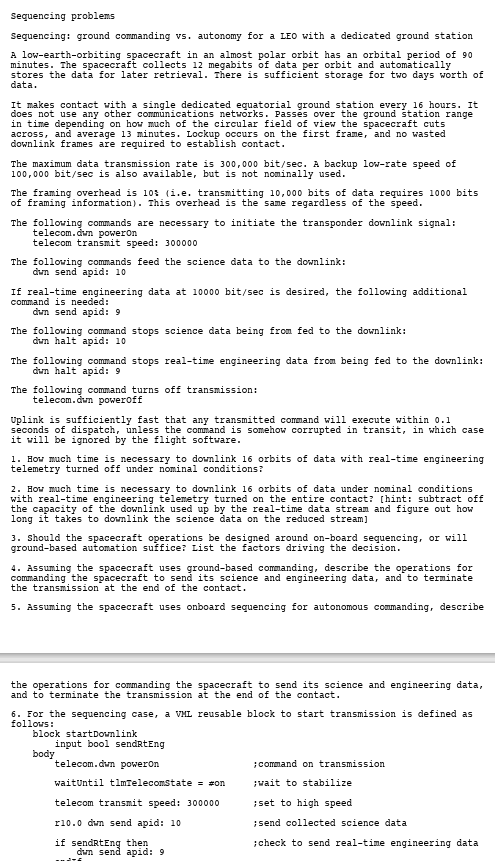
Sequencing: ground commanding vs autonomy for a LEO with a dedicated ground station
A lowearthorbiting spacecraft in an almost polar orbit has an orbital period of
minutes. The spacecraft collects megabits of data per orbit and automatically
stores the data for later retrieval. There is sufficient storage for two days worth of
data.
It makes contact with a single dedicated equatorial ground station every hours. It
does not use any other communications networks. Passes over the ground station range
in time depending on how much of the circular field of view the spacecraft cuts
across, and average minutes. Lockup occurs on the first frame, and no wasted
downlink frames are required to establish contact.
The maximum data transmission rate is bitsec A backup lowrate speed of
bitsec is also available, but is not nominally used.
The framing overhead is ie transmitting bits of data requires bits
of framing information This overhead is the same regardless of the speed.
The following commands are necessary to initiate the transponder downlink signal:
telecom.dwn powerOn
telecom transmit speed:
The following commands feed the science data to the downlink:
dwn send apid:
If realtime engineering data at bitsec is desired, the following additional
command is needed:
dwn send apid:
The following command stops science data being from fed to the downlink:
dwn halt apid:
The following command stops realtime engineering data from being fed to the downlink:
dwn halt apid:
The following command turns off transmission:
telecom.dwn powerOff
Uplink is sufficiently fast that any transmitted command will execute within
seconds of dispatch, unless the command is somehow corrupted in transit, in which case
it will be ignored by the flight software.
How much time is necessary to downlink orbits of data with realtime engineering
telemetry turned off under nominal conditions?
How much time is necessary to downlink orbits of data under nominal conditions
with realtime engineering telemetry turned on the entire contact? hint: subtract off
the capacity of the downlink used up by the realtime data stream and figure out how
long it takes to downlink the science data on the reduced stream
Should the spacecraft operations be designed around onboard sequencing, or will
groundbased automation suffice? List the factors driving the decision.
Assuming the spacecraft uses groundbased commanding, describe the operations for
commanding the spacecraft to send its science and engineering data, and to terminate
the transmission at the end of the contact.
Assuming the spacecraft uses onboard sequencing for autonomous commanding, describe
the operations for commanding the spacecraft to send its science and engineering data,
and to terminate the transmission at the end of the contact.
For the sequencing case, a VML reusable block to start transmission is defined as
follows:
block startDownlink
input bool sendRtEng
body
telecom.dwn powerOn ;command on transmission
waitUntil tlmTelecomState #on ;wait to stabilize
telecom transmit speed: ;set to high speed
r dwn send apid: ;send collected science data
if sendRtEng then ;check to send realtime engineering data
dwn send apid:
endIf
endBody
In the master sequence, a typical call to the block to include realtime engineering
telemetry appears as:
AT:: call startDownlink sendRtEng: true
Update the block to accept another input parameter, and select the downlink rate to be
either the nominal or the lowrate based on that parameter. Then write a
master sequence invocation of the block for each case, issuing the call to the block.
Step by Step Solution
There are 3 Steps involved in it
1 Expert Approved Answer
Step: 1 Unlock

Question Has Been Solved by an Expert!
Get step-by-step solutions from verified subject matter experts
Step: 2 Unlock
Step: 3 Unlock
 Study Help