







Question: Serial vs. Parallel Processes Conceptual Overview: Explore the reliabilities of serial and parallel processes. The reliability of a system of components equals the product of
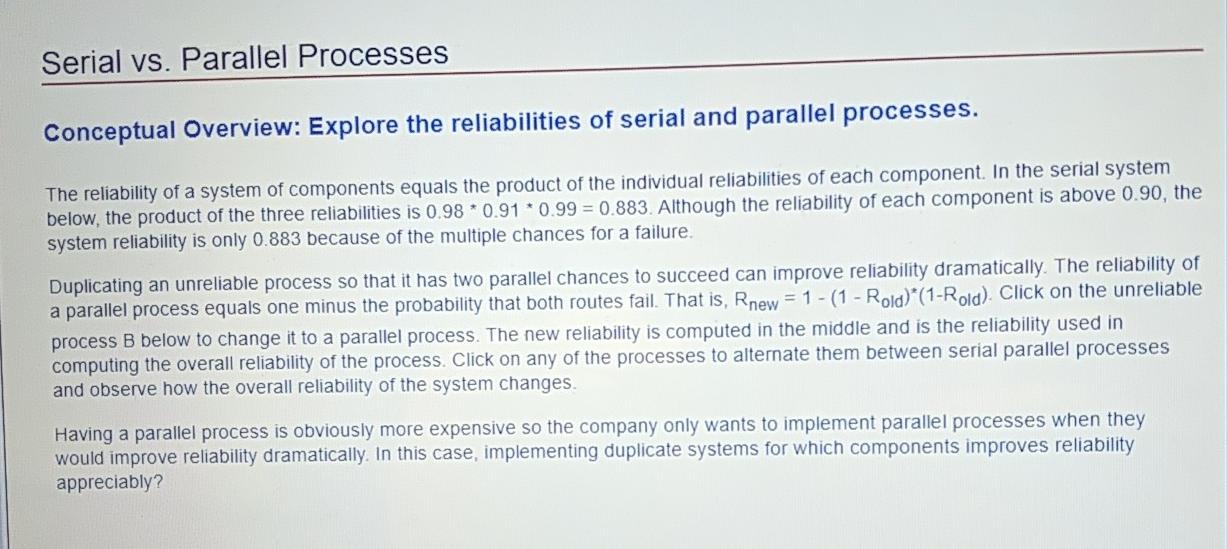








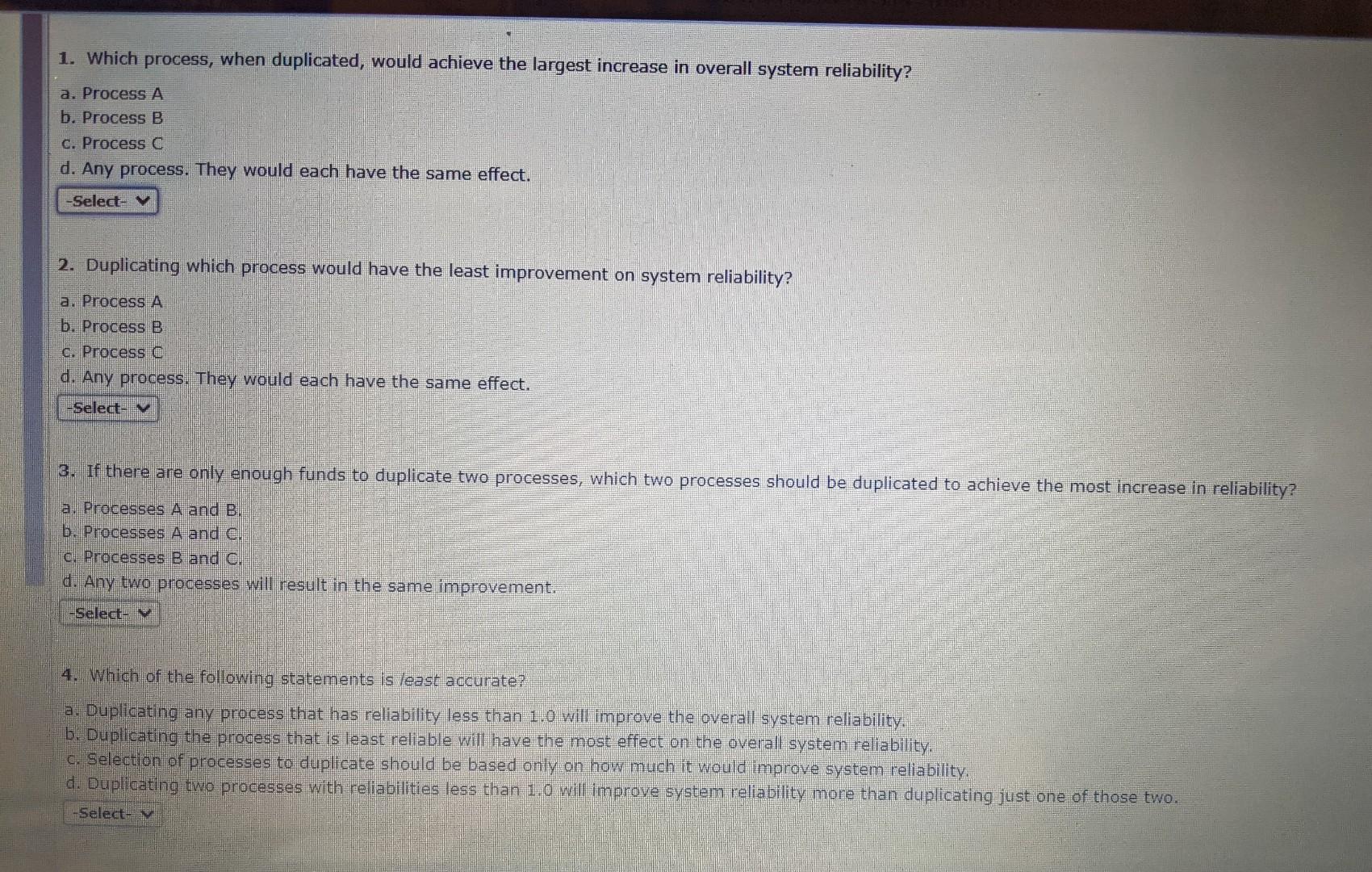
Serial vs. Parallel Processes Conceptual Overview: Explore the reliabilities of serial and parallel processes. The reliability of a system of components equals the product of the individual reliabilities of each component. In the serial system below, the product of the three reliabilities is 0.98 * 0.91 * 0.99 = 0.883. Although the reliability of each component is above 0.90, the system reliability is only 0.883 because of the multiple chances for a failure. Duplicating an unreliable process so that it has two parallel chances to succeed can improve reliability dramatically. The reliability of a parallel process equals one minus the probability that both routes fail. That is, Rnew = 1 - (1 - Rold)*(1-Rold). Click on the unreliable process B below to change it to a parallel process. The new reliability is computed in the middle and is the reliability used in computing the overall reliability of the process. Click on any of the processes to alternate them between serial parallel processes and observe how the overall reliability of the system changes. Having a parallel process is obviously more expensive so the company only wants to implement parallel processes when they would improve reliability dramatically. In this case, implementing duplicate systems for which components improves reliability appreciably? A B C -0.883 0.98 0.91 0.99 Created by Gary H. McClelland, Professor Emeritus | University of Colorado Boulder 0.98 A 1.000 B C -0.901 0.91 0.99 A 0.98 ty dramatically. In this case, implementing duplicate systems for which components improves lellability 0.98 0.91 A 1.000 0.992 -0.982 0.99 A B 0.98 0.91 0.98 0.91 0.99 B. 1.000 0.992 1.000 0.991 A B 0.98 0.91 0.99 0.98 099 A 1.000 1.000 -0.910 0.91 A .98 0.99 0.91 0.99 B C A 0992 1.000 0.972 0.98 B C 0.91 0.99 0.99 A 1.000 -0.892 0.98 0.91 0.99 0.91 B A 0.992 -0.962 0.98 0.99 0.91 1. Which process, when duplicated, would achieve the largest increase in overall system reliability? a. Process A b. Process B c. Process C d. Any process. They would each have the same effect. -Select- v 2. Duplicating which process would have the least improvement on system reliability? a. Process A b. Process B c. Process d. Any process. They would each have the same effect. -Select- M 3. If there are only enough funds to duplicate two processes, which two processes should be duplicated to achieve the most increase in reliability? a, Processes A and B. b. Processes A and C. c. Processes B and C. d. Any two processes will result in the same improvement. -Select- 4. Which of the following statements is least accurate? a. Duplicating any process that has reliability less than 1.0 will improve the overall system reliability. b. Duplicating the process that is least reliable will have the most effect on the overall system reliability. c. Selection of processes to duplicate should be based only on how much it would improve system reliability. d. Duplicating two processes with reliabilities less than 1.0 will improve system reliability more than duplicating just one of those two. -Select
Step by Step Solution
There are 3 Steps involved in it
1 Expert Approved Answer
Step: 1 Unlock

Question Has Been Solved by an Expert!
Get step-by-step solutions from verified subject matter experts
Step: 2 Unlock
Step: 3 Unlock
 Study Help