



Question: Set up a capital contribution account in Excel using the corkscrew methodology. Ignore fees and expenses. Model periods through 5 $100 is called at the
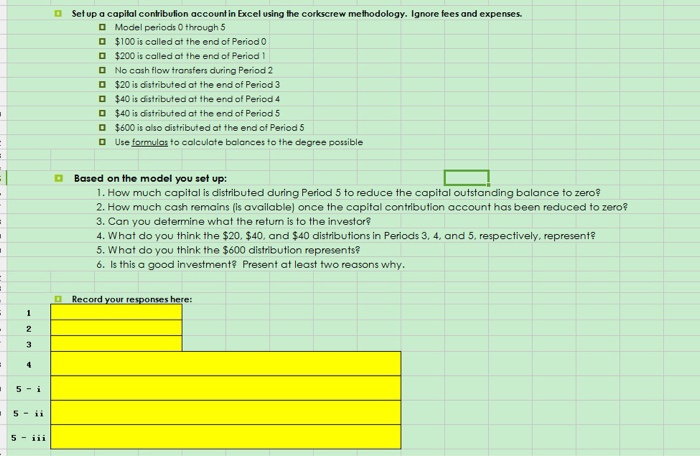
Set up a capital contribution account in Excel using the corkscrew methodology. Ignore fees and expenses. Model periods through 5 $100 is called at the end of Period 0 $200 is called at the end of Period 1 No cash flow transfers during Period 2 $20 is distributed at the end of Period 3 0 $40 is distributed at the end of Period 4 $40 is distributed at the end of Period 5 $600 is also distributed at the end of Period 5 Use formulas to calculate balances to the degree possible . Based on the model you set up: 1. How much capital is distributed during Period 5 to reduce the capital outstanding balance to zero 2. How much cash remains (is available) once the capital contribution account has been reduced to zero 3. Can you determine what the return is to the investor 4. What do you think the $20, $40, and $40 distributions in Periods 3, 4, and 5. respectively, represente 5. What do you think the $600 distribution represents 6. Is this a good investment Present at least two reasons why. . Record your responses here: Set up a capital contribution account in Excel using the corkscrew methodology. Ignore fees and expenses. Model periods through 5 $100 is called at the end of Period 0 $200 is called at the end of Period 1 No cash flow transfers during Period 2 $20 is distributed at the end of Period 3 0 $40 is distributed at the end of Period 4 $40 is distributed at the end of Period 5 $600 is also distributed at the end of Period 5 Use formulas to calculate balances to the degree possible . Based on the model you set up: 1. How much capital is distributed during Period 5 to reduce the capital outstanding balance to zero 2. How much cash remains (is available) once the capital contribution account has been reduced to zero 3. Can you determine what the return is to the investor 4. What do you think the $20, $40, and $40 distributions in Periods 3, 4, and 5. respectively, represente 5. What do you think the $600 distribution represents 6. Is this a good investment Present at least two reasons why. . Record your responses here
Step by Step Solution
There are 3 Steps involved in it

Get step-by-step solutions from verified subject matter experts