







Question: Setup Consider the following model setup somewhat analogous to Shleifer and Vishny (1997). There are three periods, labeled 1, 2 and 3, and there is
Setup
Consider the following model setup somewhat analogous to Shleifer and Vishny (1997).
There are three periods, labeled 1, 2 and 3, and there is only one asset, a stock available in one unit net supply. There are two types of participants: noise traders and arbitrageurs. At time 3 all participants realize the fundamental value of the asset and the asset is liquidated at a price P3 = v. Since the price is equal to v at t = 3 for sure, there is no long run fundamental risk in this stock. The value v can be either vH or vL and becomes known to arbitrageurs at time 2; whereas both possibilities are considered equally likely at time 1. Noise traders, however, misestimate the expected value at time t of the asset by some sentiment shock St , i.e.,  . Our convention is that positive St denotes optimism and negative St pessimism. Hence aggregate noise trader demand is given by:
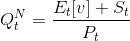
Arbitrageurs are risk-neutral and fully rational and take positions against the mispricing generated by the noise traders. Arbitrageurs have cumulative resources under management Ft , meaning the maximum position size they may take (long or short) can have value up to Ft .
Question
Suppose that St = S > 0 in both periods 1 and 2. Also take F2 as given and suppose F2 is never large enough for arbitrageurs to be able to bring prices to fundamental value. Assume that arbitrageurs invest all of F2 in the stock. Write down an expression for the demand  of arbitrageurs at t=2. Then use this expression along with the equation for
  above to solve for the price at t=2, P2(v), as a function of v (= vH or vL ) and in terms of the parameters S and F2. (Hint: Calculate aggregate demand. We know aggregate supply. What is the market clearing equilibrium price?)
EN [] = E?[0] + St EN [] = E?[0] + St
Step by Step Solution
There are 3 Steps involved in it

Get step-by-step solutions from verified subject matter experts
 Study Help