







Question: Setup for Problems 1 and 2. Both of these problems are about a harmonic oscillator confined to a one-dimensional box. Specifically, a single particle of
Setup for Problems 1 and 2. Both of these problems are about a harmonic oscillator confined to a one-dimensional box. Specifically, a single particle of mass m moves in one dimension 2. The particle is connected to the origin by a spring with spring constant K, so the spring force on the particle is F, =-Ka. The particle is confined by a box (infinite square well) to the region -I/2
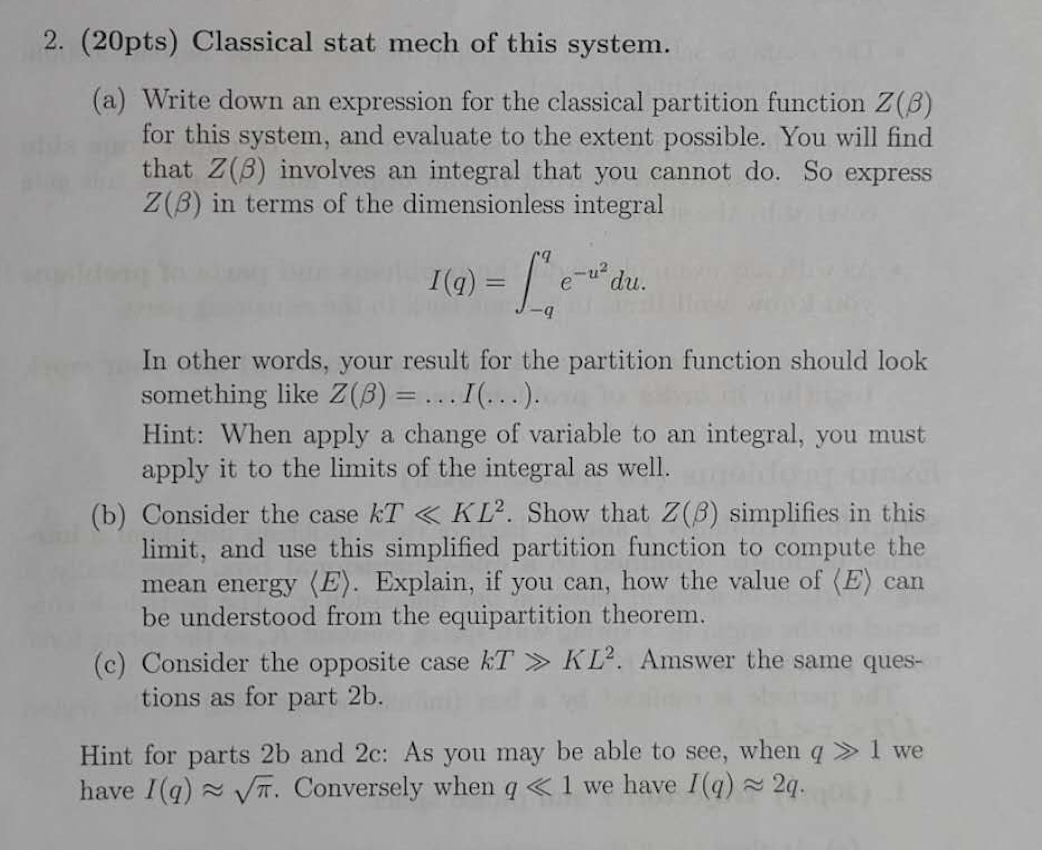
(a) Write down an expression for the classical partition function Z(B) for this svstem, and evaluate to the extent possible. You will find that Z(8) involves an integral that you cannot do. So express Z(B) in terms of the dimensionless integral In other words, your result for the partition function should look something like Z(B)=...I(...). Hint: When apply a change of variable to an integral, you must apply it to the limits of the integral as well.
(b) Consider the case KT
(c) Consider the opposite case kT > KL?. Answer the same questions as for part 2b. Hint for parts 2b and 2c: As you may be able to see, when g > 1 we have I(g) ~ VT. Conversely when q 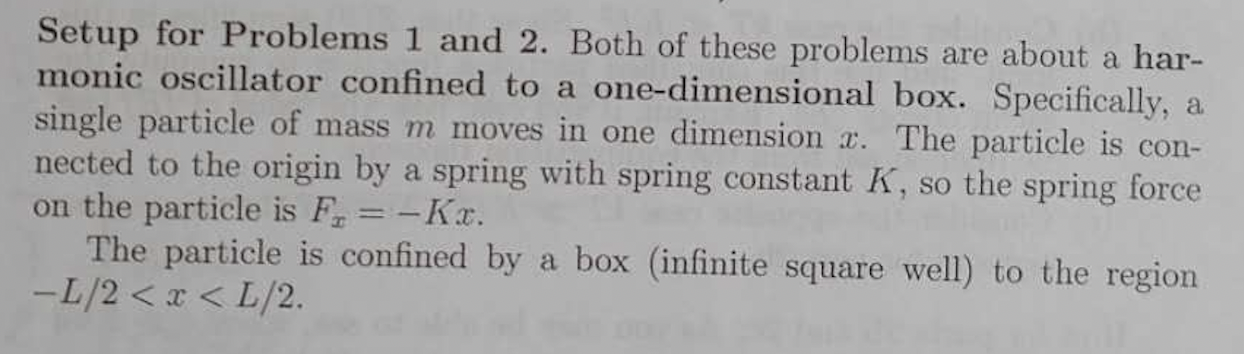
Setup for Problems 1 and 2. Both of these problems are about a harmonic oscillator confined to a one-dimensional box. Specifically, a single particle of mass m moves in one dimension x. The particle is connected to the origin by a spring with spring constant K, so the spring force on the particle is Fx=Kx. The particle is confined by a box (infinite square well) to the region L/2
Step by Step Solution
There are 3 Steps involved in it

Get step-by-step solutions from verified subject matter experts
 Study Help