







Question: Setup: In an experiment to compare different methods of teaching arithmetic, a group of students were randomly divided into three equal-sized groups. Group A was
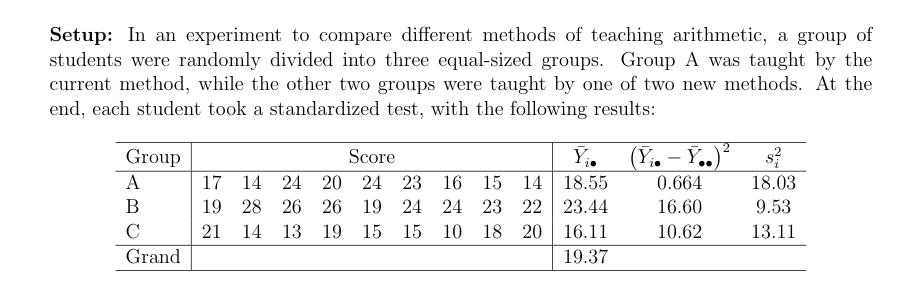


Setup: In an experiment to compare different methods of teaching arithmetic, a group of students were randomly divided into three equal-sized groups. Group A was taught by the current method, while the other two groups were taught by one of two new methods. At the end, each student took a standardized test, with the following results: Find the 95% Bonferroni's Simultaneous Confidence Intervals (SCI) for all pairwise mean difference {ii,i,i=1,2,3}. Which differences are significant? Find the 95% Tukey's Simultaneous Confidence Intervals for all pairwise mean differences. Which differences are significant? What are their advantages and disadvantages of the different SCI methods above? Setup: In an experiment to compare different methods of teaching arithmetic, a group of students were randomly divided into three equal-sized groups. Group A was taught by the current method, while the other two groups were taught by one of two new methods. At the end, each student took a standardized test, with the following results: Find the 95% Bonferroni's Simultaneous Confidence Intervals (SCI) for all pairwise mean difference {ii,i,i=1,2,3}. Which differences are significant? Find the 95% Tukey's Simultaneous Confidence Intervals for all pairwise mean differences. Which differences are significant? What are their advantages and disadvantages of the different SCI methods above
Step by Step Solution
There are 3 Steps involved in it

Get step-by-step solutions from verified subject matter experts
 Study Help