







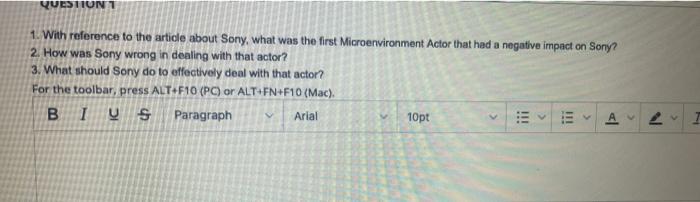
Question: Short Case Study Question s: With all the hype these days about companies like Apple, Google, Amazon , and Samsung, its hard to remember that
Short Case Study Questions:
With all the hype these days about companies like Apple, Google, Amazon, and Samsung, its hard to remember that companies like Sony once ruled. In fact, not all that long ago, Sony was a high-tech rock star, a veritable merchant of cool. Not only was it the worlds largest consumer electronics company, its history of innovative productssuch as Trinitron TVs, Walkman portable music players, Handycam video recorders, and PlayStation video game consoleshad revolutionized entire industries. Sonys innovations drove pop culture, earned the adoration of the masses, and made money for the company. The Sony brand was revered as a symbol of innovation, style, and high quality.
Today, however, Sony is more a relic than a rock star, lost in theshadows of todays high-fliers. While Sony is still an enormous company with extensive global reach, Samsung overtook theformer market leader as the worlds largest consumer electronics company a decade ago and has been pulling away ever since. Likewise, Apple has pounded Sony with one new product afteranother. When I was young, I had to have a Sony product, summarizes one analyst, but for the younger generation today its Apple. All of this has turned Sonys current Make. Believe. brand promise into one that is more make-believe.
Sonys declining popularity among consumers is reflected in itsfinancial situation. For the most recent year, Samsung and Appleeach tallied revenues exceeding $170 billionmore than doubleSonys top line. Samsungs profits have surged in recent years while Sonys losses reached catastrophic levels. And whereasstock prices and brand values have skyrocketed for competitors, Sonys have reached new lows. Adding insult to injury, Moodys Investors Service recently cut Sonys credit rating to junk status.
How did Sony fall so hard so fast? The answer is a complex one. Sony never lost the capabilities that made it great. In fact, throughout the past decade, Sony was poised to sweep themarkets for MP3 players, smartphones, online digital stores, and many other hit products that other companies have marketed successfully. But Sony was caught in the middle of a perfect storm of environmental forces that inhibited its growth and success. Some factors were beyond Sonys control. However, atthe core of it all, Sony took its eye off the market, losing sight ofthe future by failing to adapt to important changes occurring allaround it.
Hit on all Sides
For starters, Sony fell behind in technology. Sony built its once mighty empire based on the innovative engineering and design of standalone electronicsTVs, CD players, and video game consoles. However, as Internet and digital technologies surged, creating a more connected and mobile world, standalone hardware was rapidly replaced by new connecting technologies, media, and content. As the world of consumer entertainment gave way to digital downloads and shared content accessed through PCs, iPods, smartphones, tablets, and Internet-ready TVs, Sony was late to adapt.
Behaving as though its market leadership could never be challenged, an arrogant Sony clung to successful old technologies rather than embracing new ones. For example, prior to the launch of Apples first iPod in 2001, Sony had for three years been selling devices that would download and play digital music files. Sony had everything it needed to create an iPod/iTunes-type world, including its own recording company. But it passed up that idea in favor of continued emphasis on its then-highly successful CD business. [Apples] Steve Jobs figured it out, we figured it out, we didnt execute, said Sir Howard Stringer, former Sony CEO. The music guys didnt want to see the CD go away.
Similarly, as the worlds largest TV producer, Sony clung to itscherished Trinitron cathode-ray-tube technology. Meanwhile, Samsung, LG, and other competitors were moving rapidly aheadwith flat screens. Sony eventually responded. But today, bothSamsung and LG sell more TVs than Sony. Sonys TV business, once its main profit center, has lost nearly $8 billion over the last 10 years. Recently, in an effort to get back on its feet, Sony spun off its TV division into a standalone unit. But it faces a daunting uphill battle in a competitive landscape that is far different from the one in Sonys heyday. Not only does Sony continue to lose market share to Samsung and LG, but Chinese TV makers such as Haier, Hisense, and TCL are producing cutting edge flat panel offerings with a cost advantage that significantly undercutsSony.
It was a similar story for Sonys PlayStation consoles, once theundisputed market leader and accounting for one-third of Sonysprofits. Sony yawned when Nintendo introduced its innovative motion-sensing Nintendo Wii, dismissing it as a niche gamedevice. Instead, Sony engineers loaded up the PS3 with priceytechnology that produced a loss of $300 per unit sold. Wii became a smash hit and the best-selling game console; the PS3 lost billions for Sony, dropping it from first place to place to third.
Even as a money loser, the PlayStation system, with its elegantblending of hardware and software, had all the right ingredientsto make Sony a leader in the new world of digital entertainment distribution and social networking. Executives inside Sony even recognized the PlayStation platform as the epitome of convergence, with the potential to create a fusion of computers and entertainment. In other words, Sony could have had a strong competitive response to Apples iTunes. But that vision never materialized, and Sony has lagged in the burgeoning business of connecting people to digitalentertainment.
There are plenty of other examples of Sonys failure to capitalize on market trends despite the fact that it had the products to doso. Consider the Sony MYLO (or MY Life Online), a clever device released a year before the first iPhone that had the essence of everything that would eventually define the smartphonea touch screen, Skype, a built-in camera, even apps. Or how about the long line of Sony Reader devices, the first of which was released a year before Amazon took the world by storm with its first Kindle.
The Turnaround
As Sony awoke to the reality of flattening revenues and plummeting profits, efforts were made to turn things around. In 2005, then CEO Stringer moved in to put Sony back on track. To his credit, Stringer made a credible effort to reignite the company, developing a turnaround plan aimed at changing the Sony mind-set and moving the company into the new connected and mobile digital age. Stringers efforts were slow to take root, meeting resistance by Sonys hardware-worshipping culture. Whenever I mentioned content, he says, people would roll their eyes because, This is an electronics company, and content is secondary. But even with its rigid structure and inflexible culture working against it, Sonys strengths kept it in the game. In fact, just a few years into Stringers tenure, the once great consumer electronics giant began to show signs of life, as Sonys profits jumped 200 percent to $3.3 billion on rising revenue.
But if Sony didnt have enough challenges, this uptick occurred just as the Great Recession hit. A year later, Sony was right back where it started with a billion-dollar loss. Stringer was quick to point out that if not for the global financial collapse and the yen trading near a post-war high, it would have been comfortably profitable. After a few more years of negative profits, 2011 was to be Sonys comeback year. Its best batch of new products in over a decade was heading for store shelves, including a portable PlayStation player, a compact 24-megapixel camera, one of the most advanced smartphones on the market, a personal three-dimensional video viewer, and the companys first tablets. Perhaps more important, the company was ready to launch the Sony Entertainment Networkan iTunes-like global network that would finally combine Sonys strengths in movies, music, and video games to all its televisions, PCs, phones, and tablets. Analysts forecasted a profit of $2 billion.
But on March 11, 2011, Stringer received a text message at 4:30 a.m., after having just arrived in New York City. Eastern Japanhad been devastated by an earthquake and tsunami. Nobody at Sony was hurt. In fact, Sonys employees dove into rescueefforts, fashioning rescue boats from foam shipping containers to assist in saving victims and ferrying supplies. But in the aftermath of the destruction, Sony shuttered 10 plants, disrupting the flow of Blu-ray discs, batteries, and many other Sony items.
In the wake of the extreme natural disasters, Sonys miseries hadonly just begun. A month later, a hacking attack invaded the companys Internet entertainment services. In what was determined to be the second-largest online data breach in U.S. history, Sony was forced to shut down the PlayStation Network. A short four months later, fires set by rioters in London destroyed a Sony warehouse and an estimated 25 million CDs and DVDs, gutting the inventory of 150 independent labels. And to round out the year, floods in Thailand shut down component plants, disrupting production and distribution of Sony cameras.
Sonys 2011 comeback year turned out to be big all right, but forall the wrong reasons. The projected $2 billion profit ended upas a $3.1 billion loss, marking a three-year losing streak. As Stringer prepared to fade away into retirement, Kazuo Hirai, Sonys emerging CEO, began speaking publicly of Sonys sense of crisis. Indeed, Sony entered the record books the following year with a net loss in excess of $6 billionits biggest ever.
Assessing the Damage
So, in the end, just what is it that has caused Sonys fall from grace? Was it an addiction to hardware, an uncompetitive cost structure, the global financial crisis, natural disasters, computer hacking, or riots? In retrospect, all these elements of the marketing environment combined to deliver blow after blow. Sonys encounter with a perfect storm of environmental forces illustrates the havoc such forces can wreakwhether unforeseeable natural and economic events or more predictable turns in technology.
Throughout Sonys turbulent existence over the past decade, afew things remain clear. Sony is a company with a long history and strong legacy that refuses to give up. Even now, Hirai and others at Sony are firmly resolved to save the company. And with engineering and design at the core, they still have all the ingredients needed to become a total entertainment provider in todays market. Sony is a gaming console maker, a TV producer, a mobile company, a home device company, a movie studio, and a major recorded-music label. With renewed efforts toward cost-cutting and breaking down divisional walls, Sonys portfolio of new state-of-the-art products and the unifying umbrella of the Sony Entertainment Network show promise. Now, if Sony can just get the economy and Mother Nature to cooperate.
Step by Step Solution
There are 3 Steps involved in it

Get step-by-step solutions from verified subject matter experts
 Study Help