







Question: Should include: Flow chart. Using:1.if statement. 2.switch. 3.loops. PARTI (10 Points): Apply the 5-steps Engineering Problem Solving Methodology for solving the problem described in Part
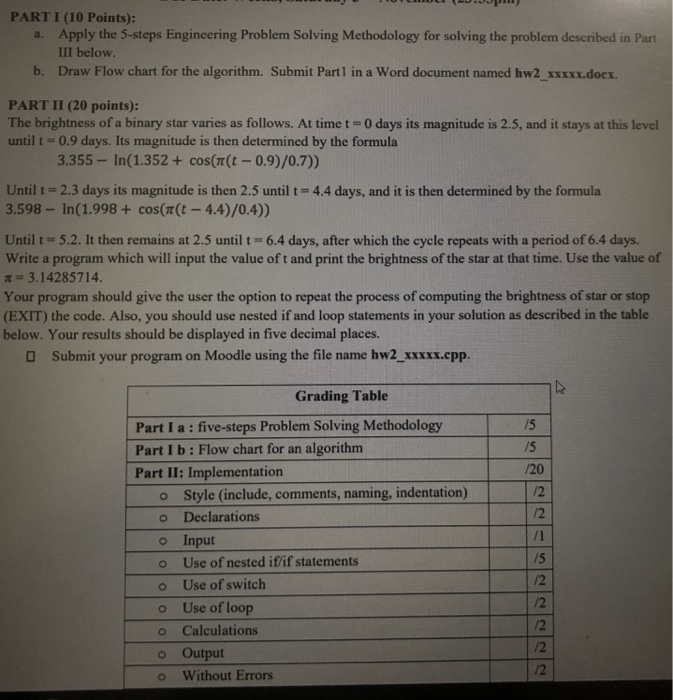
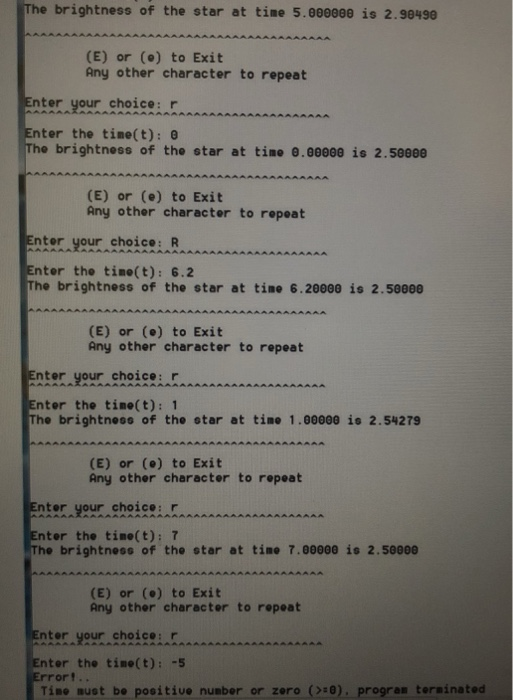
PARTI (10 Points): Apply the 5-steps Engineering Problem Solving Methodology for solving the problem described in Part a. lT below b. Draw Flow chart for the algorithm. Submit Partl in a Word document named hw2 xxxxx.docx. PART II (20 points): The brightness of a binary star varies as follows. At time t 0 days its magnitude is 2.5, and it stays at this level until t = 0.9 days. Its magnitude is then determined by the formula 3.355- In(1.352 + cos((-0.9)/0.7)) Until t- 2.3 days its magnitude is then 2.5 until t- 4.4 days, and it is then determined by the formula 3.598- In(1.998 + cos((t-4.4)/0.4)) Until t-5.2. It then remains at 2.5 until t- 6.4 days, after which the cycle repeats with a period of 6.4 days. Write a program which will input the value of t and print the brightness of the star at that time. Use the value of 3.14285714 Your program should give the user the option to repeat the process of computing the brightness of star or stop (EXIT) the code. Also, you should use nested if and loop statements in your solution as described in the table below. Your results should be displayed in five decimal places. O Submit your program on Moodle using the file name hw2_ xxxxx.epp. Grading Table Part I a : five-steps Problem Solving Methodology Part I b : Flow chart for an algorithm Part II: Implementation o Style (include, comments, naming, indentation) o Declarations o Input o Use of nested if/if statements o Use of switch o Use of loop o Calculations o Output o Without Errors 5-20-12 12 /1-15 12 12 12 12 /2
Step by Step Solution
There are 3 Steps involved in it

Get step-by-step solutions from verified subject matter experts
 Study Help