



Question: Show all steps/deductions/assumptions leading to each answer. Question 1 2 3 4 Total Mark Question's Mark 8 8 4 5 20 Note: You have to
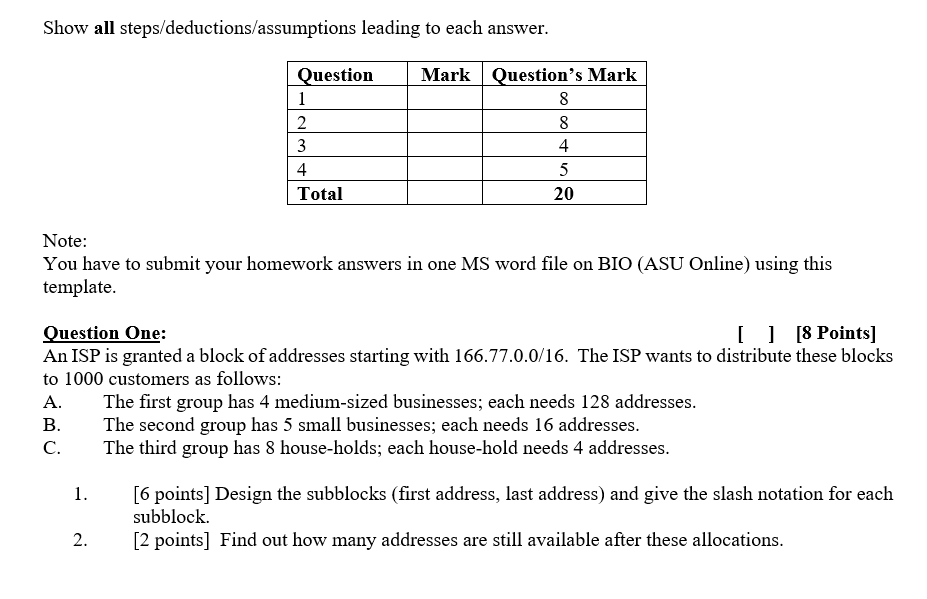
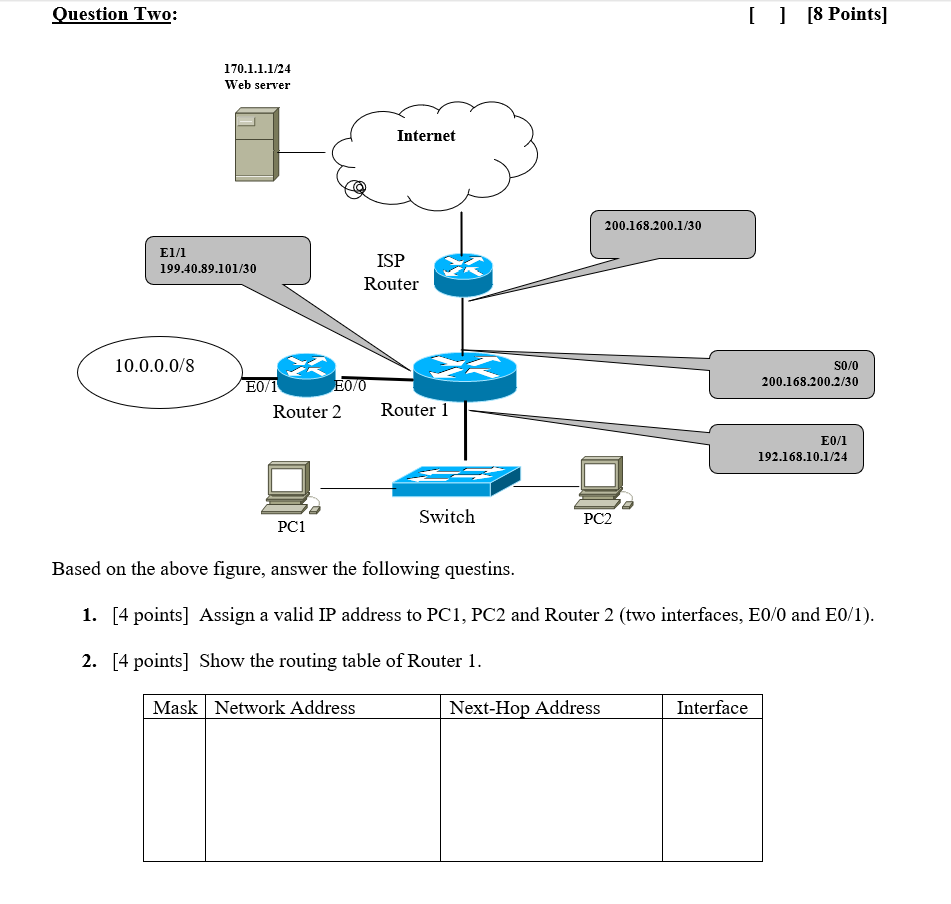
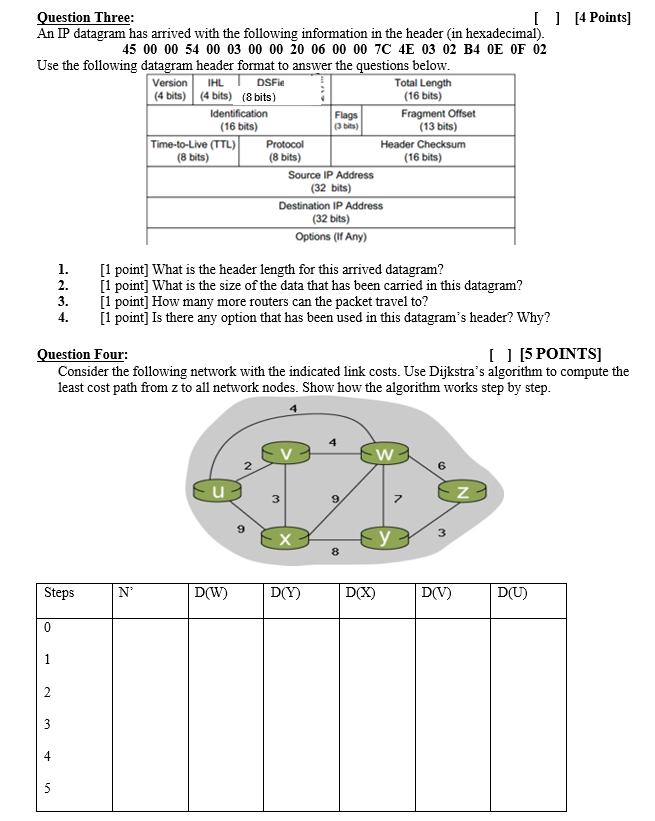
Show all steps/deductions/assumptions leading to each answer. Question 1 2 3 4 Total Mark Question's Mark 8 8 4 5 20 Note: You have to submit your homework answers in one MS word file on BIO (ASU Online) using this template. Question One: [] [8 Points] An ISP is granted a block of addresses starting with 166.77.0.0/16. The ISP wants to distribute these blocks to 1000 customers as follows: A. The first group has 4 medium-sized businesses; each needs 128 addresses. B. The second group has 5 small businesses; each needs 16 addresses. C. The third group has 8 house-holds; each house-hold needs 4 addresses. 1. [6 points] Design the subblocks (first address, last address) and give the slash notation for each subblock. [2 points] Find out how many addresses are still available after these allocations. 2. Question Two: [] [8 Points] 170.1.1.1/24 Web server Internet 200.168.200.1/30 El/l 199.40.89.101/30 ISP Router 10.0.0.0/8 S0/0 200.168.200.2/30 E0/1 E070 Router 2 Router 1 E0/1 192.168.10.1/24 Switch PC2 PC1 Based on the above figure, answer the following questins. 1. [4 points] Assign a valid IP address to PC1, PC2 and Router 2 (two interfaces, E0/0 and E0/1). 2. [4 points] Show the routing table of Router 1. Mask Network Address Next-Hop Address Interface Question Three: [] [4 Points] An IP datagram has arrived with the following information in the header (in hexadecimal). 45 00 00 54 00 03 00 00 20 06 00 00 7C 4E 03 02 B4 OE OF 02 Use the following datagram header format to answer the questions below. Version IHL DSFie Total Length (4 bits) (4 bits) (8 bits) (16 bits) Identification Flags Fragment Offset (16 bits) (13 bits) Time-to-Live (TTL) Protocol Header Checksum (8 bits) (8 bits) (16 bits) Source IP Address (32 bits) Destination IP Address (32 bits) Options (If Any) (3 bits) 1. 2. 3. 4. [1 point] What is the header length for this arrived datagram? [1 point] What is the size of the data that has been carried in this datagram? [1 point] How many more routers can the packet travel to? [1 point] Is there any option that has been used in this datagram's header? Why? Question Four: ( ) [5 POINTS] Consider the following network with the indicated link costs. Use Dijkstra's algorithm to compute the least cost path from z to all network nodes. Show how the algorithm works step by step. 4 w 2 6. 3 z 9 7 3 8 Steps N' D(W) D(Y) D(X) D(V) D(U) 0 1 2 3 4 5
Step by Step Solution
There are 3 Steps involved in it

Get step-by-step solutions from verified subject matter experts