



Question: Show all work and calculations and fix if needed. Nutty Snacks produces snack mixes for the gourmet and natural foods market. ( Click the icon
Show all work and calculations and fix if needed. Nutty Snacks produces snack mixes for the gourmet and natural foods market.
Click the icon to view the budgeted quantities and budgeted prices of direct materials.
Data table
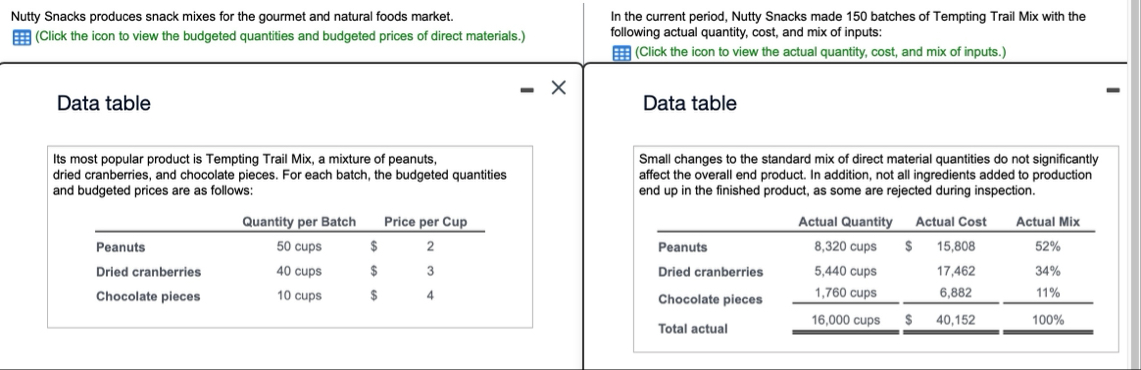
Its most popular product is Tempting Trail Mix, a mixture of peanuts, dried cranberries, and chocolate pieces. For each batch, the budgeted quantities and budgeted prices are as follows:
tableQuantity per Batch,Price per Cup,Peanuts cups,$Dried cranberries, cups,$Chocolate pieces, cups,$
In the current period, Nutty Snacks made batches of Tempting Trail Mix with the following actual quantity, cost, and mix of inputs:
Click the icon to view the actual quantity, cost, and mix of inputs.
Data table
Small changes to the standard mix of direct material quantities do not significantly affect the overall end product. In addition, not all ingredients added to production end up in the finished product, as some are rejected during inspection.
tableActual Quantity,,Actual Cost,Actual MixPeanuts cups,$Dried cranberries, cups,,Chocolate pieces, cups,,Total actual, cups,$Requirement What is the budgeted cost of direct materials for the batches?
Begin by calculating the total budgeted number of cups and the budgeted cost of direct materials for one batch.
tabletableQuantity forOne BatchPrice of Input,tableTotal Cost forOne BatchPeanuts cups,$ per cup,Dried cranberries, cups,$ per cup,Chocolate pieces, cups,$ per cup,Totalcups,,,
Now select the formula and enter the amounts to calculate the budgeted cost of direct materials for batches.
tableBudgeted cost per batch, Number of batches, Budgeted cost of batches
Requirement Calculate the total direct materials efficiency variance.
Select the formula and enter the amounts to calculate the total direct materials efficiency variance. Identify each variance as either factorable F or unfavorable UEnter any quantity amounts as the number of cups. Act. Actual, Budg. Budgeted, Cran. Cranberries, Effic. Efficiency, Qty Quantity, Var. Variance.Requirement Calculate the total direct materials mix and yield variances.
Begin by selecting the formula and entering the amounts to calculate the total direct materials mix variance. Identify each variance as either factorable F or unfavorable UEnter any percentages in decimal format to two decimal places, Abbreviations used: A$ of DM input Actual price of direct materials input, ADM mix Actual direct materials input mix percentage, ATQ inputs used Actual total quantity of all direct materials inputs used, B$ of DM input Budgeted price of direct materials input, BDM mix Budgeted direct materials input mix percentage, BTQ inputs allowed Budgeted total quantity of all direct materials inputs allowed for actual output, Mix var. Direct materials mix variance for each input.
Next, select the formula and enter the amounts to calculate the total direct materials yield variance. Identify each variance as either factorable F or unfavorable UEnter any percentages in decimal format to two decimal places, Abbreviations used: A$ of DM input Actual price of direct materials input, ADM mix Actual direct materials input mix percentage, ATQ inputs used Actual total quantity of all direct materials inputs used, B$ of DM input Budgeted price of direct materials input, BDM mix Budgeted direct materials input mix percentage, BTQ inputs allowed Budgeted total quantity of all direct materials inputs allowed for actual output, Yield var. Direct materials mix variance for each input.Requirement How do the variances calculated in requirement relate to those calculated in requirement What do the variances calculated in requirement tell you about the batches produced this period? Are the variances large enough to investigate?
How do the variances calculated in requirement relate to those calculated in requirement
A The total efficiency variance combines with the total mix variance to equal the total yield variance.
B The total mix variance combines with the total yield variance to equal the total efficiency variance.
C The total yield variance less the total mix variance equals the total efficiency variance.
D The total mix variance less the total yield variance equals the total efficiency variance.
What do the variances calculated in requirement tell you
Step by Step Solution
There are 3 Steps involved in it
1 Expert Approved Answer
Step: 1 Unlock

Question Has Been Solved by an Expert!
Get step-by-step solutions from verified subject matter experts
Step: 2 Unlock
Step: 3 Unlock